| Ultimi arrivi - Venus |

North_Polar_Regions-Ishtar_Terra.jpgIshtar Terra73 visiteIshtar Terra: this is a topographic map made by Don P. Mitchell, from Venera and Magellan altimetry data.
It shows the continent-sized highlands of Ishtar Terra, near the North Pole of Venus.
Dic 16, 2005
|
|

Venusian_Surface-Venera_13-02.jpgVenus from Venera 13 (camera 2)149 visitenessun commentoDic 16, 2005
|
|

Venusian_Surface-Venera_13-01.jpgVenus from Venera 13 (camera 1)127 visitenessun commentoDic 16, 2005
|
|

Venusian_Surface-Venera_14-02.jpgVenus from Venera 14 (camera 2)120 visite"...These images are the original Russian digital images, with a little reprocessing. The original color images were darker and somewhat noisier than the b/w pictures scanned through the clear filter.
In this image, I combined the chroma signal from the color images with the luminance from the clear-filter images. The color chart, extended from the spacecraft was originally painted with gray, red, green and blue silicone enamel. On Venus, its color was shifted by effects of heat and pressure, and tinted by the orange sky. I adjusted the image colors slightly to match the calculated hues of the chart, but these pictures are not precisely color balanced..."Dic 16, 2005
|
|

Venusian_Surface-Venera_14-00.jpgVenus from Venera 14 (camera 1)128 visite"...The quality (of the Venera frames) is remarkably good, and a nearly perfect transmission can be compiled by carefully merging the information from multiple transmissions. A few sections appear damaged by noise, but these are actually bit synchronization errors which can be repaired in software. For example: work on this data set is in progress. Recovering the radiometric response function and balancing color are the next steps. Since the scene was scanned several times, it may be possible to calculate a super-resolution image from multiple panoramas, as NASA has done with Mars Pathfinder images..."Dic 16, 2005
|
|

Venusian_Surface-Venera_13-03.jpgVenus from Venera 13 (detail mgnf)125 visiteSpettacolare dettaglio di un frame originale Venera 13 il quale ci mostra, molto vicino al Lander, delle rocce che - ad occhio - sembrano essere di natura basaltica (ergo avere un'origine vulcanica).
Molto intrigante il dettaglio, visibile in alto a Sx e proprio a ridosso della linea dell'orizzonte, di un rilievo immerso nella nebbia. Si direbbe una modesta collina dal profilo smussato (simile alla famosa Husband Hill di Gusev Crater). Un profilo così smussato da farla somigliare ad una sorta di "cupola".
Una splendida elaborazione, davvero.Dic 16, 2005
|
|

2-Rising_Venus.jpgThe Phases of Venus (1)104 visiteThe images above, by the talented amateur astronomer Damian Peach, show the appearance of Venus through a high-quality telescope, at various points in its orbit. When Venus is close, its diameter is almost visible to the naked eye (one minute of arc), but it is then lit from behind. Dic 16, 2005
|
|
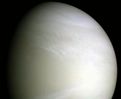
1-Venus_Galileo_Visible.jpgVenus140 visiteUna magnifica ricostruzione di Venere - ad opera dello "Space Artist" Don P. Mitchell - nei colori in cui un umano che fosse nello spazio la vedrebbe.
Queste le annotazioni originali dell'Artista:
Full spectral data is rarely available, and instead we must use views through color filters. Above, the Galileo probe captured Venus through a clear filter (left) and through a 410 nm violet filter, which reveals the subtle yellow and white clouds. Unfortunately, many different color images could result in the same two clear and violet signals above. Even when so-called red, green and blue filters are used, the problem is just as difficult, because the filters are not really the right red, green and blue to just plug into the channels of a color display. Theoretically, information from the two images above and from the Cassini spectrum could be combined using Bayesian decision theory, to compute the most probable color image. If colors are estimated correctly, there is a final issue of tone mapping. How bright does the image appear to the eye in a given context. The image above is the best color image of Venus I've found, showing the planet as it would likely appear to a human observer in space. It was made by Turkish astronomer A. Tayfun Oner, using the two color channels from the Galileo camera, and a third interpolated channel. Dic 16, 2005
|
|

Volcanoes-Maat_Mons-PIA00106.jpg3D view of Maat Mons77 visiteCaption NASA originale:"Maat Mons is displayed in this computer generated 3D view of the surface of Venus. The viewpoint is located 634 Km North of Maat Mons at an elevation of 3 Km above the terrain.
Lava flows extend for hundreds of kilometers across the fractured plains shown in the foreground, to the base of Maat Mons. The view is to the south with the volcano Maat Mons appearing at the center of the image on the horizon and rising to almost 5 Km above the surrounding terrain. Maat Mons is located at approx. 0,9° North latitude; 194,5° East longitude with a peak that ascends to 8 Km above the mean surface. Maat Mons is named for an Egyptian Goddess of Truth and Justice. Magellan synthetic aperture radar data is combined with radar altimetry to develop a three-dimensional map of the surface. The vertical scale in this perspective has been exaggerated 10 times".Mar 29, 2005
|
|
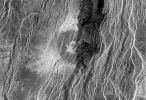
Craters-Somerville_Crater-PIA00100.jpgMagellan Probe: radio image of fractured Somerville Crater73 visiteCaption NASA originale:"This Magellan radar image is of a 'half crater' located in the rift between Rhea and Theia Montes in Beta Regio on Venus. The unnamed crater is 37 Km in diameter and is located at 29,9° North latitude and 282,9° East longitude. It has been cut by many fractures or faults since it was formed by the impact of a large asteroid. The eastern half of the crater was destroyed during the formation of a fault valley that is up to 20 Km wide and apparently quite deep. A north-south profile through the very center of this crater is visible as a result of the down dropping and removal of the eastern half of the crater". Mar 29, 2005
|
|

Venusian_Clouds-IR-PIA00124.jpgLow altitude Venusian clouds (false colors)93 visiteThis false-color image is a near-infrared map of lower-level clouds on the night side of Venus, obtained by the Near Infrared Mapping Spectrometer aboard the Galileo spacecraft as it approached the planet's night side on February 10, 1990. Bright slivers of sunlit high clouds are visible above and below the dark, glowing hemisphere. The spacecraft is about 100.000 Km above the planet. An infrared wavelength of 2,3 microns (about 3 times the longest wavelength visible to the human eye) was used. The map shows the turbulent, cloudy middle atmosphere some 50-55 Km above the surface, 10-16 Km below the visible cloudtops. The red color represents the radiant heat from the lower atmosphere (about 400° Fahrenheit) shining through the sulfuric acid clouds, which appear as much as 10 times darker than the bright gaps between clouds. This cloud layer is at about -30° Fahrenheit, at a pressure about 1/2 Earth's surface atmospheric pressure. Near the equator, the clouds appear fluffy and blocky; farther north, they are stretched out into East-West filaments by winds estimated at more than 150 mph, while the poles are capped by thick clouds at this altitude.Mar 29, 2005
|
|

Craters-Unnamed_Craters_in_Lavinia_Planitia-PIA00103.jpg3D view of impact craters in Lavinia Planitia (simulated colors)87 visiteCaption NASA originale:"Three impact craters are displayed in this 3D perspective view of the surface of Venus. The center of the image is located at approx. 27° South latitude, 339° East longitude in the NWestern portion of Lavinia Planitia. The viewpoint is located SW of Howe Crater, which appears centered in the lower portion of the image. Howe is a crater with a diameter of 37,3 Km. Danilova, a crater with a diameter of 47,6 Km, appears above and to the left of Howe in the image. Aglaonice, a crater with a diameter of 62,7 Km, is shown to the right of Danilova.Magellan synthetic aperture radar data is combined with radar altimetry to develop a three-dimensional map of the surface. Rays cast in a computer intersect the surface to create a three-dimensional perspective view. Simulated color and a digital elevation map developed by the U.S. Geological Survey are used to enhance small-scale structure. The simulated hues are based on color images recorded by the Soviet Venera 13 and 14 spacecraft".Mar 29, 2005
|
|
| 126 immagini su 11 pagina(e) |
 |
|
|
|
|
|
8 | |
|
|





