| |

| Ultimi arrivi - Venus |

Venusian_Atmosphere-Airglow_VIRTIS_Anticlockwise-02.jpgThe "Glowing Oxygen" of Venus (false colors - elab. ESA)54 visite“During one year of observations, we have already collected huge amount of data, which is exactly what we need to decode the secrets of an atmosphere as complex as that of Venus,” said Håkan Svedhem, Venus Express Project Scientist at ESA. “Analysing it is an extreme effort for all science teams, but it is definitively paying back in terms of results.”
The first ever, terrific global views of the double-eyed vortex at Venus’ south pole, the first sets of 3D data about the structure and the dynamics of the sulphuric-acid clouds surrounding the planet in a thick curtain, temperature maps of the surface and the atmosphere at different altitudes, are only a few of the results obtained so far.
“Continuing at today’s rate, and on the basis of what we were able to see so far, there is no doubt that Venus Express will eventually allow a better global understanding of this planet,” continued Svedhem. “Not only will planetary science in general benefit from this, but also understanding Venus – its climate and atmospheric dynamics –will provide a better comprehension of the mechanisms that drive long-term climate evolution on our own Earth.”
MareKromiumApr 20, 2007
|
|

Venusian_Atmosphere-Airglow_VIRTIS_Anticlockwise-00.jpgThe "Airglow" of Venus54 visiteNew infrared data is now available about Venus’ oxygen airglow – a phenomenon detectable on the night-side that makes the planet glow like a ‘space lantern’.
“The oxygen airglow was first discovered thanks to ground observations, and also observed by other missions to Venus such as the Russian Venera spacecraft and the US Pioneer Venus orbiter,” said Pierre Drossart, co-Principal Investigator on Venus Express’ VIRTIS instrument. “However, the global and detailed view we are getting thanks to Venus Express is truly unprecedented.”
The fluorescence of the airglow is produced when oxygen atoms present in the atmosphere ‘recombine’ into molecular oxygen (or ‘O2’) emitting light. Where does the oxygen come from?
“The oxygen in the atmosphere of Venus is a very rare element,” continued Drossart. At high altitudes in the atmosphere, on the day-side of Venus, the strong flux of ultraviolet radiation coming from the Sun ‘breaks’ the molecules of carbon dioxide (‘CO2’) present in large quantity in the atmosphere, liberating oxygen atoms. “These atoms are then transported by the so-called ‘sub-solar’ and ‘anti-solar’ atmospheric circulation towards the night side of the planet. Here the atoms migrate from the high atmosphere to a lower layer, called ‘mesosphere’, where they recombine into O2. By doing this, they emit light at specific wavelengths that can be observed through remote sensing from Earth and with Venus Express,” added Drossart.
The detection of the airglow, and the capability to follow its evolution in time, is extremely important for several reasons.
“First, we can use the distribution and motion of these fluorescent O2 ‘clouds’ to understand how the atmospheric layers below move and behave,” said Giuseppe Piccioni, the other co-Principal Investigator on VIRTIS. “In this sense, the O2 airglow is a real ‘tracer’ of the atmospheric dynamics on Venus.”
“Second, the analysis of this phenomenon will provide new clues on how its global atmospheric chemistry works – a very challenging task indeed, and still an open field of research,” continued Piccioni. “By calculating the speed at which this chemical ‘recombination’ takes place, we might be able – in the future – to understand if there are mechanisms that favour, or catalyze, this recombination, and learn more about the production and recombination of the other chemical species in the Venusian atmosphere.”
“Third, the observation of the oxygen airglow also allows to a better understanding of the global ‘energetic’ exchange between Venus’s mesosphere – at upper boundary of which the airglow is situated, with Venus’ thermosphere, an even higher layer directly influenced by the Sun.”
MareKromiumApr 20, 2007
|
|

Venusian_Atmosphere-ORB157_00_17_WB_H.jpgVenusian Turbulence: South Polar Region54 visiteThis image of the Venusian South Polar Region was acquired on 24 September 2006 by the Ultraviolet, Visible and Near-Infrared Mapping Spectrometer (VIRTIS) on board ESA’s Venus Express, from a distance of about 60.000 Km from the Planet’s surface.
The image, taken on the night-side of Venus at a wavelength of 1,7 micron, shows waves structure (faint light vertical streaks at the lower left part of the dark band in the centre-left side of the image) and a highly turbulent region (bottom left).
The Alpha Regio area is at the bottom left of the image. This area is characterised by a series of troughs, ridges, and faults that are oriented in many directions, with surface features that can be up to 4 kilometres high. It is not yet clear if atmospheric turbulences may be induced by the rough topography below the clouds.
The grey-scale of the image is such that black means more transparency, therefore less clouds, while white means more opacity, therefore more cloud concentration. MareKromiumApr 20, 2007
|
|
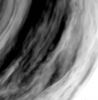
Venusian_Atmosphere-ORB157_01_17_WB_H.jpgVenusian Turbulence: the Alpha Regio Area61 visiteThis image of the Venusian South Polar Region was acquired on 24 September 2006 by the Ultraviolet, Visible and Near-Infrared Mapping Spectrometer (VIRTIS) on board ESA’s Venus Express, from a distance of about 65.000 Km from the Planet’s surface.
The image, showing a complex cloud system, was taken on the night-side of Venus (04:00 Local Time - V.L.T.), at a wavelength of 1,7 micron that allows viewing the deep atmospheric layers. The field of view covers an area located at approximately 20° West Longitude (diagonal top left to bottom right), spanning from the Equator (at the horizon on the right) to 60° Southern Latitude (top left corner of the image).
The grey-scale of the image is such that black means more transparency, therefore less clouds, while white means more opacity, therefore more cloud concentration.
The Alpha Regio area is at the bottom left of the image. This area is characterised by a series of troughs, ridges, and faults that are oriented in many directions, with surface features that can be up to 4 kilometres high. It is not yet clear if atmospheric turbulences may be induced by the rough topography below the clouds.MareKromiumApr 20, 2007
|
|

Venusian_Atmosphere-ORB157_02_17_WB_H.jpgVenusian Turbulence: the Alpha Regio Area54 visiteThis image of the Venusian South Polar Region was acquired on 24 September 2006 by the Ultraviolet, Visible and Near-Infrared Mapping Spectrometer (VIRTIS) on board ESA’s Venus Express, from a distance of about 53.000 Km from the Planet’s surface.
The image, taken on the night-side of Venus at a wavelength of 1,7 micron, shows waves structure (faint light vertical streaks at the lower left part of the dark band in the centre-left side of the image) and a highly turbulent region (bottom left).
The Alpha Regio area is at the bottom left of the image. This area is characterised by a series of troughs, ridges, and faults that are oriented in many directions, with surface features that can be up to 4 Km high. It is not yet clear if atmospheric turbulences may be induced by the rough topography below the clouds.
The grey-scale of the image is such that black means more transparency, therefore less clouds, while white means more opacity, therefore more cloud concentration.MareKromiumApr 20, 2007
|
|

Venusian_Atmosphere-ORB157_03_17_WB_H.jpgVenusian Turbulence: the Near-Equatorial Region55 visiteThis image of the Near-Equatorial Region of Venus was acquired on 24 September 2006 by the Ultraviolet, Visible and Near-Infrared Mapping Spectrometer (VIRTIS) on board ESA’s Venus Express, from a distance of about 37.000 Km from the Planet’s surface.
The image, taken on the night-side of Venus at a wavelength of 1,7 micron, provides a close-up view of a highly turbulent region, with irregular and warped clouds, which is common at these low latitudes. This is different from what happens at higher latitudes (pole-ward) where clouds are generally streaky and more regularly shaped.
The gray ‘bubble’ slightly below the centre of the image is located at about 27° Southern Latitude and 7° Western Longitude, and has a diameter of about 300 Km.
The Alpha Regio area is at the bottom left of the image. This area is characterised by a series of troughs, ridges, and faults that are oriented in many directions, with surface features that can be up to 4 Km high. It is not yet clear if atmospheric turbulences may be induced by the rough topography below the clouds.
The grey-scale of the image is such that black means more transparency, therefore less clouds, while white means more opacity, therefore more cloud concentration.MareKromiumApr 20, 2007
|
|

9-Venus.gifApproaching Venus (GIF anim.)56 visiteOn 20 April 2006, after its first 9-day, elongated orbit around Venus, ESA’s Venus Express started to get closer to the Planet, until it reached its final 24-hour long orbit on 7 May. During this time, and up to today, the spacecraft has been working relentlessly: the new data coming in are already providing first glimpses on planetary features never seen before.
If taking the first ever clear images of the double-eye vortex at Venus’ south pole - imaged by Venus Express during its very first orbit - was already a first in the history of planetary exploration and a very pleasant surprise for the scientists, nobody could expect that the vortex had a structure even more complicated than possibly foreseen.
Infrared images taken by the Ultraviolet/Visible/Near-Infrared spectrometer (VIRTIS) on board the spacecraft not only provided the first clear view of the vortex, but also gave a much closer insight into it when Venus Express flew over the South Pole at the end of May this year (2006). MareKromiumNov 12, 2006
|
|

7-Venus_orbit31V3_fc_H.jpgThe Bright&Blue Northern Hemisphere of Venus60 visitenessun commentoLug 16, 2006
|
|

Venusian_Clouds_and_winds_in_the_infrared_H.jpgVenusian cloud structures - Night view (2)57 visiteOriginal ESA caption:""We are also collecting the first information on the minor chemical components of the atmosphere, such as CO - Carbon Monoxide" added Pierre Drossart.
"With VIRTIS we can see in the atmosphere of the southern hemisphere deeper than any other previous mission, and we started gathering data on the yet unknown chemistry of the lower atmospheric layers, to build a global picture. Studying the variation of minor chemical compounds over different latitudes and depths is also a very useful tracer for the atmospheric global motion".Lug 16, 2006
|
|

Venusian_Clouds_tracking_infrared_2_b_H.jpgVenusian cloud structures - Night view (1)54 visiteOriginal ESA caption:"Tracking cloud motion and starting to characterise the wind speed is an exercise that the Venus Express scientists have already started. A spectacular night view of the mid to low atmospheric layers over low latitudes (between 20º and 90 º South) by VIRTIS, show clouds being clearly pushed by winds.
"We can now make a first qualitative assessment of the wind fields and circulation, which is comfortably matching with previous measurement from the Galileo mission over the North Pole", said Giuseppe Piccioni.
"We are now collecting more data from different atmospheric depths, to be able to provide the first precise numbers, possibly in the near future".Lug 16, 2006
|
|

South_Polar_Vortex-02.jpgVenusian South Polar Vortex (3)54 visiteOriginal ESA caption:"The reason why the morphology of the vortex varies so extensively along a 'vertical' line is still unexplained.
"This is why we are organizing a campaign to observe the South Polar Vortex, fully dedicated to solve this unexpected puzzle", said Giuseppe Piccioni, VIRTIS co-Principal Investigator.
"First we want to understand how the structure is organized - actually, with VIRTIS we are building a true 3D view of the vortex. Then we hope to be able to better understand what are the driving forces that shape it".Lug 16, 2006
|
|

South_Polar_Vortex-01.jpgVenusian South Polar Vortex (2)59 visiteOriginal ESA caption:"Infrared images taken by the Ultraviolet-Visible-Near-Infrared spectrometer (VIRTIS) on board the spacecraft, not only provided the first clear view of the vortex, but also gave a much closer insight into it when Venus Express flew over the South Pole at the end of May 2006.
VIRTIS is an instrument that can operate at different wavelengths. Each infrared wavelength provides a view of the Venusian atmosphere at a different altitude, like a 'cross-section'.
"When we looked at this gigantic vortex at different depths, we realised how much its shape is varying over altitude", said Pierre Drossart, VIRTIS co-Principal Investigator, from the Observatoire de Paris, France.
"It is like if we were looking at different structures, rather than a single one.
And the new data we have just started gathering and analysing reveal even stronger differences".Lug 16, 2006
|
|
| 126 immagini su 11 pagina(e) |
|
|
|
|
6 | |
|
|
|
|
|
|





