| Ultimi arrivi - Venus |

Venus-South_Polar_Vortex-12_VIRTIS_vortex_movie_H.gifThe restless South Pole of Venus (GIF-Movie - credits: ESA)79 visiteCaption ESA:"This video is composed of a set of images acquired by the Visible and Infrared Thermal Imaging Spectrometer (VIRTIS) on board ESA’s Venus Express, during two observations slots in August 2007. The spacecraft was flying at a distance of about 65.000 Km from the Planet.
The video was obtained at 3.8-micrometre wavelength, allowing the instrument to see the cloud top thermal emission at an altitude of about 60-65 km.
The South Polar "Dipole", a complex atmospheric vortex-like feature situated over the South Pole of the Planet, can be clearly seen.
The change of the Polar Vortex shape in a time scale of a few hours is remarkably noticeable here"MareKromiumFeb 26, 2008
|
|
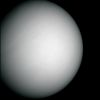
Venus-PIA10124.jpgVenus (natural colors; credits: NASA)54 visiteCaption NASA:"The Planet Venus is enshrouded by a global layer of clouds that obscures its surface to the MESSENGER Dual Imaging System (MDIS) cameras.
This single frame is part of a color sequence taken to help the MESSENGER team calibrate the camera in preparation for the spacecraft's first flyby of Mercury on January 14, 2008. Over the next several months the camera team will pore over the 614 images taken during this Venus encounter to ascertain color sensitivity and other optical properties of the instrument. These tasks address two key goals for the camera at Mercury: understanding surface color variations and their relation to compositional variations in the crust, and ensuring accurate cartographic placement of features on Mercury's surface.
Preliminary analysis of the Venus flyby images indicates that the cameras are healthy and will be ready for next January's close encounter with Mercury".MareKromiumDic 18, 2007
|
|
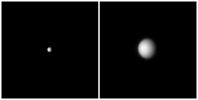
Venus-PIA10123.jpgApproaching Venus54 visiteCaption NASA:"On Oct. 24, 2006, the MESSENGER Spacecraft came within 2990 Km (such as about 1860 miles) of Venus during its second planetary encounter.
Twenty days before closest approach to Venus the MESSENGER Dual Imaging System snapped pictures of the Planet from a distance of about 16,5 MKM (about 10,3 MMs). Despite the low resolution of the image on the left, one can see that Venus is shrouded in a thick blanket of clouds that hides its surface.
The picture on the right is the same image expanded 4 times, clearly showing the dense Venusian cloud cover".MareKromiumDic 18, 2007
|
|
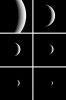
Venus-PIA10125.jpgFarewell to Venus54 visiteCaptio NASA:"After acquiring hundreds of HR images during close approach to Venus, the MESSENGER Spacecraft turned its wide-angle camera back to the Planet and acquired a departure sequence. These images provide a spectacular good-bye to the cloud-shrouded Planet while also providing valuable data to the camera calibration team. The MESSENGER Spacecraft was 60.688 Km (about 37.710 miles) from the Planet at the start of the sequence and 89.310 Km (approx. 55.495 miles) at the end. Initially, images were acquired at a rate of one of every 20', and then as Venus shrank the timing interval was increased to 60'.
The first image was taken on June 6, 2007, at 12:58 UTC (8:58 p.m. EDT on June 5), and the final image on June 7 at 02:18 UTC (10:18 p.m. EDT on June 6). During this 25 h, 20' period the Spacecraft traveled 833.234 Km (about 517.748 miles-more than twice the distance from the Earth to the Moon) with respect to Venus at an average speed of 9,13 Km-per-second (such as 5,67 miles-per-second).
These images represent the last view of Venus by the MESSENGER Spacecraft, but they also point toward the spacecraft's first encounter with Mercury in January 2008".MareKromiumDic 18, 2007
|
|

Thermal_Map-ORB410_01_surf_comp_H1.jpgThermal Map of Venusian Surface (comparison ESA/NASA)54 visiteCaption ESA:"An unprocessed thermal map of the Venusian Surface obtained by VIRTIS on 5 June 2007 (left) is compared here with a radar image of the same area obtained by NASA’s Magellan Spacecraft in the 1990s (right).
VIRTIS, the imaging spectrometer on board Venus Express, obtained this image at 1 micrometre, a wavelength that allows detection of radiation originating from the surface. The imaged region is that which NASA’s MESSENGER flew over as it made its closest approach to the Planet.
Magellan’s radar imaging and altimetry maps made it possible to measure the elevation and the radio-optical properties of the surface. Venus Express’ VIRTIS is providing the first complete set of thermal maps of the surface of Venus.
Correlations between topographic and thermal data similar to the ones shown in this image-composite will allow the scientists to understand if the measured temperature of the surface depends only on the altitude – where higher altitudes simply corresponds to colder, temperatures such as on Earth – or if it depends on the presence of previously undetected sources of heat such as active volcanoes".MareKromiumAgo 18, 2007
|
|

Venusian_Atmosphere-ORB410_411_tot_H1.jpgThe Venusian Atmosphere under the Messenger54 visiteCaption ESA:"The images in this panel were obtained by the VIRTIS imaging spectrometer on board Venus Express on 5 and 6 June 2007, before and after MESSENGER’s closest approach to the Planet. These panels from VIRTIS provide a night-side view of the same Region that Messenger flew over and imaged.
The images where obtained at 1,7 micrometres, revealing atmospheric details down to an altitude of 50 Km from the surface".MareKromiumAgo 18, 2007
|
|
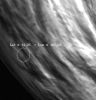
Venusian_Atmosphere-VI410_01_23_with_spot_H1.jpgThe Venusian Atmosphere under the Messenger56 visiteCaption ESA:"This grey-scale image, obtained by the VIRTIS instrument on board ESA’s Venus Express, shows the Atmospheric Region of Venus over which NASA’s MESSENGER Spacecraft passed on 5 June 2007. The Region of MESSENGER’s closest approach is in the night side (marked by a circle).
VIRTIS obtained this image at 2,3 micrometres from about 35.000 Km from the Planet, on the night side.
This wavelength makes it possible to probe the atmosphere down to about 30 Km from the surface. Much of the contrast in this image is due to the structure of the lower clouds.
The bright areas correspond to radiation from the lower atmospheric layers, indicating that the clouds are thinner in those areas. At the 2,3-micrometre wavelength it is possible to study not only the morphology of the cloud layers, but also its chemical composition (such as Carbon Monoxide - CO -, Water - H2O -, Sulphur Dioxide - SO2 -, etc)".MareKromiumAgo 18, 2007
|
|
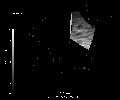
Venusian_Clouds-VI410_411_23_tot.gifVenusian Cloud Structure (GIF-movie)54 visiteCaption ESA:"This movie consists of a sequence of six images obtained by the VIRTIS imaging spectrometer on board ESA’s Venus Express on 5 and 6 June 2007, before and after NASA MESSENGER’s closest approach to the Planet. The image sequence, obtained by VIRTIS, provides a night-side view of the same region that Messenger flew over and imaged.
They were obtained at 1,7 micrometres, revealing atmospheric details down to an altitude of 50 Km from the surface".MareKromiumAgo 18, 2007
|
|

South_Polar_Regions-0.gifVenusian South Polar Vortex through Venus Express (1)54 visiteThis composite video sequence was obtained by the Ultraviolet, Visible and Near-Infrared Mapping Spectrometer (VIRTIS) on board ESA’s Venus Express.
The single images were taken from 7 to 11 April 2007 over 5 different orbits. In each orbit the images were collected over a time span of 8 hours and were separated by about half an hour. The average distance from the Planet was about 65.000 Km.
The Latitude of the observed area spans 50 to 90° South. The Longitude spans about 20 to 150° East.
The video shows details of the Planet’s South Pole in RGB colour. The data obtained at 1.7 microns is shown in blue, while those obtained at 3.8 microns is represented in red.
Using specific wavelengths (3.8 and 1.7 microns, respectively), the observations allowed the imaging of the day and night areas around the South Pole simultaneously, at different depths (at about 65 Km and below the cloud deck, respectively) simultaneously. The intersection between the polar atmospheric structures seen at different wavelengths is visible well, due to the optical properties of the clouds.
MareKromiumMag 15, 2007
|
|

South_Polar_Regions-1.gifVenusian South Polar Vortex through Venus Express (2)54 visiteThis composite video sequence was obtained by the Ultraviolet, Visible and Near-Infrared Mapping Spectrometer (VIRTIS) on board ESA’s Venus Express.
The single images were taken from 7 to 11 April 2007 over 5 different orbits. In each orbit the images were collected during a time span of 8 hours and were separated by about half an hour. The average distance from the Planet was about 65.000 Km.
The Latitude of the observed area spans from 90 to 50° South. The Longitude spans from about 20 to 150° East.
The video shows details of the Planet’s South Pole with edge-enhanced contrast.
Using specific wavelengths (3.8 and 1.7 microns, respectively), the observations allowed the imaging of the day and night areas around the South Pole simultaneously, at different depths (at about 65 Km and below the cloud deck, respectively) simultaneously. The intersection between the polar atmospheric structures seen at different wavelengths is visible in good detail, due to the optical properties of the clouds.MareKromiumMag 15, 2007
|
|
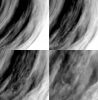
Venusian_Atmosphere-ORB157_multiple_H.jpgVenusian Turbulence: Image Mosaic of the (visible) Venusian Cloud System54 visiteThis image is a composite of four different views of the Venusian Cloud System.
The images were acquired on 24 September 2006 by the Ultraviolet, Visible and Near-Infrared Mapping Spectrometer (VIRTIS) on board ESA’s Venus Express, from distances of about 65.000 Km (top left), 60.000 Km (top right), 53.000 Km (bottom left), 37.000 Km (bottom right) from the Planet’s surface.
The images, showing a complex cloud system, were taken on the night-side of Venus (04:00 V.L.T.), at a wavelength of 1,7 micron that allows viewing the deep atmospheric layers.
The grey-scale of the images is such that black means more transparency, therefore less clouds, while white means more opacity, therefore more cloud concentration.MareKromiumApr 20, 2007
|
|

Venusian_Atmosphere-Airglow_VIRTIS_Anticlockwise-01.jpgThe "Airglow" of Venus54 visiteOne year has passed since 11 April 2006, when Venus Express, Europe’s first mission to Venus and the only spacecraft now in orbit around the planet, reached its destination. Since then, this advanced probe, born to explore one of the most mysterious planetary bodies in the Solar System, has been revealing planetary details never caught before.
Intensively visited by several Russian and American probes from the 60s to the early 90s, Venus has always represented a puzzling target for scientists worldwide to observe. Venus Express, designed and built in record time by ESA, was conceived with the purpose of studying Venus - unvisited since 1994 - in the most comprehensive and systematic way ever, to provide a long-due tribute to a planet so interesting, yet cryptic.
Using state-of-the-art instrumentation, Venus Express is approaching the study of Venus on a global scale. The space probe is collecting information about Venus’ noxious and restless atmosphere (including its clouds and high-speed winds, as seen from this video obtained with the VMC camera on board) and its interaction with the solar wind and the interplanetary environment. Last but not least, it is looking for signs of surface activity, such as active volcanism. MareKromiumApr 20, 2007
|
|
| 126 immagini su 11 pagina(e) |
 |
|
|
5 | |
|
|
|
|
|





