| |

| Ultimi arrivi - Venus |

Venusian_Surface-Venera_13-05.jpgVenus, from Venera 13 (an Image-Mosaic by Dr Marco Faccin - Lunexit Team)64 visiteQuesta immagine esce un pò dai canoni tipici e propri delle solite (ed orrende) immagini che si trovano in giro sulla Rete; sono stati usati, per la fotocomposizione, i frames originali - che sono stati ri-processati per ottenere qualcosa di decente su cui lavorare.
Parte dell'illuminazione di fondo ("glare") dell'Atmosfera di Venere è stata rimossa e/od abbattuta (ed infatti il pezzo che si vede in mezzo al frame ha una parte bianca, ed essa è bianca rispetto a tutte le altre famose foto reperibili sul WWW; la bandierina dei colori è meno confusa - si nota il rosso ed anche un altro colore, più blando, che però si stacca e non si fonde con il resto del panorama.
A qualcuno questa immagine potrà sembrare brutta, ma i colori originali sono quelli e NON SONO STATI ALTERATI!
Intendiamoci, questa elaborazione è nettamente più scura delle altre che si trovano sulla Rete, ma è proprio questo il nostro punto: creare un'alternativa RAZIONALE e CREDIBILE!
ATTENZIONE: l'Atmosfera di Venere non consente la diffusione della Luce Blu e, probabilmente, dei toni più chiari della Luce Verde.
Un altro grandissimo Lavoro del nostro eccezionale Dr Faccin (alias Titanio44).MareKromiumMar 14, 2010
|
|
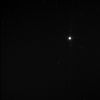
Venus-PIA12443.jpgVenus, overexposed and from VERY FAR AWAY...54 visiteImages from the latest Vulcanoid search are currently being transmitted to Earth, and one of those 256 images is shown here.
Vulcanoids are small rocky bodies that have been postulated to exist in orbits between Mercury and the Sun, though no such object has yet been detected.
MESSENGER has the unique opportunity to search for smaller and fainter Vulcanoids than has ever before been possible.
The best opportunities for MESSENGER to search for Vulcanoids are during perihelion passages, when the Spacecraft's orbit brings it closest to the Sun. MESSENGER has searched for Vulcanoids during three perihelion passages to date, in June 2008, in February 2009, and most recently in January 2010.
There will be another three perihelion passages in 2010, which will provide additional opportunities to continue the search.
MESSENGER images acquired to date have not revealed any Vulcanoids.
The bright object in the image here is Venus. For examining Venus, the image is over-exposed, but in the quest for very small, very faint objects, this type of image is just what is needed.MareKromiumFeb 17, 2010
|
|

Volcanic_Features-Lava_Flows-PIA00471.jpgLava Flows (possible Natural Colors; credits: Dr Paolo C. Fienga - Lunexit Team)56 visiteThis is a full resolution mosaic centered at 25° North Latitude and 351° East Longitude.
The Region is approximately 160 Km (100 miles) across. It shows a series of complex Lava Flows which emerge from the Northern Flank of Sif Mons, a large Southern Venusian Volcano.
Several of the Flows occupy narrow troughs formed by long fractures. A sequence of events that can be inferred from this image is the formation of the dark background Plains by eruptions of extremely fluid volcanic material, and the formation of the small Shield Volcanoes on the Plains' Surface that can be seen in the upper left part of the image.
Next, the Region was domed upward probably by heat from the interior of Venus that ultimately caused magmas to break out from the Surface near the Summit Regions forming the Sif volcanic structure and its associated flank eruptions which can be seen in this image.MareKromiumGen 30, 2010
|
|

Craters-Isabella_Crater-PIA00480.jpgIsabella Crater (possible Natural Colors; credits: Dr Paolo C. Fienga - Lunexit Team)55 visiteCrater Isabella, with a diameter of approx. 175 Km (such as about 108 miles), seen in this MRI (Magellan Radar Image), is the second largest Impact Crater on Venus.
The feature is named in honor of the 15th Century Queen of Spain, Isabella of Castile. Located at 30° South Latitude and 204° East Longitude, the Crater has two extensive flow-like structures extending to the South and to the S/E.
The end of the Southern Flow partially surrounds a pre-existing 40 Km (approx. 25 mile) circular Volcanic Shield.
The South-Eastern Flow shows a complex pattern of Channels and Flow Lobes, and is overlain at its South-Eastern tip by deposits from a later approx. 20 Km (about 12 mile) diameter Impact Crater, Cohn (for Carola Cohn, Australian artist, 1892-1964).
The extensive Flows, unique to Venusian Impact Craters, are a continuing subject of study for a number of Planetary Scientists. It is thought that the Flows may consist of "Impact Melt", suc as rock melted by the intense heat released in the impact explosion. An alternate hypothesis invokes "Debris Flows", which may consist of clouds of hot gases and both melted and solid rock fragments that race across the landscape during the impact event.
That type of Emplacement Process is similar to that which occurs in violent eruptions on Earth, such as the 1991 Mount Pinatubo eruption in the Philippines.MareKromiumGen 30, 2010
|
|

Volcanoes-Sacajawea_Patera-PIA00485.jpgSacajawea Patera (possible Natural Colors; credits: Dr Paolo C. Fienga - Lunexit Team)56 visiteThis Magellan image reveals Sacajawea Patera, a large, elongate caldera located in Western Ishtar Terra on the smooth plateau of Lakshmi Planum.
The image is centered at 64,5° North Latitude and 337° East Longitude. It is approximately 420 Km (about 252 miles) wide at the base.
Sacajawea is a depression approximately 1-2 Km (0,6-1,2 miles) deep and abo 120 by 215 Km (approx. 74 by 133 miles) in diameter; it is elongate in a S/W-N/E direction.
The depression is bounded by a zone of circumferential curvilinear structures interpreted to be Graben and Fault Scarps. These structures are spaced 0,5-4 Km (0,3-2,5 miles) apart, are 0,6-4 Km (0,4-2,5 miles) in width and up to 100 Km (approx. 62 miles) in length.
Extending up to approximately 140 Km (about 87 miles) in length from the South/East of the Patera, is a system of linear structures thought to represent a flanking rift zone along which the lateral injection and eruption of magma may have occurred.
A shield edifice of approx. 12 Km (about 7 miles) in diameter with a prominent Central Pit, lies along the trend of one of these features.
The Impact crater Zlata, approx. 6 Km (a little less than 4 miles) in diameter is located within the zone of Graben to the N/W of the Patera.
Few flow features are observed in association with Sacajawea, possibly due to age and state of degradation of the flows.
Mottled bright deposits of about 4 to 20 Km (such as 2,5 up to approx. 12 miles) in width are located near the periphery and in the center of the Patera Floor, within local topographic lows. Diffuse patches of dark material approx. 40 Km (such as about 25 miles) in width are observed S/W of the Patera, superposed on portions of the surrounding Graben.
The formation of Sacajawea is thought to be related to the drainage and collapse of a large Magma Chamber. Gravitational relaxation may have caused the resultant Caldera to sag, producing the numerous Faults and Graben that circumscribe the Patera.
Regions of complex, highly deformed tessera-like terrain are located North and East of the Patera and are seen in the upper portion of the image.MareKromiumGen 30, 2010
|
|
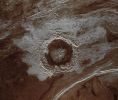
Craters-Dickinson_Crater-PIA00479.jpgDickinson Crater (possible Natural Colors; credits: Dr Paolo C. Fienga - Lunexit Team)63 visiteThis Magellan image is centered at 74,6° North Latitude and 177,3° East Longitude, in the North/Eastern Atalanta Region of Venus.
The image is approximately 185 Km (about 115 miles) wide at the base, and shows Dickinson, an Impact Crater of about 69 Km (approx. 43 miles) in diameter. The Crater is complex, characterized by a partial Central Ring and a Floor flooded by radar-dark and radar-bright materials.
Hummocky, rough-textured ejecta extend all around the Crater, except to the West. The lack of ejecta to the West may indicate that the Impactor that produced the Crater reached the Surface on an oblique angle, and from the West.
Extensive radar-bright flows that emanate from the Crater's Eastern Walls may represent large volumes of impact melt, or they may be the result of volcanic material released from the Subsurface during the cratering event.MareKromiumGen 30, 2010
|
|

Craters-Stephania_Crater-PIA00475.jpgStephania Crater (possible Natural Colors; credits: Dr Paolo C. Fienga - Lunexit Team)56 visiteCrater Stephania is located at 51,3° Norh Latitude and 333,3° East Longitude in Northern Sedna Planitia.
With a diameter of about 11 Km (6,8 miles), Stephania is one of the smaller Craters on Venus.
Because many small meteoroids disintegrate during their passage through the dense Venusian atmosphere, there is an absence of craters smaller than 3 Km (approx. 1,9 miles) in diameter, and even craters smaller than 25 Km (15,5 miles) are relatively scarce.
The apron of ejected material suggests that the impacting body made contact with the Surface from an oblique angle. Upon closer observation it is possible to delineate secondary craters, impact scars from blocks ejected from the primary crater.
A feature associated with this and many other Venusian Craters is a radar-dark halo.
Since dark radar return signifies a smooth surface, it has been hypothesized that an intense shock wave removed or pulverized previously rough surface material or that a blanket of fine material was deposited during or after the impact.MareKromiumGen 30, 2010
|
|

Volcanoes-Maat_Mons-PIA00487.jpgVolcanic Domes on the Flank of Maat Mons - East Ovda Region (possible Natural Colors; credits: Dr Paolo C. Fienga - Lunexit Team)56 visiteThis Magellan image is centered at about 3,2° North Latitude and 194,9° East Longitude, in the Eastern Ovda Region of Venus.
The image, which is approx. 90 Km (about 56 miles) in width and approx. 80 Km (such as about 50 miles) in length, shows some small Volcanic Domes on the Flank of the volcano Maat Mons. The bright flows to the East are most likely rough Lava Flows while the darker flows to the West are probably smoother flows. The dark flows do show some roughness, however, as can be seen by the structure in the flows to the South/West.
These dark flows also have some debris that has been deposited on top of them. The debris may be fine material from the surrounding Plains on top of the flow by wind or it may be ash from the volcano.
Small Volcanic Domes are very common features on the Surface of Venus, indicating that there has been (and maybe there still is) much volcanic activity going on almost everywhere.
Assuming that the central Volcanic Cone is symmetrical in shape and knowing the length of the cone's side and the incidence angle, radar foreshortening yields a height and slope of 688 meters and 8,2°, respectively, for the Cone.
These values are similar to heights and slopes of some Volcanic Cones on the Earth. MareKromiumGen 30, 2010
|
|

Craters-Unnamed_Craters-Lakshmi_Region-PIA00477.jpgPossible Remnants of a Meteoroid in Lakshmi Region (possible Natural Colors; credits: Dr Paolo C. Fienga - Lunexit Team)55 visiteThis full resolution mosaiced image covers an area of approx. 100 by 120 Km (such as about 62 by 74 miles) and is located in the Lakshmi Region of Venus, at 47° North Latitude and 334° East Longitude.
Due to the dense Venusian Atmosphere, Primary Impact Craters of less than a 3 Km (a little less than 2 miles) diameter are nonexistent.
The dark circular region and associated central bright feature in this image are thought to be the remnants of a Meteoroid smaller than the size necessary to create an Impact Crater, and entering the Atmosphere at low velocity (approx. 350 meters/second.)
The central bright feature appears to be a cluster of small secondary impacts, ejecta and debris from the original meteor that broke up in the Atmosphere.
Even though most of the meteorite did not hit the Surface, the Atmospheric Shock wave could be great enough to modify the surrounding region. One explanation for this radar dark circular formation, called "Dark Margins", could be that the shock wave was energetic enough to pulverize the Surface (smooth surfaces generally appear radar dark).
Another explanation is that the Surface could be blanketed by a fine material that was formed by the original meteor's breakup through the Atmosphere.
More than half of the Impact Craters on Venus have associated Dark Margins, and most of these are prominently located left of center of the rater. This is another effect which could be caused by the extremely dense Atmosphere of Venus. MareKromiumGen 30, 2010
|
|

Hestia_Rupes-PIA00469.jpgComplex Network of Narrow Fractures near Hestia Rupes Region (possible Natural Colors; credits: Dr Paolo C. Fienga - Lunexit Team)55 visiteThis is a Magellan radar image covering an about 105- Km (approx. 63-mile) by 45-Km (approx. 27-mile) Region near Hestia Rupes on the North-Western corner of Aphrodite Terra.
The complex network of narrow (such as <1 Km) Fractures in the center of the image extends for approx. 50 Km (about 31 miles). This network exhibits tributary-like branches similar to those observed in river systems on Earth. However, the angular intersections of the tributaries suggest tectonic control.
These features appear to be due to drainage of lava along preexisting fractures and subsequent collapse of the Surface. The underlying tectonic fabric can be observed in the North-East trending Ridges which predate the Plains.MareKromiumGen 14, 2010
|
|

Channels-Unnamed_Outflow_Channel-PIA00483.jpgOutflow Channel in South Nawka Vallis (possible Natural Colors; credits: Dr Paolo C. Fienga - Lunexit Team)57 visiteThis SAR image from the Southern portion of Navka (24,4-25,3° South Latitude and 338,5-340,5° East Longitude) is a mosaic of twelve Magellan orbits that covers approx. 180 Km (about 108 miles) in width and approx. 78 Km (about 47 miles) in length.
In the center of this image are two bright Deposits running North to South.
These Deposits outline an Outflow Channel that flowed from an about 60-Km diameter Crater that is to the South of the Channel itself. Inside the Outflow Channel and outlined by some so-called 'Bathtub Ring' Deposits are small Cones, most likely of volcanic origin.
At the end of the Outflow Channel, where one would expect the smallest particles to be deposited, are specular features which may represent Sand Dunes.
Seasat and space shuttle radar images of sand dunes on Earth also show specular reflections from smooth dune faces that are near-normal to the radar beam.
Other evidence for aeolian activity are the dark and bright Windstreaks running East to West and that formed behind the Cones. Notice how the wind changes direction from a South/East-North/West flow at the right of the image to an East-West flow at the eastern edge of the Outflow Channel.MareKromiumGen 14, 2010
|
|

Craters-Barton_Crater-PIA00463.jpgBarton Crater (possible Natural Colors; credits: Dr Paolo C. Fienga - Lunexit Team)56 visiteDuring orbits 404 through 414 on 19-20 September 1990, the Magellan Probe imaged a Peak-Ring Crater that is about 50 Km in diameter located at Latitude 27,4° North and Longitude 337,5° East. The name "Barton" has been proposed by the Magellan Science Team for this Crater, after Clara Barton, founder of the Red Cross; however, the name is tentative pending approval by the International Astronomical Union.
Barton is just at the diameter size that Venus Impact Craters appear to begin to possess Peak-Rings instead of a single Central Peak or Central Peak complex like does about 75% of the craters with diameters between about 50 and 15 Km.
The floor of the Crater is flat and radar-dark, indicating possible infilling by volcanic deposits sometime following the impact event. Barton's Central Peak Ring is discontinuous and appears to have been disrupted or separated during or following the cratering process. The extremely blocky crater deposits (ejecta) surrounding Barton appear to be most extensive on the South-West to South-East (lower left to right) side of it.MareKromiumGen 11, 2010
|
|
| 126 immagini su 11 pagina(e) |
2 | |
|
|
|
|
|
|
|
|
|
|





