| Ultimi arrivi - Saturn: the "Ringed Beauty" and His Moons |

Prometheus.jpgPrometheus: the "Ring-Shaper"...57 visiteCaption NASA originale:"Prometheus zooms across the Cassini spacecraft's field of view, attended by faint streamers and deep gores in Saturn's F-Ring. This frame (taken from a movie sequence of five images) shows the F-Ring shepherd moon shaping the Ring's inner edge.
Note (watching the movie) that the faint ringlet coincident with the orbit of Prometheus (only 102 Km or approx. 63 miles across) decreases sharply in brightness behind the moon in its path. The normally twisted-looking F-Ring core is overexposed in the images, causing its appearance to be more uniform than it usually is.
This image was taken in visible light with the Cassini spacecraft narrow-angle camera on Aug. 11, 2006, at a distance of approx. 2,2 MKM (about 1,4 MMs) from Saturn and at a Sun-Saturn-spacecraft, or phase, angle of 162°. Image scale is roughly 13 Km (about 8 miles) per pixel".Set 08, 2006
|
|

Dione & Rhea-PIA08261.jpgNight-lights, in the Saturnshine...58 visiteCaption NASA originale:"Soft light from Saturn lifts the veil of night from the moons Dione (lower left) and Rhea (upper right).
A scant crescent on each satellite marks the limit of the Sun's direct reach. The remaining light is reflected onto the moons by the Ringed Planet (Saturn-shine).
This view was acquired using an image compression scheme that results in minor artifacts being present - on Rhea in particular.
Rhea (approx. 1.528 Km, or 949 miles across - pictured above) is somewhat bland in appearance at this image scale, although Dione's spectacular fractures stand out marvelously. Dione is approx. 1.126 Km (about 700 miles) across.
North, on both moons, is rotated 45° to the right.
The image was taken in visible light with the Cassini spacecraft narrow-angle camera on Aug. 11, 2006 at a distance of approx. 2,6 MKM (about 1,6 MMs) from Dione and 2.8 MKM (1,7 MMs) from Rhea. Image scale is about 15 Km (approx. 10 miles) per pixel on Dione and about 17 Km (approx. 11 miles) on Rhea".Set 07, 2006
|
|

The Rings-PIA08259.jpgGravitational Disturbances55 visiteCaption NASA originale:"The clumpy disturbed appearance of the brilliant F-Ring constantly changes. The irregular structure of the Ring is due, in large part, to the gravitational perturbations on the ring material by one of Saturn's moons, Prometheus (about 102 Km, or 63 miles across).
Interior to the F-Ring, the A-Ring bears a striking resemblance to a classic grooved, vinyl record. Visible here are the Keeler Gap (about 42 Km, or 26 miles wide) and the Encke Gap (about 325 Km, or 200 miles wide).
The image was taken using a spectral filter sensitive to wavelengths of infrared light centered at 862 nnmts. The view was acquired with the Cassini spacecraft narrow-angle camera on July 26, 2006 at a distance of approx. 1,5 MKM (about 900.000 miles) from Saturn and at a Sun-Saturn-spacecraft, or phase, angle of 141°. Image scale is roughly 8 Km (such as about 5 miles) per pixel".Set 05, 2006
|
|

The Rings-PIA08257.jpgThe Music of Pan...The Waves in the Rings...56 visiteCaption NASA:"The Encke Gap displays gentle waves in its inner and outer edges that are caused by gravitational tugs from the small moon Pan. These scalloped edges were captured in a dramatic image taken by Cassini during its insertion into Saturn orbit in 2004.
The Encke Gap is a 325-Km (about 200-mile) wide division in Saturn's outer A-Ring.
Pan (26 Km, or approx. 16 miles across) orbits squarely in the center of this gap.
The original image was stretched in the horizontal direction by a factor of four to exaggerate the amplitude of the waves, then reduced to half size and cropped to focus on the gap.
The image was taken in visible light with the Cassini spacecraft narrow-angle camera on July 23, 2006 at a distance of approx. 290.000 Km(such as about 180.000 miles) from Saturn.
Scale in the original image was roughly 1 Km (about 0,6 mile) per pixel".Set 04, 2006
|
|

Dione-PIA08256-E.jpgThe "White (and Bright) Cliffs" of Dione (detail mgnf n. 5)95 visitenessun commentoSet 01, 2006
|
|

Dione-PIA08256-D.jpgThe "White (and Bright) Cliffs" of Dione (detail mgnf n. 4)58 visitenessun commentoSet 01, 2006
|
|

Dione-PIA08256-C.jpgThe "White (and Bright) Cliffs" of Dione (detail mgnf n. 3)59 visitenessun commentoSet 01, 2006
|
|
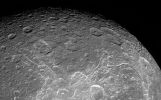
Dione-PIA08256-B.jpgThe "White (and Bright) Cliffs" of Dione (detail mgnf n. 2)58 visitenessun commentoSet 01, 2006
|
|
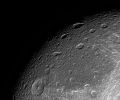
Dione-PIA08256-A.jpgThe "White (and Bright) Cliffs" of Dione (detail mgnf n. 1)58 visitenessun commentoSet 01, 2006
|
|
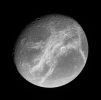
Dione-PIA08256.jpgThe "White (and Bright) Cliffs" of Dione (context image)66 visiteCaption NASA:"This splendid view showcases Dione's tortured complex of bright cliffs. At lower right is the feature called Cassandra, exhibiting linear rays extending in multiple directions.
This is the Trailing Hemisphere of Dione; North is up.
The image was taken in polarized green light with the Cassini spacecraft narrow-angle camera on July 24, 2006 at a distance of approx. 263.000 Km (about 163.000 miles) from Dione. Image scale is roughly 2 Km (such a little more than 1 mile) per pixel".Set 01, 2006
|
|

The Rings-PIA08255.jpg"Penumbral fade" on Saturn's Rings59 visiteCaption NASA:"As the particles comprising Saturn's A-Ring slip into the Planet's shadow, they find themselves briefly in the penumbra of Saturn's shadow. In this very narrow region along the edge of the shadow, part (but not all) of the Sun is still visible around the side of the Planet, creating only a partial shadow there and making the shadow edge look fuzzy.
The image was taken in visible light with the Cassini spacecraft narrow-angle camera on July 26, 2006 at a distance of approx. 1,5 MKM (such as about 900.000 miles) from Saturn. Image scale is roughly 9 Km (about 5 miles) per pixel".Ago 31, 2006
|
|

Tethys-PIA08254-0.jpgMelanthius Crater (context image)56 visitenessun commentoAgo 29, 2006
|
|
| 2245 immagini su 188 pagina(e) |
 |
|
|
|
|
98 | |
|
|
|
|





