| |

| Ultimi arrivi - Saturn: the "Ringed Beauty" and His Moons |

The Rings-PIA08285.jpgNot the Sun, but Aldebaran!56 visitenessun commentoOtt 13, 2006
|
|

Enceladus-PIA08286.jpgCrescent Enceladus55 visiteCaption NASA originale:"A world whose mysteries are just coming to light, Enceladus has enchanted scientists and non-scientists alike. With its potential for near-surface liquid water, the icy moon may be the latest addition to the list of possible abodes for life (!).
The view was acquired about two-and-a-half hours after PIA08280, during one of the many encounters with Enceladus.
The image was taken using a combination of spectral filters sensitive to wavelengths of polarized ultraviolet light. The Cassini spacecraft narrow-angle camera acquired the view on Sept. 9, 2006 at a distance of approx. 141.000 Km (about 87.000 miles) from Enceladus and at a Sun-Enceladus-spacecraft, or phase, angle of 96°.
Image scale is roughly 850 mt (about 0,5 mile) per pixel".Ott 12, 2006
|
|
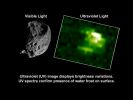
Phoebe-PIA06401.jpgFrozen water on Phoebe55 visiteCaption NASA originale:"On the right, the ultraviolet image of Saturn's moon Phoebe, taken from a distance of approx. 31.000 Km (such as about 19.263 miles) shows an irregular surface and bright crater region (white area). The bright areas indicate water frost on Phoebe's surface.
The image was taken by Cassini's UltraViolet Imaging Spectrograph during the spacecraft's closest approach to Phoebe, on June 11, 2004.
The large crater shows clearly in the image on the left".Ott 12, 2006
|
|

The Rings-PIA08331.jpgNew "Ringlets" (2)82 visiteCaption NASA:"HR Cassini images show an astonishing level of structure in Saturn's Cassini Division, including two ringlets that were not seen in NASA Voyager spacecraft images 25 years ago.
This view was taken with the Sun almost directly behind Saturn and its Rings, a viewing geometry in which microscopic ring particles brighten substantially. The image shows the diffuse new ringlet in the Cassini Division as the brightest feature in that Region.
This image was taken in visible light with the Cassini spacecraft narrow-angle camera on Sept. 15, 2006, at a distance of approx. 2,2 MKM (such as about 1,4 MMs) from Saturn. This view looks toward the unlit side of the Rings from about 15° above the ringplane. The phase angle, or Sun-Saturn-spacecraft angle, was 179°. Image scale on the sky at the distance of Saturn is roughly 13 Km (such as about 8 miles) per pixel".Ott 12, 2006
|
|

The Rings-PIA08330.jpgNew "Ringlets" (1)101 visiteCaption NASA:"HR Cassini images show an astonishing level of structure in Saturn's Cassini Division, including two ringlets that were not seen in NASA Voyager spacecraft images 25 years ago.
This image shows a new ringlet at right, just interior to the bright outer edge of the Cassini Division. This diffuse structure is about 50 Km (approx. 31 miles) wide.
The second new ringlet is roughly at center in this view. It is a very narrow feature, about 6 Km (apprx. 4 miles) wide, between the familiar broad bands of material in the Cassini Division, and displays a great deal of variation in brightness along its length.
This image was taken in visible light with the Cassini spacecraft narrow-angle camera on Sept. 9, 2006, at a distance of approx. 414.000 Km (such as about 257.000 miles) from Saturn. This view looks toward the lit side of the Rings from about 17° below the Ring-Plane. The phase angle, or Sun-Saturn-spacecraft angle, was 96°.
Image scale on the sky at the distance of Saturn is roughly 2 Km (a little more than 1 mile) per pixel".
This image was taken in visible light with the Cassini spacecraft narrow-angle camera on Sept. 9, 2006, at a distance of approximately 414,000 kilometers (257,000 miles) from Saturn. This view looks toward the lit side of the rings from about 17 degrees below the ringplane. The phase angle, or sun-Saturn-spaceOtt 12, 2006
|
|

Saturn-PIA01941.jpgInfrared Saturn68 visiteIn this image, Saturn's fascinating meteorology manifests itself in a "string of pearls" formation, spanning over 60.000 Km (about 37.000 miles). Seen in new images acquired by Cassini's VIMS (Visual and Infrared Mapping Spectrometer) and lit from below by Saturn's internal thermal glow, the bright "pearls" are actually clearings in Saturn's deep cloud system. More than two dozen occur at 40° North Latitude. Each clearing follows another at a regular spacing of some 3,5° in Longitude.
This is the first time such a regular and extensive train of cloud-clearings has been observed. The regularity indicates that they may be a manifestation of a large planetary wave. Scientists plan to take more observations of this phenomenon over the next few years to try to understand Saturn's deep circulation systems and meteorology. This image was taken on April 27, 2006.Ott 12, 2006
|
|
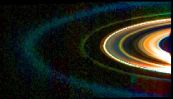
The Rings-PIA01940.jpgInfrared Rings56 visiteThis mosaic of Saturn's rings was acquired by Cassini's VIMS (Visual and Infrared Mapping Spectrometer) on Sept. 15, 2006, while the spacecraft was in the shadow of the Planet looking back towards the Rings from a distance of about 2,16 MKM (approx. 1,34 MMs).
Data at wavelengths of 1,0, 1,75 and 3,6 microns were combined in the blue, green and red channels to make the pseudo-color image shown here. The brightest feature in the mosaic is the F-Ring, located at the outer edge of the main Rings. The F-Ring is overexposed and appears white in this image. Of the main A, B and C Rings; the C-Ring is the most prominent and reddish in color, becoming saturated close to the Sun. The more opaque A and B Rings are muddy in color and very dark in this geometry.
By contrast, the normally faint D-Ring, located just interior to the C-Ring, is quite bright and blue, indicating the presence of very small ring particles. Similarly, a narrow, green ringlet in the Cassini Division, as well as the greenish G-Ring and blue E-Ring - located at increasing distances outside the F-Ring - are predominantly composed of small particles.
The faint reddish band immediately outside the F-Ring is likely to be an artifact caused by the extremely bright F-Ring.
Ott 12, 2006
|
|

The Rings-PIA08283.jpgNot the Sun, but Aldebaran!54 visiteCaption NASA:"The Cassini spacecraft took a series of images on Sept. 9, 2006 as it watched the bright red giant star Aldebaran slip behind Saturn's Rings.
This type of observation is known as a stellar occultation and uses a star whose brightness is well known. As Cassini watches the rings pass in front of the star, the star's light fluctuates, providing information about the concentrations of ring particles within the various radial features in the Rings.
This view shows the Encke Gap (325 Km, or approx. 200 miles wide) and the faint ringlets which share the gap with the embedded moon Pan. The view looks toward the sunlit side of the Rings from about 19° below the Ring-Plane.
Bright Aldebaran is overexposed, creating thin vertical lines on its image.
The image was taken in visible light with the Cassini spacecraft narrow-angle camera on Sept. 9, 2006 at a distance of approx. 359,000 Km (about 233.000 miles) from Saturn. Image scale on the sky at the distance of Saturn is 2 Km per pixel".
Nota: la NASA - finalmente - ci fornisce un'informazione contestuale utile e ci permette di correggere un nostro errore interpretativo (del quale ci scusiamo con Voi). Non è dunque il Sole, l'astro che viene occultato dagli Anelli di Saturno, bensì la super-gigante Rossa "Aldebaran". Ottimo: non finiamo mai di stupirci per quello che Cassini riesce a mostrarci!Ott 09, 2006
|
|

Saturn-PIA08282.jpgIn the darkness58 visiteSunlight filters through Saturn's Rings in sepia tones in this artful view from the Cassini spacecraft of the dark side of the Rings. Those rays from the Sun directly reflected from the lit side of the Rings onto the Planet strike and illuminate the night-side Southern Hemisphere.
The densely populated B-Ring blocks much of the Sun's light and thus looks quite dark and Tethys is a mere sliver below left.
Note that unprocessed wide-angle camera images taken in a high-phase viewing geometry generally contain stray light artifacts. These have largely been removed from this image by computer image processing.
Cassini was about 3° above the Ring-Plane when this image was obtained on Sept. 6, 2006. Images taken using red, green and blue spectral filters were combined to create this natural color view. The images were taken using the Cassini spacecraft wide-angle camera at a distance of approx. 1,8 MKM (about 1,1 MMs) from Saturn and at a phase angle of 154°. Image scale is roughly 106 Km/pixel.Ott 07, 2006
|
|

The Rings-PIA08288.jpgSpokes!56 visiteA group of bright spokes tightly cluster together in Saturn's B ring. The spokes seen here generally all exhibit the same degree of shearing, or tilting, but some deviations are apparent. In this image, the direction to Saturn is downward; orbital motion is to the left.
Ring scientists are eager for data to help them understand and eventually explain how these mysterious ring features are created. To that end, Cassini has been directed to acquire movie sequences, like the one this image is part of, that watch for these elusive radial structures.
This observation focused on the morning side of the rings, the side where the rings are rotating out from Saturn's shadow. Spokes appear most frequently at this location.
Also barely visible in this image are broader, much fainter but still bright radial regions that extend over larger radial distances than the spokes in the upper left. Where these fainter features cross ringlets in the lower part of the image, slight variations in brightness are apparent. These are probably due to tiny particles, possibly part of a former spoke, that haven't yet settled down onto the ring plane.
Although their formation is still a subject of inquiry, scientists are confident that the microscopic spoke particles are slightly electrically charged and therefore are influenced by Saturn's magnetic field.
The brightness of the spokes, when combined with viewing geometry information and estimates of their particle sizes can help researchers determine the amount of material in the spokes--a crucial quantity to constrain theories of spoke formation.
The image was taken in visible light with the Cassini spacecraft narrow-angle camera on Sept. 28, 2006, at a distance of approximately 1.3 million kilometers (800,000 miles) from Saturn and at a Sun-Saturn-spacecraft, or phase, angle of 147 degrees. Scale in the original image was about 32 kilometers (20 miles) per pixel. The view has been magnified by a factor of two.
Ott 06, 2006
|
|

Saturn-PIA08732.jpgThe clouds of Saturn59 visiteThis false-color mosaic of Saturn shows deep-level clouds silhouetted against Saturn's glowing interior. The image was made with data from Cassini's VIMS, which can image the Planet at 352 different wavelengths. This mosaic shows the entire Planet, including features like Saturn's Ring shadows and the Terminator, the boundary between day and night.
The data were obtained in February 2006 at a distance of 1,6 MKM (about 1 MMs) from directly over the plane of Saturn's Rings, which appear here as a thin, blue line over the equator. The image was constructed from images taken at wavelengths of 1,07 microns (blue), 2,71 microns (green) and 5,02 microns (red).
The blue-green color (lower right) is Sunlight scattered off clouds high in Saturn's atmosphere and the red color (upper left) is the glow of thermal radiation from Saturn's warm interior, easily seen on Saturn's night side (top left), within the shadow of the Rings and with somewhat less contrast on Saturn's day side (bottom right). The darker areas within Saturn show the strongest thermal radiation. The bright red color indicates areas where Saturn's atmosphere is relatively clear. The great variety of cloud shapes and sizes reveals a surprisingly active planet below the overlying sun-scattering haze.
The brighter glow of the northern hemisphere versus the southern indicates that the clouds and hazes there are noticeably thinner than those in the south. Scientists speculate that this is a seasonal effect, and if so, it will change as the northern hemisphere enters springtime during the next few years.
Ott 06, 2006
|
|
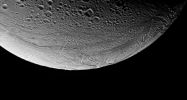
Enceladus-PIA08280.jpgThe active South Pole of Enceladus69 visiteCaption NASA originale:"The wrinkled border of Enceladus' South Polar Region snakes across this view, separating fresher, younger terrain from more ancient, cratered provinces.
This is the Region of Enceladus that is known to be presently geologically active. At right are clearly visible ridges and troughs thought to be caused (probably) by compressional stresses across the icy surface.
The image was taken in polarized green light with the Cassini spacecraft narrow-angle camera on Sept. 9, 2006 at a distance of approx. 66.000 Km (such as about 41.000 miles) from Enceladus and at a Sun-Enceladus-spacecraft, or phase, angle of 104°. Image scale is roughly 396 mt (about 1.300 feet) per pixel".Ott 05, 2006
|
|
| 2245 immagini su 188 pagina(e) |
|
|
|
|
|
93 | |
|
|
|
|
|
|





