| Ultimi arrivi - Saturn: the "Ringed Beauty" and His Moons |

Pan-N00068548.jpgPan: just "in-between"..57 visitenessun commentoOtt 31, 2006
|
|
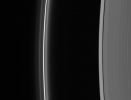
The_Rings-PIA08299.jpgSigns of Daphnis...67 visiteCaption NASA:"Edge waves in the Keeler Gap betray the presence of the embedded moon Daphnis.
Though the Cassini spacecraft cannot see Daphnis (only 7 - or approx. 4,3 miles - across) in this image (because the spacecraft is looking at its Dark Side), the tiny moon is undoubtedly located right of center, where the inner edge waves cease and the outer waves begin. The little moon was discovered in Cassini images that revealed its signature waves in the Keeler Gap (42 Km, or about 26 miles wide).
At left lies the brilliant F-Ring with its flanking strands. The bright F-Ring core is about 50 Km (approx. 30 miles) wide.
This view looks toward the unlit side of the Rings from about 32° above the Ring-Plane.
The image was taken in visible light with the Cassini spacecraft narrow-angle camera on Sept. 29, 2006 at a distance of approx. 1,7 MKM (such as a little more than 1 MMs) from Saturn and at a phase angle of 157°.
Image scale is about 10 Km (approx. 6 miles per pixel)".Ott 31, 2006
|
|

Saturn-PIA08297.jpgOut of the Dark...57 visiteCaption NASA:"As Ring particles emerge from the darkness of Saturn's shadow, they pass through a region of twilight. The Sun's light, refracted by the Planet's atmosphere, peeks around the limb, followed shortly by the Sun itself.
The "penumbra" is the narrow fringe Region of the Planet's shadow where part (but not all) of the Sun is visible around the side of the Planet, creating only a partial shadow there and making the shadow edge look fuzzy.
The A and F-Rings are captured here. This view looks toward the unlit side of the Rings from about 20° above the Ring-Plane. Two faint ringlets can be seen within the Encke Gap, which stretches out of the blackness at center and toward right.
The image was taken in visible light with the Cassini spacecraft narrow-angle camera on Sept. 12, 2006 at a distance of approx. 1,5 MKM (about 900.000 miles) from Saturn and at a phase angle of 163°. Image scale is roughly 9 Km (about 5 miles)".Ott 27, 2006
|
|

Janus-PIA08296.jpgJanus, from VERY close!58 visiteCaption NASA:"The Cassini spacecraft provides this dramatic portrait of Janus against the cloud-streaked backdrop of Saturn.
Like many small bodies in the Solar System, Janus (about 181 Km, such as approx. 113 miles across) is potato-shaped with many craters, and the moon has a surface that looks as though it has been smoothed by some process.
Like Pandora and Telesto, Janus may be covered with a mantle of fine dust-sized, icy material.
The image was taken using a spectral filter sensitive to wavelengths of infrared light centered at 930 nanometers.
This view was acquired with the Cassini spacecraft narrow-angle camera on Sept. 25, 2006 at a distance of approx. 145.000 Km (such as about 90.000 miles) from Janus and at a Sun-Janus-spacecraft, or phase, angle of 62°. North on Saturn is up. Image scale is roughly 871 mt (about 2.858 feet) per pixel".Ott 26, 2006
|
|

The Rings-PIA08295.jpgWhat's inside the Rings?56 visiteThe 2 prominent dark gaps in Saturn's A-Ring contain small embedded moons and a host of other intriguing features. Here, 3 unique ringlets are visible in the Encke Gap (about 325 Km wide). The innermost ringlet (topmost here) is faint but continuous. The center ringlet brightens substantially toward upper left and displays a few slight kinks. This ringlet is coincident with the orbit of Pan (about 26 Km across). The outermost ringlet is discontinuous, with two bright regions visible.
The narrower Keeler Gap (about 42 Km wide) hosts the moon Daphnis (7 Km across - not visible in this image), which raises waves in the Gap edges as it orbits Saturn. At lower left, faint ringlets flanking the bright F-Ring core are visible. These features were found by the Cassini spacecraft to be arranged into a spiral arm structure that winds around the Planet like a spring. The spiral may be caused by tiny moonlets or clumps of material that have smashed through the F-Ring core and liberated material.
This view looks toward the unlit side of the rings from about 23 degrees above the ringplane.
The image was taken in visible red light with the Cassini spacecraft narrow-angle camera on Sept. 11, 2006 at a distance of approximately 1.1 million kilometers (700,000 miles) from Saturn and at a Sun-Saturn-spacecraft, or phase, angle of 151 degrees. Image scale is about 6 kilometers (4 miles) per pixel.
Ott 25, 2006
|
|

Streamers-PIA08294.jpgUnbelievable "Streamers"...57 visiteCaption NASA originale:"This close-up view of the core of Saturn's narrow outlying F-Ring provides an unprecedented look at the fine scale structure of this highly perturbed Ring.
The structure seen here could be further evidence of the gravitational effects of small moons orbiting in the F-Ring Region. The moons could produce the basic structure which then starts to shear - the inner/lower part of the F-Ring core orbits Saturn faster than the outer/upper part - giving rise to the slanted features.
The image was taken in visible light with the Cassini spacecraft narrow-angle camera on Sept. 25, 2006 at a distance of approx. 254.000 Km (about 158.000 miles) from Saturn and at a phase angle of 28°. Scale in the original image was roughly 1 Km (3.845 feet) per pixel. The image has been magnified by a factor of two and contrast enhanced".Ott 25, 2006
|
|

Dione-PIA08293.jpgThe "wrinkled Face" of Dione58 visiteCaption NASA:"Bright fractures creep across the surface of icy Dione. This extensive canyon system is centered on a region of terrain that is significantly darker than the rest of the moon. Part of the darker terrain is visible at right.
Lit terrain in this view is on the Saturn-Facing Hemisphere of Dione.
North is up and rotated 8° to the left.
The image was taken in visible light with the Cassini spacecraft narrow-angle camera on Sept. 25, 2006 at a distance of approx. 677.000 Km (such as 421.000 miles) from Dione and at a Sun-Dione-spacecraft, or phase, angle of 62°.
Image scale is roughly 4 Km (about 2,5 miles) per pixel".Ott 24, 2006
|
|

Tethys-PIA08291.jpgTethys59 visiteCaption NASA:"Tethys has a crater-saturated surface, where older, larger basins have been completely overprinted by newer, smaller impacts. This state is what scientists expect to see on a very old surface, where small impactors have struck more frequently than larger ones over several billion years. Larger impacts were more common events in the early history of the Solar System.
This view looks toward the Leading Hemisphere of Tethys (1.071 Km, or about 665 miles across). North is up. The great scar of Ithaca Chasma is seen at right.
The view was captured in visible light with the Cassini spacecraft narrow-angle camera on Sept. 25, 2006 at a distance of approx. 449.000 Km (such as about 279.000 miles) from Tethys and at a phase angle of 49°. Image scale is roughly 3 Km (about 2 miles) per pixel".Ott 21, 2006
|
|

Streamers-PIA08292.jpgThe "F-Ring Streamers" (detail mgnf - HR)59 visiteCaption NASA originale:"Multiple faint, streamer-like objects can be seen in this HR Cassini spacecraft view of the F-Ring's bright core. The regular spacing of some of the features extending from the core indicates that they could all be produced by the perturbing effect of a single body as it passes close by. Scientists are examining Cassini images closely in an attempt to determine whether there are tiny moonlets - or perhaps transient clumps of material - orbiting Saturn near the F-Ring core. The researchers believe the streamer features seen here could be caused by a related phenomenon to that by which Prometheus produces streamers in the F-Ring.
This image was taken in visible light with the Cassini spacecraft narrow-angle camera on Sept. 25, 2006 at a distance of approx. 339.000 Km (about 211.000 miles) from Saturn and at a phase angle of 69°. Image scale is roughly 2 Km (a little more than 1 mile) per pixel".
Nota: quanto scommetete che, in un prossimo futuro, il Prof. Hoagland (o anche qualcun altro della Sua Scuola) ci verrà a raccontare che gli Streamers (---> corpi fluttuanti) non sono altro che minuscole astronavi le quali hanno il compito di bilanciare gravitazionalmente la porzione più esterna degli Anelli di Saturno e che l'intero "Impianto degli Anelli" non è altro - in fondo - che una gigantesca opera di Ingegneria Planetaria, creata per mero "piacere visivo" e lasciataci da chissà quale Civilità a testimonianza del suo glorioso passato? Insomma, dopo la Sfinge e le Piramidi, perchè non dirigere il prossimo business interplanetario verso l'"Architettura Cosmica", di cui gli Anelli di Saturno non rappresentano altro che un timido preliminare?!?...Ott 21, 2006
|
|

The Rings-PIA08290.jpgThe F-Ring (detail mgnf)56 visiteCaption NASA:"For some time, scientists have suspected the presence of tiny moonlets that orbit Saturn in association with the clumpy and braided-looking Ring. As the small satellites move close to the F-Ring core they leave a gravitational signature. In some cases they can draw out material in the form of a "streamer" - a miniature version of the interaction Cassini has witnessed between Prometheus and the F-Ring material. The dynamics of this interaction are the same, but the scale is different.
Scientists speculate that there could be several small moons with a variety of sizes involved in the creation of structures like the one seen here.
The image was taken in visible light with the Cassini spacecraft narrow-angle camera on Sept. 25, 2006 at a distance of approx. 255.000 Km (about 159.000 miles) from Saturn and at phase angle of 29°. Scale in the original image was 1 Km (about 3.873 feet) per pixel. The image has been magnified by a factor of two and contrast enhanced".Ott 18, 2006
|
|

Tethys-PIA08284-1.jpgTethys' transition (false colors)56 visiteCaption NASA originale:"An extreme false-color view of Tethys reveals a surface detail not visible in a monochrome view taken at the same time. The false-color view shows a color transition from the moon's Saturn-facing side (left) to a region its trailing side (bottom).
Near the top of the images, the central-peaked crater Telemachus lies in the deeply grooved terrain that marks the northern reaches of Ithaca Chasma.
To create the false-color view, ultraviolet, green and infrared images were combined into a single picture that isolates and maps regional color differences. This "color map" was then superposed over a clear-filter image that preserves the relative brightness across the body.
The combination of color map and brightness image shows how colors vary across Tethys' surface. The origin of the color differences is not yet understood, but may be caused by subtle differences in the surface composition or the sizes of grains making up the icy surface material".Ott 13, 2006
|
|

The Rings-PIA08287.jpgNot the Sun, but Aldebaran!56 visiteCaption NASA originale:"Cassini took a series of images on Sept. 9, 2006 as it watched the bright red giant star Aldebaran slip behind Saturn's Rings.
This type of observation is known as a "stellar occultation" and uses a star whose brightness is well known. As Cassini watches the rings pass in front, the star's light fluctuates, providing information about the concentrations of ring particles within the various radial features in the Rings.
Here, Cassini watches the star through the part of the Rings masked by Saturn's shadow. The view looks toward the sunlit side of the Rings from about 20° below the Ring-Plane. Bright Aldebaran is over exposed, creating thin vertical lines ("effetto goccia") on its image.
The image was taken in visible light with the Cassini spacecraft narrow-angle camera on Sept. 9, 2006 at a distance of approx. 351.000 Km (such as about 218.000 miles) from Saturn. Image scale on the sky at the distance of Saturn is 2 Km (a little more than 1 mile) per pixel".Ott 13, 2006
|
|
| 2245 immagini su 188 pagina(e) |
 |
|
|
|
|
92 | |
|
|
|
|





