| |

| Ultimi arrivi - Saturn: the "Ringed Beauty" and His Moons |

Pandora-PIA08315.jpgPandora, from about 2 MKM57 visiteCaption NASA:"Less intrusive than her sibling shepherd moon (Prometheus), Pandora nonetheless provides a gravitational influence that helps confine and perturb the F-Ring's shape.
Also notable here is the brightness of the region of the outer A-Ring which lies outside the very narrow Keeler Gap. This view looks toward the unlit side of the Rings from about 38° above the Ring-Plane.
The image was taken in visible light with the Cassini spacecraft narrow-angle camera on Oct. 16, 2006 at a distance of approx. 2 MKM (about 1,2 MMs) from Pandora and at a Sun-Pandora-spacecraft, or phase, angle of 157°. Image scale is roughly 12 Km (about 7 miles) per pixel".
Nota: nell'inset, Pandora da poco meno di 52.000 Km di distanzaMareKromiumNov 23, 2006
|
|

Prometheus-PIA08311.jpgPrometheus' streamers61 visiteCaption NASA:"This view shows Prometheus with a streamer it has created in the inner edge of the F-Ring. Prometheus comes close to the inner edge of the Ring once per orbit, perturbing the Ring particles there.
In 2009, the moon's orbit is expected to carry it repeatedly into the F-Ring core, an event that ring scientists are eagerly awaiting.
Prometheus is 102 Km (approx. 63 miles) across. This view looks toward the unlit side of the Rings, from about 40° above the Ring-Plane.
The image was taken in visible light with the Cassini spacecraft narrow-angle camera on Oct. 16, 2006 at a distance of approx. 1,8 MKM (1,1 MMs) from Prometheus and at a Sun-Prometheus-spacecraft, or phase, angle of 150°.
Scale in the original image was roughly 11 Km (about 7 miles) per pixel.
The image has been magnified by a factor of two".MareKromiumNov 16, 2006
|
|
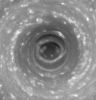
Saturn-PIA08332.jpgA "Hole" in the (South) "Pole"57 visiteCassini stares deep into the swirling hurricane-like vortex at Saturn's south pole, where the vertical structure of the clouds is highlighted by shadows. Such a storm, with a well-developed eye ringed by towering clouds, is a phenomenon never before seen on another planet.
This 14-frame movie shows a swirling cloud mass centered on the south pole, around which winds blow at 550 kilometers (350 miles) per hour. The frames have been aligned to make the planet appear stationary, while the sun appears to revolve about the pole in a counterclockwise direction. The clouds inside the dark, inner circle are lower than the surrounding clouds, which cast a shadow that follows the sun.
At the beginning of the movie, the sun illuminates directly from the top, and by the end it illuminates from the left. The width of the shadow and the height of the sun above the local horizon yield a crude estimate of the height of the surrounding clouds relative to the clouds in the center. The shadow-casting clouds tower 30 to 75 kilometers (20 to 45 miles) above those in the center. This is two to five times greater than the tallest terrestrial thunderstorms and two to five times the height of clouds surrounding the eye of a terrestrial hurricane. Such a height difference arises because Saturn's hydrogen-helium atmosphere is less dense at comparable pressures than Earth's atmosphere, and is therefore more distended in the vertical dimension.
The south polar storm, which displays two spiral arms of clouds extending from the central ring and spans the dark area inside a thick, brighter ring of clouds, is approximately 8,000 kilometers (5,000 miles) across, which is considerably larger than a terrestrial hurricane.
Eye-wall clouds are a distinguishing feature of hurricanes on Earth. They form where moist air flows inward across the ocean's surface, rising vertically and releasing a load of precipitation around an interior circular region of descending air, which is the eye itself.
Though it is uncertain whether moist convection is driving this storm, as is the case with Earthly hurricanes, the dark 'eye' at the pole, the eye-wall clouds and the spiral arms together indicate a hurricane-like system. The distinctive eye-wall clouds especially have not been seen on any planet beyond Earth. Even Jupiter's Great Red Spot, much larger than Saturn's polar storm, has no eye, no eye-wall, and is relatively calm at the center.
This giant Saturnian storm is apparently different from hurricanes on Earth because it is locked to the pole, does not drift around like terrestrial hurricanes and because it does not form over liquid water oceans.
The images were acquired over a period of three hours on Oct. 11, 2006, when Cassini was approximately 340,000 kilometers (210,000 miles) from Saturn. Image scale is about 17 kilometers (11 miles) per pixel. The images were taken with the wide-angle camera using a spectral filter sensitive to wavelengths of infrared light centered at 752 nanometers. All frames have been contrast enhanced using digital image processing techniques. The unprocessed images show an oblique view toward the pole, and have been reprojected to show the planet from a perspective directly over the south pole.
Nov 10, 2006
|
|
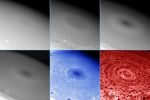
Saturn-PIA08333.jpgThe VERY RESTLESS South Pole of Saturn58 visiteThese images of Saturn's south pole, taken by two different instruments on Cassini, show the hurricane-like storm swirling there and features in the clouds at various depths surrounding the pole. Different wavelengths reveal the height of the clouds, which span tens of kilometers in altitude.
The four monochrome images displayed here were acquired by the imaging science subsystem; the blue and red images in the bottom row were taken by the visual and infrared mapping spectrometer. The images are arranged in order of increasing wavelength in nanometers as follows: (top row) 460 nm, 752 nm, 728 nm; (bottom row) 890 nm, 2,800 nm, 5,000 nm.
At the center of the cauldron of storms spinning around the south pole is the south pole itself, which literally appears to be the eye of this vast polar storm system. As in a hurricane on Earth, the south polar "eye" is relatively clear of clouds and is surrounded by a wall of towering clouds that cast shadows into the center. However, while morphologically similar, it is not clear if this vortex operates in the same fashion as a terrestrial hurricane. In most of the images, the center of the polar storm is quite dark, indicating an unusually cloud-free atmosphere in the upper skies, which are otherwise typically inhabited by bright ammonia clouds. This polar hole in the ammonia cloud layer represents the eye of the hurricane-like storm. Unusually dark clouds likely exist at the bottom of this deep hole, enhancing the murkiness there.
The first image in this montage (at upper left) shows a muted eye, due to the enhanced scattering of light from the atmosphere itself at this blue wavelength (460 nanometers), just as in the blue skies of Earth. In the last image at bottom right, the eye appears relatively bright. This image is taken at a wavelength of 5,000 nanometers, where the dominant source of light is the thermal glow of the planet itself. The bright thermal glow seen in this polar hole again shows that the eye is relatively cloud-free to unusual depths.
In the imaging science subsystem images, the eye looks dark at wavelengths where methane gas absorbs the light (728 nanometers and 890 nanometers, at upper right and lower left) and only the highest clouds are visible, confirming that the clouds within the eye are deeper than their surroundings. This effect is also seen in visual and infrared mapping spectrometer images that show gas absorption.
In the visual and infrared mapping spectrometer image taken at 2,800 nanometers, four times the wavelength of light visible to the human eye, this cloud clearing appears dark, which is consistent with the idea that the atmosphere above any distinct clouds is unusually deep there. The eye is some 1,500 kilometers (930 miles) across, and is surrounded by a distinct ring of clouds some 300 kilometers (185 miles) across. The images also indicate the prevalence of smaller but vertically well-developed storms across the entire south polar region, indicating the extent to which convection characterizes the area.
Literally hundreds of storm clouds encircle the pole, appearing as dark spots in the infrared spectrometer thermal image (red image) and as both bright and dark spots in images taken in sunlight (blue image). Each of these spots represents a storm. These pictures reveal that Saturn's south pole is a cauldron of storm activity, unlike anything ever seen on any planet.
The individual storms surrounding the pole are seen as dark "leopard spots" in the thermal image (red) taken at a wavelength of 5,000 nanometers, some seven times the wavelength of light visible to the human eye. Here, these spots are blocking the thermal light, or heat, from the interior of Saturn. The storm clouds are thus seen in silhouette against Saturn's thermal glow. The effectiveness of these clouds in blocking Saturn's interior thermal glow indicates that the storm clouds are unusually thick, extending deep down into Saturn's atmosphere, and are comprised of relatively large cloud particles, likely condensates formed in upwelling air currents.
The large number of dark, circular leopard spots at the south pole seen at 5,000 nanometer wavelength, and their correlation with the features seen in sunlight at 2,800 nanometer wavelength, indicates that convective activity extending over dozens of kilometers in altitude is surprisingly rampant in the south polar region. Why such unusual dynamics exist there is perhaps linked to Saturn's southern summer, which is the season Saturn is in now. Observations taken over the next few years, as the south pole season changes from summer to fall, will help scientists understand the role seasons play in driving the dramatic meteorology at the south pole of Saturn. The images in this montage were acquired on Oct. 11, 2006, when Cassini was approximately 340,000 kilometers (210,000 miles) from Saturn. The original imaging science subsystem images have a scale of about 17 kilometers (11 miles) per pixel. The visual and infrared spectrometer images have a scale of about 174 kilometers (108 miles) per pixel. The images have been resized to approximately the same scale for presentation here.
Nov 10, 2006
|
|
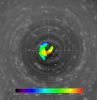
Saturn-PIA08334.jpgThe temperature of Saturn's "Stormy" South Pole60 visiteThe Cassini data presented in this view appear to confirm a region of warm atmospheric descent into the eye of a hurricane-like storm locked to Saturn's south pole. The view shows temperature data from the Cassini spacecraft composite infrared spectrometer overlaid onto an image from the imaging science subsystem wide-angle camera.
The composite infrared spectrometer data refer to a depth in Saturn's upper stratosphere where the pressure is 0.5 millibars (324 kilometers above the 1-bar level), a region higher than that imaged by the imaging camera and visual and infrared spectrometer during the same observation period. The composite infrared spectrometer data show a very small hot spot over the pole, similar in size to the "eye" of the storm seen in the imaging science subsystem images. See also Looking Saturn in the Eye and Saturn's Surprisingly Stormy South for related images.
The color scale at the bottom indicates the temperature in Kelvin corresponding to the colors of the temperature map. Numbers on the grid correspond to lines of latitude and longitude on the planet.
Infrared images taken through the Keck I telescope by ground-based observers had previously shown the south polar spot to be warm. Cassini's composite infrared spectrometer has confirmed this with higher resolution temperature maps of the area (like the map displayed here) and sees a temperature increase of about 2 Kelvin (4 degrees Fahrenheit) at the pole.
The temperatures are in the stratosphere and higher up than the clouds seen by the Cassini imaging and visual and infrared mapping spectrometer instruments, but they suggest that the atmosphere sinks over the south pole. Because the pressure increases with depth, the descending atmosphere compresses and heats up. The warmer temperatures over the south pole also indicate that the vortex winds are decaying with height in the stratosphere. The descent implied by the temperatures nicely supports the lower cloud altitudes observed by the imaging camera and visual and infrared spectrometer instruments at the pole.
The image and atmospheric data were acquired on Oct. 11, 2006, when Cassini was approximately 340,000 kilometers (210,000 miles) from Saturn. The wide-angle camera image was taken using a spectral filter sensitive to wavelengths of infrared light centered at 752 nanometers. The image has been contrast enhanced using digital image processing techniques. The unprocessed image shows an oblique view toward the pole, and was reprojected to show the planet from a perspective directly over the south pole. Scale in the original image was about 17 kilometers (11 miles) per pixel.
Nov 10, 2006
|
|
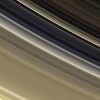
The_Rings-PIA08306.jpgThe A and B-Rings (and the Cassini Division) in natural colors (Credits: NASA/JPL/Space Science Institute)64 visiteThe Rings are awash in subtle tones of gold and cream in this view which shows the outer B-Ring, the Cassini Division and the inner part of the A-Ring. In this viewing geometry, the brightest feature in the Cassini Division is the recently discovered diffuse Ringlet near the outer edge of the Division.
The diffuse Ringlet has a distinctive bluish cast.
The color of the Rings appears more golden than earlier in the mission because of the viewing geometry here - increased scattering in the Rings is brought about by the high phase angle and the view being toward the Rings' unlit side. This view looks toward the unlit side of the rings from about 30° above the Ring-Plane.
Images taken using red, green and blue spectral filters were combined to create this natural color view. The images were acquired by the Cassini spacecraft narrow-angle camera on Sept. 29, 2006 at a distance of approx. 1,8 MKM (about 1,13 MMs) from Saturn. Image scale is roughly 11 Km (about 7 miles) per pixel.Nov 10, 2006
|
|
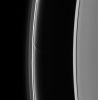
Saturn-PIA08303.jpgMore "Streamers" on sight!59 visiteA shepherd moon can do more to define ring structures than just keep the flock of particles in line, as Cassini spacecraft images such as this have shown.
Prometheus is seen here with two long streamers of material that it has pulled out of the F-Ring. When Prometheus comes close to the F-Ring in its orbit, the moon's gravity tugs on the ring particles. The disturbed particles, now pulled into orbits slightly closer to Saturn and therefore faster, shear out during successive orbits, creating the long and delicate streamers seen here.
This view looks toward the unlit side of the Rings from about 31° above the Ring-Plane.
The image was taken in visible light with the Cassini spacecraft narrow-angle camera on Sept. 29, 2006 at a distance of approx. 1,7 MKM (a little more than 1 MMs) from Prometheus and at a Sun-Prometheus-spacecraft, or phase, angle of 160°.
Image scale is roughly 10 Km (about 6 miles) per pixel.Nov 07, 2006
|
|

Saturn-W00019554.jpgA "Slice" of Light...58 visiteCaption NASA:"W00019554.jpg was taken on November 06, 2006 and received on Earth November 06, 2006. The camera was pointing toward Saturn that, at the time, was approximately 1.284.897 Km away.
The image was taken using the CB2 and IRP90 filters and it has not been validated or calibrated".Nov 07, 2006
|
|
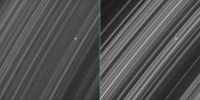
Aldebaran-PIA08300.jpgThrough the B-Ring85 visiteThese side-by-side views of a star (Aldebaran?) seen through Saturn's densely populated B-Ring show marked contrast between the region where spokes - the ghostly radial features periodically seen in it - are produced and regions where no spokes are seen.
In the view at left, the B-Ring displays an uneven grainy texture, with a great deal of variability in brightness along the direction of the particle motion. In the view at right, the B-Ring is far smoother and more uniform along the same longitudinal direction.
Ring scientists on the Cassini Imaging Team are studying images such as these to understand the processes by which spokes are created. This difference in appearance from one location to another on the Ring could provide the researchers with helpful insights into the features' formation.
These views were acquired about half an hour apart as the Cassini spacecraft looked toward the unlit side of the Rings from about 33° above the Ring-Plane. Nov 03, 2006
|
|

Saturn-N00069102.jpgSaturnian hurricane...57 visitenessun commentoNov 03, 2006
|
|

Stars-N00068672.jpgStar-trails & Cosmic Rays, from Cassini111 visitenessun commentoOtt 31, 2006
|
|

The_Rings-PIA08298.jpgFrom the Dark Side of Saturn61 visiteCaption NASA:"The Cassini spacecraft gazes down through the Dark Side of Saturn's Rings toward the softly glowing Planet. The night side Southern Hemisphere is lit by Sunlight reflecting off the opposite side of the Rings.
The Planet's shadow slices diagonally across the scene.
This view was acquired from about 23° above the Ring-Plane. The sliver of Saturn's sunlit crescent is partly overexposed as seen through the Cassini Division, a Region where there is less material to block or scatter incoming light.
Images taken using red, green and blue spectral filters were combined to create this natural color view. The images were taken with the Cassini spacecraft wide-angle camera on Sept. 11, 2006 at a distance of approx. 1,1 MKM (about 700.000 miles) from Saturn and at a phase angle of 151°.
Image scale is about 60 Km (such as approx. 37 miles) per pixel".Ott 31, 2006
|
|
| 2245 immagini su 188 pagina(e) |
|
|
|
|
|
91 | |
|
|
|
|
|
|





