| Ultimi arrivi - Saturn: the "Ringed Beauty" and His Moons |

The_Rings-PIA08846.jpgLights through the Rings...56 visiteCaption NASA:"With the Sun directly behind Cassini, the spacecraft spies the Opposition Surge in Saturn's inner A-Ring. The opposition effect becomes visible from this special viewing geometry. (...)
This view looks toward the Rings from about 11° below the Ring-Plane.
The image was taken in visible light with the Cassini spacecraft wide-angle camera on Dec. 2, 2006 at a distance of approx. 287.000 Km (178.000 miles) from Saturn. Image scale is roughly 17 Km (about 11 miles) per pixel".Gen 04, 2007
|
|

The_Rings-PIA08845.jpgThe strange appearence of the F-Ring65 visiteCaption NASA:"The striated appearance of the F-Ring is immediately apparent in the region of the ring that trails behind the moon Prometheus. The F-Ring is characterized here by dark gores that stretch inward toward the planet and forward in the direction of motion.
This image has been expanded in the horizontal direction by a factor of 5 in order to make radial variations more prominent.
The curvature of the Rings is also exaggerated by the horizontal stretch.
The exterior flanking ringlets (to the right of the bright ring core) are not disturbed by Prometheus to the great degree seen in the inner ringlets. This view looks toward the unlit side of the Rings from about 31° above the Ring-Plane.
The image was taken in visible light with the Cassini spacecraft narrow-angle camera on Nov. 25, 2006 at a distance of approx. 1,7 MKM (about 1,1 MMs) from Saturn and at a phase angle of 162°. Scale in the original image is roughly 10 km per pixel".MareKromiumGen 03, 2007
|
|

Saturn-PIA08340.jpgShadowlands58 visiteL'espressione "Shadowland/s" l'avevamo inventata un paio d'anni fa, per commentare le immagini che mostravano il profilo di rilievi elevati i quali si trovavano, al momento di effettuazione della ripresa, sul cosiddetto "Terminatore" (ossìa la linea che divide il giorno dalla notte).
E' non solo curioso ma anche, ed almeno dal nostro punto di vista, fonte di piacere il fatto di vedere che la NASA - chissà, forse anche ispirata da qualcuno dei "titoli" che diamo alle immagini... - abbia adottato questa medesima espressione per descrivere il regno di ombre che sembra caratterizzare, nel frame in oggetto, il Gigante Anellato più famoso del Sistema Solare: Saturno.Gen 01, 2007
|
|

The_Rings-N00073991.jpgSomething's in the Rings...57 visitenessun commentoDic 31, 2006
|
|

Enceladus-PIA08355.jpgCanyonland (HR)61 visiteFine topographic detail and color variations are revealed in this 11-image, false color mosaic taken during Cassini's 2nd close flyby of Saturn's moon Enceladus, on March 9, 2005.
This mosaic, a HR cropped section of the full-disk mosaic available in Fractured World, shows the center of the anti-Saturnian Hemisphere of Enceladus -- such as the side of Enceladus that always faces away from Saturn. The left portion of the mosaic is dominated by Diyar Planitia. Dic 30, 2006
|
|

Helene-PIA08335-00.jpgHelene (HR and False Colors)58 visiteCaption NASA:"Cassini came close to Saturn's small moon Helene on Feb. 25, 2006, acquiring this High-Resolution (HR) view. This object seems to be buried in its own crater debris, like another Saturnian moon, Telesto.
Helene (32 Km, or 20 miles across) orbits 60° ahead of Dione in the larger moon's orbit, making it a "trojan" moon of Dione. Trojan moons are named for the Trojan group of asteroids that orbit 60° ahead of and behind Jupiter as it circles the Sun.
This image was taken in visible light with the Cassini spacecraft narrow-angle camera at a distance of approx. 68.000 Km (42.000 miles) from Helene and at a Sun-Helene-spacecraft, or phase, angle of 99°. Image scale is roughly 406 mt (1.334 feet) per pixel".Dic 30, 2006
|
|

Enceladus-PIA08354.jpgEnceladus (in false colors)60 visiteThe mosaic shows the anti-Saturnian Hemisphere of Enceladus -- the side that always faces away from Saturn.
This Region contains a number of tectonic and impact features and shows how these two geologic forces interact on Enceladus. The center left portion of this mosaic is dominated by Diyar Planitia.
Like Sarandib Planitia observed in the previous Enceladus flyby, the Region is characterized by low ridges and troughs. Throughout this Hemisphere, fractures of all sizes disrupt the previously existing cratered terrain and even the comparatively youthful Diyar Planitia.
Many of the younger fractures have blue-green walls, revealing coarse-grained water ice in the top layers of Enceladus' lithosphere, compared to the fine-grained ice that coats much of Enceladus' surface. The blue-green color is very similar to the coatings surrounding the South Polar "tiger stripes" (these appear greener than the features in the south polar mosaic released in 2005 due to the use of clear-filter images, instead of green, in that mosaic). Dic 30, 2006
|
|

Mimas-PIA08842.jpgMonochrome Mimas57 visitenessun commentoDic 29, 2006
|
|
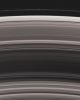
The_Rings-PIA08840.jpgThe Main Ring-System57 visiteCaption NASA originale:"This expansive view takes in most of Saturn's main Ring System, from the outer C-Ring to the narrow and knotted-looking F-Ring. The broad brightness plateaus in the C-Ring (at bottom) transform into the more densely populated (and thus darker in this viewing geometry) B-Ring. The Rings' appearance becomes brighter and smoother beyond the bands of the Cassini Division, in the A-Ring. This view looks toward the unlit side of the Rings from about 49° above the Ring-Plane.
The image was taken in visible blue light with the Cassini spacecraft wide-angle camera on Nov. 21, 2006 at a distance of approx. 539,000 Km (about 335.000 miles) from Saturn and at a Sun-Saturn-spacecraft, or phase, angle of 98°.
Image scale is 29 kilometers (18 miles) per pixel".MareKromiumDic 28, 2006
|
|

Dione-PIA08839.jpgThe "fractured face" of Dione59 visiteCaption NASA:"The fractured terrain so distinctive to Dione curves away toward the South in this view, which looks down at the moon's Northern Hemisphere.
Lit terrain in this view is on the Saturn-Facing Hemisphere of Dione.
The image was taken in visible light with the Cassini spacecraft narrow-angle camera on Nov. 22, 2006 at a distance of approx. 943.000 Km (about 586.000 miles) from Dione and at a Sun-Dione-spacecraft, or phase, angle of 109°.
Image scale is roughly 6 Km (a little less than 4 miles) per pixel".MareKromiumDic 27, 2006
|
|

Enceladus-PIA09037.jpgActive Enceladus57 visiteOn Nov. 9, 2006, Cassini's Composite Infrared Spectrometer captured its first view of the Infrared Heat Radiation emanating from the "Tiger Stripe" fractures at the South Pole of Saturn's moon Enceladus (right) since the discovery of the hot spot 16 months earlier (left). The original discovery was made just before a close flyby of Enceladus on July 14, 2006, and coincided with the discovery of plumes of water-rich gas and ice particles jetting out of the Tiger Stripes. However, the spacecraft's orbit did not provide any good views of the South Pole for follow-up observations until November 2006.
The new observations were made from a range of 110.000 Km (68.350 miles), slightly more distant than the 80.000-Km range (49.700 miles) of the original observations.
Comparison of the two images shows that the South Polar Region continues to be active, and the distribution of temperatures there has changed little in 16 months.
The distribution of Heat Radiation suggests that most or all of the South Polar heat comes from the Tiger Stripes themselves, though the individual stripes are not resolved at the approximate 30-Km (19-mile) spatial resolution of these images.
The images show the intensity of Heat Radiation in the 10- to 16-micron wavelength range, translated into temperature and displayed in false color.
Peak South Polar temperature on both dates reached about 85 Kelvin (- 306 degr. Fahrenheit), averaged over the 30-Km (19-mile) spatial resolution of the data. However, the variation in brightness with wavelength, which is also measured by the Composite Infrared Spectrometer, reveals that the warm region includes small areas, possibly zones a few 100 mt (320 feet) wide along the length of the Tiger Stripes, that are at higher temperatures, reaching at least 130 Kelvin (- 225 degr. Fahrenheit) and perhaps much warmer still.
While the South Polar Tiger Stripes are almost certainly heated by energy from the moon's interior, daytime regions at low latitudes are warmed by sunlight to temperatures in the high 70s Kelvin (about - 320 degrees Fahrenheit).
The white numbers on the images show West Longitudes on Enceladus, which is 500 Km (310 miles) in diameter.
The dashed line shows the Terminator, the boundary between day and night.
The blotchy appearance of the cooler regions away from the South Pole, and of the sky beyond the globe of Enceladus, is an artifact resulting from the fact that apart from the Polar Hot Spot, the Composite Infrared Spectrometer can barely detect the very faint Heat Radiation from this very cold moon.MareKromiumDic 24, 2006
|
|
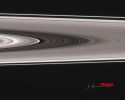
The_Rings-PIA08827.jpgMimas and the Rings58 visiteCaption NASA:"A recently discovered diffuse ringlet shines brightly in the Cassini Division as Mimas cruises past at bottom. Most of the main Rings are comprised of particles ranging from marble-size to house-size. In contrast, the brightness of this ringlet (seen right of center) when viewed at a high phase angle (the Sun-Saturn-Spacecraft angle) indicates it contains a large quantity of microscopic particles, which were likely generated by the disruption of a larger body. Such an event was probably recent, since this ringlet was not observed by the Voyager spacecraft in 1980 and 1981.
This view looks toward the lit side of the Rings from about 1° below the Ring-Plane. Mimas, which is in the foreground between Cassini and the Rings, is 397 Km (about 247 miles) wide. See PIA08330 and PIA08331 for other views of the new ringlet.
The image was taken in visible light with the Cassini spacecraft wide-angle camera on Nov. 18, 2006 and from a phase angle of 140°. Cassini was then at a distance of about 1,2 MKM (about 800.000 miles) from Saturn. Image scale is roughly 7 Km per pixel".MareKromiumDic 24, 2006
|
|
| 2245 immagini su 188 pagina(e) |
 |
|
|
|
|
89 | |
|
|
|
|





