| Ultimi arrivi - Saturn: the "Ringed Beauty" and His Moons |

Saturn-PIA08864.jpgTurbulences... (False Colors; credits: Lunexit)58 visiteCaption NASA:"The Cassini spacecraft captures the ripples, loops and storms that swirl in Saturn's East-West flowing cloud bands.
The image was taken with the Cassini spacecraft wide-angle camera using a spectral filter sensitive to wavelengths of infrared light centered at 728 nanometers. The view was obtained on Dec. 13, 2006 at a distance of approx. 775.000 Km (about 482.000 miles) from Saturn. Image scale is roughly 43 Km (about 27 miles) per pixel".Gen 29, 2007
|
|

The_Rings-PIA08863.jpgWhat's inside the F-Ring?!?61 visiteCaption NASA:"These 2 images, taken about 8' apart, show clump-like structures and a great deal of dust in Saturn's ever-changing F-Ring. The images show an object-interior to and detached from the bright core of the F-Ring that appears to be breaking up into discrete clumps.
Cassini scientists have been monitoring clumps in the F-Ring for more than 2 years now, trying to understand whether these represent small permanent moonlets or transient aggregates of material. This view looks toward the unlit side of the Rings from about 35° above the Ring-Plane.
The images were taken in visible light with the Cassini spacecraft narrow-angle camera on Dec. 23, 2006 at a distance of approx. 2 MKM (about 1,2 MMs) from Saturn. Image scale is roughly 12 Km (about 7 miles) per pixel". Gen 28, 2007
|
|

Saturn-W00018153.jpgSunshine on Saturn... (natural colors)59 visitenessun commentoMareKromiumGen 20, 2007
|
|
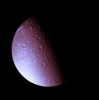
Dione-PIA08856.jpgDione's Terminator (false colors - elab. Lunexit)60 visitenessun commentoMareKromiumGen 20, 2007
|
|
Enceladus-N00075253.jpgThe light colors of Enceladus (elab. Lunexit)65 visitenessun commentoMareKromiumGen 20, 2007
|
|

Saturn-PIA08858.jpgInfrared Saturn (elab. NASA)59 visiteCaption NASA:"This psychedelic view of Saturn and its Rings is a composite made from images taken with the Cassini spacecraft wide-angle camera using spectral filters sensitive to wavelengths of infrared light centered at 728, 752 and 890 nanometers.
Cassini acquired the view on Dec. 13, 2006 at a distance of approx. 822.000 Km(such as about 511.000 miles) from Saturn. Image scale is roughly 46 Km (approx. 28 miles) per pixel". MareKromiumGen 20, 2007
|
|

Rhea-N00075318.jpgRhea (natural colors)58 visitenessun commentoMareKromiumGen 20, 2007
|
|

Pan-PIA08857.jpgPan58 visiteCaption NASA:"Pan is seen in this color view as it sweeps through the Encke Gap with its attendant ringlets. As the lemon-shaped little moon orbits Saturn, it always keeps its long axis pointed along a line toward the Planet. From this vantage point, the dark side of the moon is visible.
This view looks toward Pan (26 Km or 16 miles across) within the Encke Gap (325 Km or 200 miles wide), on the unlit side of the Rings, and from an inclination of about 33° above the Ring-Plane.
Images taken using red, green and blue spectral filters were combined to create this natural color view. The image was taken with the Cassini spacecraft narrow-angle camera on Dec. 16, 2006 at a distance of approx. 779.000 Km (about 484.000 miles) from Pan and at a Sun-Pan-spacecraft, or phase angle of 83°.
Image scale is roughly 5 Km (a little more than 3 miles) per pixel".MareKromiumGen 18, 2007
|
|

The_Rings-PIA08855.jpgMulticolored Rings...58 visiteCaption NASA:"Both luminous and translucent the C-Ring sweeps out of the darkness of Saturn's shadow and obscures the Planet at lower left.
The Ring is characterized by broad, isolated bright areas, or "plateaux", surrounded by fainter material. This view looks toward the unlit side of the Rings from about 19° above the Ring-Plane. North on Saturn is up. The dark, inner B-Ring is seen at lower right.
The image was taken in visible light with the Cassini spacecraft wide-angle camera on Dec. 15, 2006 at a distance of approx. 632.000 Km (about 393.000 miles) from Saturn and at a phase angle of 56°.
Image scale is roughly 34 Km (about 21 miles) per pixel".
Nota: il sistema di elaborazione in "colori naturali" non è cambiato ma, come vedete Voi stessi, i colori di Saturno sono (leggermente) mutati. Come mai? La risposta, a nostro parere, deve essere rinvenuta nel tipo di filtraggio utilizzato dalla NASA per l'ottenimento dell'immagine originale in b/n. Questo vuol dire, fra l'altro, che i frames in b/n NON sono affatto tutti uguali (come molti invece ritengono). E' il tipo di flitro impiegato per l'ottenimento dell'immagine originale - ottenuta sulla scala dei grigi - che poi determinerà, in sede di trasformazione del frame in immagine a colori, il "tipo di colori"!Gen 17, 2007
|
|
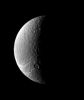
Rhea-PIA08851.jpgRhea76 visiteCaption NASA:"This view looks toward Rhea's North Polar Region, where icy fractures slither away toward the South. The lit terrain in this view is on the Saturn-facing Hemisphere of Rhea.
The image was taken in visible light with the Cassini spacecraft narrow-angle camera on Dec. 4, 2006 at a distance of approx. 773.000 Km (about 480000 miles) from Rhea and at a Sun-Rhea-spacecraft, or phase, angle of 105°.
Image scale is 5 Km (a little more than 3 miles) per pixel".MareKromiumGen 11, 2007
|
|

Prometheus-PIA08849.jpgThe "Wave-Maker"...76 visiteCaption NASA:"Prometheus dips into the inner F-Ring at its farthest point from Saturn in its orbit, creating a dark gore and a corresponding bright streamer. Gores created during previous apoapsis (the name for the farthest point in an orbit) passes, are seen above. The older gores are farther behind the moon in its orbit of Saturn. This view looks toward the unlit side of the Rings from about 31° above the Ring-Plane.
The image was taken in visible light with the Cassini spacecraft narrow-angle camera on Nov. 1, 2006 at a distance of approx. 1,7 MKM (about 1,1 MMs) from Saturn and at a Sun-Saturn-spacecraft, or phase, angle of 162°.
Image scale is roughly 10 Km (a little more than 6 miles) per pixel".
Nota: si tratta di una elaborazione Lunexit in falsi colori che abbiamo realizzato per evidenziare non solo la reale forma di Prometheus ma anche la presenza, sia internamente, sia esternamente all'Anello "F", di una debolissima luminosità (che appare di colore rosso scuro) la quale, a nostro parere, NON è un semplice effetto ottico - tipo luce diffusa dall'Anello "F" - bensì è vero e proprio materiale: la porzione più estrema (esterna ed interna) dell'Anello "F" stesso la quale è formata, con ogni probabilità, solo da polveri.MareKromiumGen 08, 2007
|
|

Prometheus-PIA08847.jpgPrometheus' trail64 visiteCaption NASA:"Prometheus interacts gravitationally with the inner flanking ringlets of the F-Ring, creating dark channels as it passes.
This image was taken in a complete azimuthal scan of the Rings, during which Cassini followed Prometheus (102 Km, or 63 miles across) around the Rings for one complete orbit, or about 14 hours. This view looks toward the unlit side of the Rings from about 41° above the Ring-Plane. The moon is partly lit by Sunlight (at left) and elsewhere lit by reflected light from Saturn.
The image was taken in visible light with the Cassini spacecraft narrow-angle camera on Nov. 23, 2006 at a distance of approx. 1,5 MKM (900.000 miles) from Prometheus and at a Sun-Prometheus-spacecraft, or phase, angle of 152°. Image scale is roughly 9 Km (a little more than 5 miles) per pixel".Gen 05, 2007
|
|
| 2245 immagini su 188 pagina(e) |
 |
|
|
|
|
88 | |
|
|
|
|





