| Ultimi arrivi - Saturn: the "Ringed Beauty" and His Moons |

Enceladus-PIA08954.jpgIcy Emanations...58 visiteCaption NASA:"Peeking over the crescent of Enceladus, the Cassini spacecraft views the towering plume of ice particles erupting from the moon's South Polar Region.
Multiple components of the overall plume are visible in this view of Enceladus.
The image was taken in visible light with the Cassini spacecraft narrow-angle camera on April 24, 2007 at a distance of approx. 188.000 Km (such as about 117.000 miles) from Enceladus and at a Sun-Enceladus-spacecraft, or phase, angle of 153°.
Image scale is roughly 1 Km (about 0,6 miles) per pixel".MareKromiumGiu 06, 2007
|
|

Saturn-PIA08952.jpgThe Southern Latitudes of Saturn57 visiteCaption NASA:"Stunning details in Saturn's clouds suggest movement within bands of atmosphere. This false color enhancement makes visible an exciting level of detail in the bright and dark bands that is more easily seen at Jupiter than at Saturn.
Saturn's Southern Hemisphere seems to fade into the blackness of space in this view.
The image was taken with the Cassini spacecraft wide-angle camera using a combination of spectral filters sensitive to wavelengths of infrared light centered at 752 (red channel), 890 (blue channel) and 728 (green channel) nanometers.
The view was acquired on Feb. 2, 2007 at a distance of approx. 1 MKM (such as about 600.000 miles) from Saturn.
Image scale is roughly 57 Km (about 36 miles) per pixel".MareKromiumGiu 01, 2007
|
|
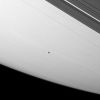
Janus-PIA08951.jpgFloating Janus59 visiteCaption NASA:"Janus floats above the meandering clouds of Saturn and a few of the large craters on the moon are just visible.
This view looks toward the unilluminated side of the Rings from about 18° above the Ring-Plane. Saturn's narrow F-Ring and outer A-Ring are pictured in the upper right.
The image was taken in visible light with the Cassini spacecraft narrow-angle camera on April 13, 2007 at a distance of approx. 1,7 MKM (a little more than 1 MMs) from Janus.
Image scale is roughly 10 Km (about 6 miles) per pixel".MareKromiumGiu 01, 2007
|
|

Japetus-IMG002621-cr2000.jpgJapetus' "Bright Side" (natural colors - elab. Lunexit)82 visitenessun commentoMareKromiumMag 29, 2007
|
|

Japetus-IMG002621-br500.jpgJapetus' "Bright Side" (natural colors - elab. NASA)58 visiteCaption NASA:"The Cassini spacecraft views terrain on the bright, Trailing Side of Iapetus in natural color. This side of Iapetus starkly contrasts with the much darker Leading Hemisphere, and some of the dark material seen here in association with craters near the Terminator is an extension of the Leading Hemisphere terrain.
This Region was previously imaged by the spacecraft at a much finer resolution - a spatial scale of less than 1 Km (0,6 miles) per pixel - during a Fly-By at the close of 2004. This terrain was then on the moon's night side at the time, and Cassini imaged it using weak, reflected light from Saturn.
The present view looks toward Iapetus (1468 Km or approx. 912 miles across) from about 24° above the moon's Equator.
Images taken using red, green and blue spectral filters were combined to create this natural color view. The images were taken with the Cassini spacecraft narrow-angle camera on April 15, 2007 at a distance of approx. 2,3 MKM (such as about 1,4 MMs) from Iapetus and at a Sun-Iapetus-spacecraft, or phase, angle of 66°.
Scale in the original images is roughly 13 Km (about 8 miles) per pixel.
The view has been magnified by a factor of three".
MareKromiumMag 29, 2007
|
|

Enceladus-PIA09209.jpgWarm-up on Enceladus58 visiteCaption NASA:"Plumes of water vapor and other gases escape at high velocity from the surface of Saturn's moon Enceladus, as shown in this artist concept.
The "shear heating" mechanism suggests that tidal forces acting on fault lines in the moon's icy shell cause the sides of the faults to rub back and forth against each other, producing enough heat to transform some of the ice into plumes of water vapor and ice crystals. Cold sub-surface ice (blue) becomes much warmer near the active fractures from which the plumes emanate.
Movement along the fault lines may be about half a meter (20") over the course of the 1,37-day tidal period of Enceladus around Saturn".MareKromiumMag 29, 2007
|
|

Mimas-N00083734.jpgMimas (natural colors - elab. Lunexit)59 visitenessun commentoMareKromiumMag 28, 2007
|
|

Dione-N00083791.jpgDione (b/w)56 visiteCaption NASA:"N00083791.jpg was taken on May 27, 2007 and received on Earth May 28, 2007.
The camera was pointing toward DIONE that, at the time, was approx. 846.342 Km away, and the image was taken using the CL1 and IR3 filters.
This image has not been validated or calibrated".MareKromiumMag 28, 2007
|
|
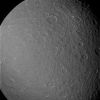
Rhea-N00083837.jpgRhea (b/w)109 visitenessun commentoMareKromiumMag 28, 2007
|
|

Atlas_Pan-PIA08946.jpgBrothers in the Night: Atlas & Pan57 visiteCaption NASA:"Atlas and Pan emerge from the Far Side of Saturn.
Light passing through the upper reaches of the Planet's Atmosphere is refracted, or bent, distorting the image of the Rings beyond.
Pan (about 26 Km, or 16 miles across) is seen within the Encke Gap. Atlas (about 32 Km, or 20 miles across) orbits just beyond the outer edge of Saturn's A-Ring.
This view looks toward the unilluminated side of the Rings from about 12° above the Ring-Plane. Shadows cast by the Rings arc across the Planet toward the Cassini spacecraft.
The image was taken in visible light with the Cassini spacecraft narrow-angle camera on April 12, 2007 at a distance of approx. 1,6 MKM (about 1 MMs) from Saturn.
Image scale is roughly 10 Km (a little more than 6 miles) per pixel".MareKromiumMag 28, 2007
|
|

Saturn-PIA08944-01.jpgPrometheus Makes Contact (natural colors - elab. Lunexit)58 visitenessun commentoMareKromiumMag 21, 2007
|
|

Saturn-PIA08944-00.jpgPrometheus Makes Contact (natural colors - elab. NASA)60 visiteCaption NASA:"The F-Ring shepherd moon Prometheus touches the face of Saturn once more before moving off into blackness and continuing in its orbit.
The F-Ring itself is visible as a thin line just below Prometheus (which is about 102 Km, or approx. 63 miles across).
This view looks toward the unilluminated side of the Rings from about 18° above the Ring-Plane. North on Saturn is up and rotated about 30° to the right.
Images taken using red, green and blue spectral filters were combined to create this natural color view.
The images were obtained by the Cassini spacecraft narrow-angle camera on April 13, 2007 at a distance of approx. 1,7 MKM (such as a little more than 1 MMs) from Prometheus and 1,8 MKM (such about 1,1 MMs) from Saturn.
Image scale is roughly 10 Km (6 miles) per pixel".MareKromiumMag 21, 2007
|
|
| 2245 immagini su 188 pagina(e) |
 |
|
|
|
|
81 | |
|
|
|
|





