| |

| Ultimi arrivi - Saturn: the "Ringed Beauty" and His Moons |

Saturnian_Lightnings-02.jpgSaturnian Storm and Lightnings (EDM - credits: NASA/JPL/SSI)162 visiteScientists are tracking the strongest lighting storm ever detected at Saturn. The storm is larger than the continental United States, with electrical activity about 1000 times stronger than the lightning on Earth. Radio outbursts were first detected by NASA's Cassini Spacecraft on Jan. 23. The storm is about 2175 miles wide (approx. 3500 Km). "It's really the only large storm on the whole planet," said Andrew Ingersoll, a member of the Cassini imaging team.
Earth-based amateur astronomers were able view Saturn's dayside with their telescopes when Cassini could not. The amateurs' images of Saturn provided the first visual confirmation of the storm.
The storm is in a Region of the Southern Hemisphere referred to as "Storm Alley" by scientists because of the high level of storm activity observed there. The latitude of the new storm matches that of the "Dragon Storm", which was a powerful emitter of radio noise and was imaged by Cassini in 2004. It may be a reemergence of that storm or a new storm, scientists said.
Sunlight reflected from Saturn's Rings (called "Ringshine") provided illumination needed to allowing the storm and other cloud features to be seen in a new Cassini image.MareKromiumApr 01, 2011
|
|

Saturnian_Lightnings-03.jpgSaturnian Lightnings151 visiteNASA's Cassini Spacecraft captured images of lightning at Saturn that allowed scientists to create the first movie showing lightning flashing on another Planet.
"The Visible Light images tell us a lot about the lightning," said Ulyana Dyudina, a Cassini imaging team associate based at the California Institute of Technology (Caltech) in Pasadena, Calif., who was the first to see the flashes. "Now we can begin to measure how powerful these storms are, where they form in the cloud layer and how the optical intensity relates to the total energy of the thunderstorms."
After waiting years for Saturn to dim enough for the Spacecraft's cameras to be able to detect bursts of light, scientists were able to create the movie, complete with an accompanying soundtrack that features the crackle of radio waves emitted when lightning bolts struck.
"This is the first time we have the visible lightning flash together with the radio data," said Georg Fischer, a radio and plasma wave science team associate based at the Space Research Institute in Graz, Austria. "Now that the radio and visible light data line up, we know for sure we are seeing powerful lightning storms."
Cassini, launched in 1997, and NASA's Voyager mission, launched in 1977, had previously captured radio emissions from storms on Saturn.
A belt around the gas giant, where Cassini previously detected radio emissions and bright, conservative clouds, even earned the nickname "storm alley." Cassini's cameras, however, had been unable to obtain pictures of lightning flashing.
Since the Robotic Spacecraft's arrival at Saturn in 2004, it has been difficult for Cassini to see lightning because the planet is very bright and reflective. Sunlight that shines off of Saturn's enormous Rings makes even the night side of Saturn brighter than a full-moon night on Earth.
The Equinox period around August 2009 finally brought enough darkness needed for Cassini's cameras. During Equinox, the Sun shone directly over the Planet's Equator, lighting the Rings edge-on only, leaving the bulk of the Rings in shadow.
The movie and radio data collected by the scientists suggest extremely powerful storms, with lightning that flashes as brightly as the brightest super-bolts of lightning on Earth, according to Andrew Ingersoll, a Cassini imaging science subsystem team member at Caltech.
"What's interesting is that the storms are as powerful or even more powerful at Saturn as on Earth," Ingersoll said. "But they occur much less frequently, with usually only one happening on the planet at any given time, though it can last for months."
The first images of lightning on Saturn were captured in August 2009, during a storm that lasted from January to October 2009, longer than any other observed lightning storm in the Solar System.
In order to make a video, scientists needed more pictures with brighter lightning and strong radio signals. Data collected during a shorter subsequent storm, which occurred from November through mid-December 2009, was also used.
The frames in the video were obtained over a period of 16 minutes on Nov. 30, 2009. The flashes lasted less than one second. The images also show a cloud as long as 1900 miles (3057,746 Km) across, with the regions illuminated by the lightning flashes reaching approx. 190 miles (305,7746 Km) in diameter. Scientists used the width of the lightning flashes to gauge the depth of the bolts below the cloud tops.
Lightning that strikes on Earth and Saturn emit radio waves at a frequency that can cause static on an AM radio. The audio in the video approximate that static sound, based on Saturn's electrostatic discharge signals that were detected by Cassini's radio and plasma wave science instrument.
Scientists monitoring the Cassini Orbiter were busy during this Equinox period, having already observed clumps in Saturn's Rings that are as high as the Rocky Mountains.
The Cassini-Huygens mission is a joint project involving NASA, the European Space Agency and the Italian Space Agency. The Jet Propulsion Laboratory, a division of Caltech, manages the Cassini-Huygens mission for NASA's Science Mission Directorate in Washington. The Cassini orbiter and its two onboard cameras were designed, developed and assembled at the Jet Propulsion Laboratory.MareKromiumApr 01, 2011
|
|

Phoebe-PIA06066.jpgPhoebe133 visiteCaption NASA:"Early images returned from the first detailed reconnaissance of Saturn's small outer moon, Phoebe, show breathtaking details in the moon's pockmarked Surface that already have imaging scientists puzzling over the body's history. The images are only a preview of what to expect from the High Resolution images which will show details about 10 times smaller.
Phoebe has revealed itself to be a rugged, heavily cratered body, with overlapping craters of varying sizes.
This morphology suggests an old Surface. There are apparently many craters smaller than 1 km, indicating that projectiles probably smaller than 100 meters once pummeled Phoebe.
Whether these objects were Cometary or Asteroidal in origin, or were the debris that resulted from impacts on other bodies within the Saturn System, is hotly debated. There is also variation in surface brightness across the body.
In the first image (at left) in which Phoebe looks somewhat like a sideways skull, the large crater near the bottom displays a complex and rugged interior. The lower right hand part of Phoebe appears to be covered by bright wispy material.
The second, Higher Resolution image further reveals the moon's battered Surface, including a crater near the right hand edge with bright rays that extend outward from its center. This suggests that dark material coats the outside. Features reminiscent of those seen on the Martian moon Phobos -- such as Linear Grooves -- are faintly visible in the upper part of this image.
There are suggestions of Linear Ridges or Grooves and of Chains of Craters, perhaps radial to a large crater just hidden on the un-illuminated region in the upper left.
Left to right, the two views were obtained at phase, or Sun-Phoebe-Spacecraft, Angles of approximately 86°, and from distances ranging from 143.068 Km (88.845,228 miles) to 77,441 kilometers (48.090,861 miles); for reference, Cassini's closest approach to Phoebe was approximately 2068 Km (1284,228 miles). The image scale ranges from 0,86 to 0,46 Km per pixel. No enhancement of any kind has been performed on the images".MareKromiumMar 31, 2011
|
|

Phoebe-PIA07775.jpgPhoebe's Global Digital Map128 visiteCaption NASA:"This Global Digital Map of Saturn's moon Phoebe was created using data taken during the Cassini Spacecraft's close Fly-By of the small moon that occurred in June 2004. The Map is an "Equidistant Projection" and has a scale of 233 meters (764 feet) per pixel.
The Mean Radius of Phoebe used for projection of this Map is approx. 107 Km (such as 66,447 miles). The resolution of the Map is 8 pixels per degree".MareKromiumMar 31, 2011
|
|

Phoebe-PIA07795.jpgPhoebe: Cartographic Projections (Mercator Projection)140 visiteCaption NASA:"This Map is part of a group release of Mercator and Polar Stereographic Projections of Saturn's moon Phoebe.
A "Mercator Projection" is a map that preserves directions on a body, but distorts sizes, especially near the Poles. This Global Digital Map of Phoebe was created using data taken during Cassini's close Fly-By of the small moon that occurred in June 2004.
The mosaic is projected into the Mercator Projection within the Latitude range from 57° South to 57° North; the Stereographic Projections represent Latitudes greater and lower than + or - 55°. Thus, this map meets the standard scale of 1:1.000.000, as recommended by the U.S.G.S.
The projections are conformal, the quadrangles overlap and the scale of the Poles was chosen such that the circumference of the Stereographic Projection is identical to the width of the Mercator Projection.
The nomenclature was proposed by the Cassini imaging team and has yet to be validated by the International Astronomical Union. Resolution of the digital mosaic is 233 meters (764 feet) per pixel, although the highest resolution images have resolutions of 70 meters (230 feet) per pixel. The Mean Radius of Phoebe is approx. 107 Km (such as 66,447 miles)".MareKromiumMar 31, 2011
|
|
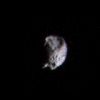
Phoebe-PIA06065.gifRevolving Phoebe (a GIF-Movie by NASA/JPL/Space Science Institute)127 visiteCaption NASA:"Phoebe rotates through nearly one full rotation in this GIF sequence of 9 frames, taken on Cassini's approach to the small Celestial Body on June, 10, 2004. Phoebe rotates on its axis once every 9 hours and 16 minutes; this sequence spans 8 hours and 14 minutes; all 360° of Longitude on Phoebe are visible in the sequence.
The Surface is clearly covered by impact craters of a wide range of sizes, up to 40% of the diameter of the moon, creating rugged topography, illustrated dramatically along the Terminator and Limb.
The images that make up this sequence were obtained at a Sun-Phoebe-Spacecraft angle of 87° and from distances ranging from 877.453 Km (544.898 miles) to 688.924 Km (427,822 miles). The image scale in this sequence ranges from 5,3 to 4,1 Km per pixel. To aid visibility, the images were magnified three times via linear interpolation; no contrast enhancement was performed".MareKromiumMar 30, 2011
|
|

Helene-PIA12758-PCF-LXTT.jpgHelene (Absolute Natural Colors; credits for the additional process. and color.: Dr Paolo C. Fienga - Lunexit Team)231 visitenessun commentoMareKromiumMar 23, 2011
|
|

Hyperion-PCF-LXTT.jpgHyperion (Absolute Natural Colors; credits for the additional process. and color.: Dr Paolo C. Fienga - Lunexit Team)1640 visitenessun commentoMareKromiumFeb 27, 2011
|
|

Dione-PIA12752.jpgWispy Terrain on Dione (Absolute Natural Colors; credits for the additional process. and color.: Dr Paolo C. Fienga - Lunexit Team)277 visiteCaption NASA:"Wispy Terrain reflects Sunlight brightly in the lower left of this Cassini image of the Northern Latitudes of Saturn's moon Dione.
These "Wisps" are actually Fractures located on the Trailing Hemisphere of Dione. Lit Terrain seen here is between the Trailing Hemisphere and the Saturn-facing Side of Dione. North is up.
The image was taken in Visible Light with the Cassini spacecraft narrow-angle camera on Dec. 20, 2010. The view was obtained at a distance of approx. 107.000 Km (66.447 miles) from Dione and at a Sun-Dione-Spacecraft, or Phase, Angle of 109°. Image scale is roughly 640 meters (2100 feet) per pixel".MareKromiumFeb 26, 2011
|
|

Saturn-PIA08823~0.jpgCrescent Saturn (Natural Colors; credits: NASA/JPL/Space Science Institute)60 visiteFrom Norther than the North Pole...
Caption NASA originale:"The Cassini spacecraft gazes down at the marvelous Rings and swirling clouds of giant Saturn from above the Planet's North Pole.
Such views are possible as the spacecraft performs its "180°-transfer," a key navigation maneuver that quickly raises the inclination of Cassini's orbit and shifts the orbital ellipse around to a different side of the Planet, before quickly lowering the inclination again.
The image was taken in visible light with the Cassini spacecraft wide-angle camera on Oct. 30, 2006. Cassini was then at a distance of approx. 1,2 MKM (about 700.000 miles) from Saturn and at a Sun-Saturn-spacecraft, or phase, angle of 142°.
Image scale is roughly 67 Km (about 41 miles) per pixel".MareKromiumFeb 22, 2011
|
|

Saturn-PIA08826.jpgVanishing Pan... (Natural Colors; credits: NASA/JPL/Space Science Institute)56 visiteCaption NASA originale:"The Cassini spacecraft looks down at the unlit side of the Rings as Pan heads into Saturn's shadow. The moon is accompanied by faint ringlets in the Encke Gap. At bottom, the bright F-Ring core fades slowly into darkness. This view looks toward the unlit side of the Rings from about 20° above the Ring-Plane.
The image was taken in visible light with the Cassini spacecraft wide-angle camera on Nov. 15, 2006. Cassini was then at a distance of approx. 1,7 MKM (about 1,1 MMs) from Saturn and at a Sun-Saturn-Spacecraft, or Phase, Angle of 163°. Image scale is roughly 10 Km (approx. 6 miles) per pixel".MareKromiumFeb 22, 2011
|
|

Saturn-PIA08838~0.jpgIn the Night of Saturn (Natural Colors; credits: NASA/JPL/Space Science Institute)59 visiteCaption NASA:"Only Cassini could provide this enchanting, Natural Color view of crescent Saturn, which gazes down onto the unlit side of the Planet's spectacular Rings. The robotic ship plies the peaceful black seas around the Ringed Giant, searching for answers to the many questions posed by the inquisitive minds of Earth.
This view looks toward the unlit side of the Rings from about 19° above the Ring-Plane. The view of Saturn is through the dark Rings at bottom; the Rings cast shadows onto the Northern Hemisphere at top. Images taken using red, green and blue spectral filters were combined to create this Natural Color view.
The images were taken with the Cassini Spacecraft wide-angle camera on Nov. 4, 2006 at a distance of approx. 1,7 MKM (a little more than 1 MMs) from Saturn and at a Sun-Saturn-Spacecraft, or Phase, Angle of 162°. Image scale is roughly 97 Km (about 61 miles) per pixel". MareKromiumFeb 22, 2011
|
|
| 2245 immagini su 188 pagina(e) |
|
|
|
|
|
8 | |
|
|
|
|
|
|





