| Ultimi arrivi - Saturn: the "Ringed Beauty" and His Moons |
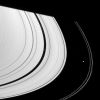
The_Rings-PIA08985.jpgMoons...57 visiteCaption NASA:"The effects of three of Saturn's Ring Moons can be spotted in this single narrow-angle camera view.
The image has been strongly enhanced to better show the wakes on both sides of the Encke Gap caused by Pan (left of center), as well as a hint of the edge waves in the narrow Keeler Gap caused by Daphnis (just below center).
Bright Prometheus (on the right) pulls away from its latest close encounter with the F-Ring. The aftereffects of its recent passes are visible in the Ring's inner edge.
This view looks toward the unilluminated side of the Rings from about 10° above the Ping-Plane.
Saturn's shadow cuts across the Rings at the top of the scene.
The image was taken in visible light with the Cassini spacecraft narrow-angle camera on June 5, 2007 at a distance of approx. 2,3 MKM (about 1,4 MMs) from Pan.
Image scale is about 13 Km (approx. 8 miles) per pixel".MareKromiumLug 19, 2007
|
|

Rhea-PIA08986.jpgRhea, in the Saturnshine (natural colors - elab. Lunexit)67 visiteCaption NASA:"The night side of Rhea shines softly in reflected light from Saturn. A similar effect, called Earthshine, can often be seen dimly illuminating the dark side Earth's Moon.
Background stars make short, dim trails across the black sky. The sunlit terrain on Rhea is so much brighter than the part lit by Saturn that the former is completely overexposed in this view, which took more than 30" to acquire.
This view looks toward the Leading Hemisphere on Rhea. North is up and rotated 28° to the left.
The image was taken in visible light with the Cassini spacecraft narrow-angle camera on June 11, 2007. The view was obtained at a distance of approx. 364.000 Km (such as about 226.000 miles) from Rhea and at a Sun-Rhea-spacecraft, or phase, angle of 154°. Image scale is roughly 4 Km (about 3 miles) per pixel".MareKromiumLug 19, 2007
|
|

Saturn-PIA08983.jpgSpokes!60 visiteCaption NASA:"The Cassini Spacecraft spies multiple spokes in Saturn's outer B-Ring. The precise origin and evolution of these transient features continue to provide Ring Scientists with intriguing puzzles to solve.
Most of these spokes are about 4000 Km long; the 2 near the bottom of the scene are about 1000 Km (about 600 miles) wide.
This view looks toward the unilluminated side of the Rings from about 8° above the Ring-Plane.
The image was taken in visible green light with the Cassini spacecraft narrow-angle camera on June 2, 2007. The view was acquired at a distance of approx. 2,2 MKM (such as about 1,4 MMs) from Saturn.
Image scale is roughly 13 Km (about 8 miles) per pixel".MareKromiumLug 14, 2007
|
|

Saturn-PIA08982.jpgIn the Night...68 visiteCaption NASA:"Graceful giant Saturn poses with a few of the small Worlds it holds close. From this viewpoint the Cassini Spacecraft can see across the entirety of the Planet's shadow on the Rings, to where the Ring-Plane emerges once again into Sunlight.
Tethys shines large and bright near the bottom of the scene. Pandora sits outside the F-Ring, below center. Epimetheus is a speck on the far side of the Ring-Plane, immediately to the right of Saturn's limb. Most of the other bright specks near the Rings are background stars.
This view looks toward the unilluminated side of the Rings from about 8° above the Ring-Plane. The image has been brightened to enhance the appearance of the small moons.
The image was taken with the Cassini spacecraft wide-angle camera on June 2, 2007 using a spectral filter sensitive to wavelengths of infrared light centered at 918 nanometers.
The view was obtained at a distance of approx. 2,2 MKM (such as about 1,4 MMs) from Saturn.
Image scale is roughly 131 Km (about miles) per pixel".MareKromiumLug 13, 2007
|
|
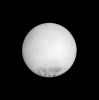
Enceladus-PIA08980.jpgThe South Polar "sulci" of Enceladus57 visiteCaption NASA:"Enceladus appears as a rather bland orb in this far-off snapshot, but the dark markings near its South Pole belie that assumption.
The markings, called "sulci", are long, roughly parallel fractures from which a spray of icy particles escapes into the void, forming Saturn's E-Ring.
This view looks toward the Saturn-facing Hemisphere on Enceladus. North is up.
The image was taken with the Cassini spacecraft narrow-angle camera on May 27, 2007 using a spectral filter sensitive to wavelengths of infrared light centered at 930 nanometers.
The view was acquired at a distance of approx. 615.000 Km (such as about 382.000 miles) from Enceladus and at a Sun-Enceladus-spacecraft, or phase, angle of 3°.
Image scale is roughly 4 Km (a little more than 2 miles) per pixel".MareKromiumLug 11, 2007
|
|
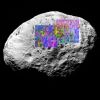
Hyperion-PIA09214.jpgWhat's all over Hyperion? (context image)67 visiteCaption NASA:"Hyperion, the eighth largest of Saturn's nearly 60 known moons, is covered in craters and landslides. Sprinkled over the icy surface is a thin layer of organic dust, which has somehow been concentrated in the bottoms of some of the craters, forming a reddish/black deposit.
This new color map shows the composition of a portion of Hyperion's surface determined with the Visual and Infrared Mapping Spectrometer aboard the Cassini spacecraft. The new composition map is overlaid onto a previously released Cassini image of Hyperion, taken with the Imaging Science Subsystem.
(...) Discovered in 1848, Hyperion held its secrets until the Cassini spacecraft flew close in September 2005, revealing its icy and organic composition.
Hyperion is irregular in shape, tumbles chaotically, and takes 21 days to orbit Saturn. It is 300 Km (about 180 miles) in its longest dimension".MareKromiumLug 07, 2007
|
|

Hyperion-PIA09215.jpgWhat's all over Hyperion? (extra-detail mgnf)58 visiteCaption NASA:"This is a color map of the composition of a portion of Saturn's moon Hyperion's surface about 75 Km (approx. 45 miles) on a side.
In this map, blue shows the maximum exposure of Frozen Water (H2O), red denotes Carbon Dioxide (CO2) ice ("dry ice"), magenta indicates regions of Water plus CO2, yellow is a mix of CO2 and an unidentified material.
This map was made with data from the Visual and Infrared Mapping Spectrometer aboard the Cassini spacecraft during its flyby of Hyperion in September 2005".MareKromiumLug 07, 2007
|
|
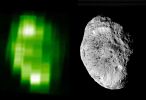
Hyperion-PIA09216.jpgCold Hyperion...59 visiteCaption NASA:"In this ultraviolet image of Hyperion, produced using data taken with Cassini's Ultraviolet Imaging Spectrograph during the September 2005 close flyby, brightness contrasts are due to both topographic and compositional variations across the surface. The brightest regions are exposed water ice in the rim of the crater that dominates the hemisphere in view.
This new ultraviolet map (left) is shown next to a previously released image (right) taken by the Imaging Science Subsystem".MareKromiumLug 07, 2007
|
|

Enceladus-N00085404.jpgEnceladus (natural colors - elab. Lunexit)56 visiteCaption NASA:"N00085404.jpg was taken on June 28, 2007 and received on Earth June 29, 2007. The camera was pointing toward Enceladus that, at the time, was approx. 293.794 Km away.
This image was taken using the BL1 and CL2 filters and it has not been validated or calibrated".MareKromiumLug 04, 2007
|
|

Tethys-PIA08974-1.jpgTethys (natural colors - elab. Lunexit)59 visiteCaption NASA:"Ithaca Chasma rips across Tethys from North to South near the center of this view. The moon's western limb is flattened, indicating the rim of the giant impact basin Odysseus.
The dark, East-West trending band often observed in this region (see PIA07571) is just visible here, but its contrast is reversed at these short, ultraviolet wavelengths -- it is bright against the already bright terrain.
North on Tethys (1071 Km, or about 665 miles across) is up and rotated 24° to the left. This view looks toward the moon's Saturn-Facing Hemisphere.
The image was taken with the Cassini spacecraft narrow-angle camera on May 27, 2007 using a combination of spectral filters sensitive to wavelengths of light centered at 298 and 338 nanometers. The view was obtained at a distance of approx. 267.000 Km (about 166.000 miles) from Tethys and at a Sun-Tethys-spacecraft, or phase, angle of 13°.
Image scale is roughly 2 Km (5.236 feet) per pixel".MareKromiumLug 02, 2007
|
|
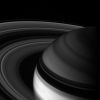
Saturn-PIA08973.jpgIR Saturn57 visiteCaption NASA:"Cassini looks toward Northern Latitudes on Saturn and out across the Ring-Plane.
This InfraRed (IR) view probes clouds beneath the hazes that obscure the Planet's depths in natural color views.
This image looks toward the unilluminated side of the Rings from about 24° above the Ring-Plane. The Rings' shadow drapes across the region North of the Planet's bright Equatorial Band.
The image was taken with the Cassini spacecraft wide-angle camera using a spectral filter sensitive to wavelengths of light centered at 890 nanometers. The view was acquired on May 24, 2007 at a distance of approx. 1,5 MKM (such as about 1 MMs) from Saturn.
Image scale is roughly 89 Km (55 miles) per pixel".MareKromiumLug 02, 2007
|
|

Enceladus-N00085255.jpgEnceladus (1) - (natural colors - elab. Lunexit)56 visiteCaption NASA:"N00085255.jpg was taken on June 28, 2007 and received on Earth June 29, 2007. The camera was pointing toward Enceladus that, at the time, was approx. 287.050 Km away. The image was taken using the CL1 and CL2 filters.
This image has not been validated or calibrated".MareKromiumLug 01, 2007
|
|
| 2245 immagini su 188 pagina(e) |
 |
|
|
|
|
78 | |
|
|
|
|





