| Ultimi arrivi - Saturn: the "Ringed Beauty" and His Moons |
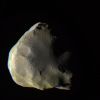
Helene-N00172877_78_79.jpgHelene (RAW Natural Colors; credits for the additional process. and color.: Dr Marco Faccin - Lunexit Team)217 visitenessun commentoMareKromiumGiu 22, 2011
|
|

Helene-N00172899_900.jpgHelene (High-Def-3D; credits for the additional process.: Dr Marco Faccin - Lunexit Team)206 visitenessun commentoMareKromiumGiu 22, 2011
|
|

Rhea-PIA12768-PCF-LXTT.jpgIntersecting Lineae on Rhea (Enhanced Natural Colors; credits for the additional process. and color: Dr Paolo C. Fienga - Lunexit Team)224 visiteCaption NASA:"Thin Lineaments cross back and forth on the Surface of Saturn's moon Rhea in this Equatorial View. These Lines can be seen intersecting Craters on Rhea. This view is centered on Terrain at about 0° Latitude and approx. 165° West Longitude.
The image was taken in Visible Light with the Cassini Spacecraft narrow-angle camera on Jan. 11, 2011. The view was acquired at a distance of approx. 41.000 Km (such as 25.461 miles) from Rhea and at a Sun-Rhea-Spacecraft, or Phase, Angle of 15°. Image scale is roughly 238 meters (781 feet) per pixel".MareKromiumGiu 03, 2011
|
|

Enceladus-PIA12765-PCF-LXTT-NASA.jpgThe Surface of Enceladus (Left Side: Absolute Natural Colors; credits for the additional process. and color.: Dr Paolo C. Fienga - Lunexit Team; Right Side: RAW Frame; credits: NASA/JPL Space Science Institute)337 visiteCaption NASA:"The Cassini Spacecraft surveys the surface of Saturn's moon Enceladus in this image, which shows newly Created Terrain in the upper right meeting older, Cratered Terrain in the lower left.
This view is centered on terrain at about 5° South Latitude and 200° West Longitude.
The image was taken in Visible Light with the Cassini Spacecraft narrow-angle camera on Dec. 21, 2010. The view was acquired at a distance of approx. 25.000 Km (such as 15.525 miles) from Enceladus and at a Sun-Enceladus-Spacecraft, or Phase, Angle of 14°. Image scale is roughly 148 meters (486 feet) per pixel".MareKromiumMag 26, 2011
|
|

Japetus-N00091967-PCF-LXTT.jpgMountains and Craters of Japetus: proximities of the Transition Zone (Absolute Natural Colors; elab. by Dr Paolo C. Fienga - Lunexit Team) 244 visitenessun commentoMareKromiumMag 24, 2011
|
|

Japetus-W00035193-PCF-LXTT.jpgOver the "Equatorial Ridge" (Absolute Natural Colors; credits for the additional process. and color.: Dr Paolo C. Fienga - Lunexit Team)242 visiteCaption NASA:"W00035193.jpg was taken on September 10, 2007 and received on Earth September 11, 2007. The camera was pointing toward Japetus that, at the time, was approximately 2084 Km away, and the image was taken using the CL1 and CL2 filters. This image has not been validated or calibrated". MareKromiumMag 24, 2011
|
|

Saturn-PIA14119.jpgLarge Ammonia Crystals in Saturn Storm (False Colors; credits: NASA/JPL-University of Arizona)64 visiteCaption NASA:"This false-color InfraRed image, obtained by NASA's Cassini Spacecraft, shows clouds of large Ammonia ice particles dredged up by a powerful storm in Saturn's Northern Hemisphere. Large updrafts dragged Ammonia gas upward more than 30 miles (approx. 50 Km) from below. The Ammonia then condensed into large crystals in the frigid Upper Atmosphere. This storm is the most violent ever observed at Saturn by an orbiting Spacecraft.
Cassini's Visual and InfraRed Mapping Spectrometer obtained these images on Feb. 24, 2011. Scientists colorized the image by assigning red to brightness detected from the 4.08-micron wavelength, green to brightness from the 0.90-micron wavelength, and blue to brightness from the 2.73-micron wavelength. Large particles (red) reflect Sunlight well at 4.08 microns. Particles at high altitude (green) reflect Sunlight well at 0.9 microns. Particles comprised of Ammonia -- especially large ones -- do not reflect 2.73-micron sunlight well, but instead absorb light at this wavelength.
The storm here shows up as yellow, demonstrating that it has a large signal in both red and green colors. This indicates the cloud has large particles and extends upward to relatively high altitude. In addition, the lack of blue in the feature indicates that the storm cloud has a substantial component of Ammonia Crystals. The head of the storm is particularly rich in such particles, as created by powerful updrafts of Ammonia gas from depth in the throes of Saturn's thunderstorm".MareKromiumMag 20, 2011
|
|

The_Rings-PIA12766.jpgClump or Impact in the F-Ring96 visiteCaption NASA:"A bright Clump of material within Saturn's tenuous F-Ring stands out near the center top of this Cassini Spacecraft image. This view looks toward the southern, unilluminated side of the Rings from about 1° below the Ring-Plane.
The image was taken in Visible Light with the Cassini Spacecraft narrow-angle camera on Oct. 16, 2010. The view was acquired at a distance of approx. 320.000 Km (about 199.000 miles) from the F-Ring. Image scale is roughly 2 Km (1,242 mile) per pixel".MareKromiumMag 20, 2011
|
|

Enceladus-PIA12762-PCF-LXTT.jpgFountains of Light (Enhanced Natural Colors; credits for the additional process. and color.: Dr Paolo C. Fienga - Lunexit Team)147 visiteCaption NASA:"A crescent Enceladus, imaged from its night side, shows off spectacular Water Ice Plumes emanating from its South Polar Regions. This image was captured at a Phase, or Sun-Enceladus-Spacecraft, angle of 157° so that Sunlight would reveal the backlit Plumes. Terrain near the South Pole is now dark as Spring has come to the Northern Hemisphere of the Celestial Body. Lit Terrain seen here is on the Trailing Hemisphere of Enceladus. North is up.
The image was taken in Visible Light with the Cassini Spacecraft narrow-angle camera on Jan. 30, 2011. The view was obtained at a distance of approx. 228.000 Km(such as 141.588 miles) from Enceladus. Image scale is roghly 1 Km (0,621 miles) per pixel".MareKromiumMag 17, 2011
|
|

The_Rings-PIA12820.gifTilting Saturn's Rings (a Computer Animation by NASA/JPL/Cornell)157 visiteCaption NASA:"This animated graphic shows in a series of three images how Saturn's Rings, after they became tilted relative to Saturn's Equatorial Plane, would have transformed into a Corrugated Ring.
Images taken after Saturn's August 2009 equinox from NASA's Cassini Spacecraft revealed alternating light and dark bands extending from Saturn's D-Ring, completely across the C-Rg, and right up to the inner B-Rg Ege. These brightness variations are almost certainly caused by the changing slopes in the rippled Rng-Plane, much like the corrugations of a tin roof.
This series of images shows how such a vertical corrugation can be produced from an initially inclined ring by the natural tendency for inclined orbits to wobble systematically and slowly at different rates, depending on their distance from Saturn. The top image shows a simple inclined ring (the central planet is omitted for clarity), while the lower two images show the same ring at two later times, where the ring particles' wobbling orbits have sheared this inclined sheet into an increasingly tightly-wound spiral corrugation.
Cassini images show the corrugation extends for about 19.000 Km (11.799 miles). Based on detailed studies of this structure, scientists conclude that a broad swath of the Rings became suddenly tilted in the early 1980s, likely because Cometary Debris crashed into them.
The corrugation's radial extent implies that the impacting material was a dispersed cloud of debris instead of a single object. The corrugation's amplitude of about 2 to 20 meters (7 to 60 feet) indicates that the debris' total mass was around 1 Trillion Kg (or 1 Billion Metric Tons)".
MareKromiumApr 10, 2011
|
|

Saturnian_Lightnings-00.jpgSaturnian Storm and Lightnings (CTX Frame - credits: NASA/JPL/SSI)133 visiteA powerful lightning storm brewing in Saturn's atmosphere since January has become the solar system's longest continuously observed thunderstorm, astronomers have announced.
The storm breaks the record duration of 7,5 months set by another thunderstorm observed on Saturn by NASA's Cassini Spacecraft between November 2007 and July 2008. The current thunderstorm on Saturn is the ninth that has been measured since Cassini swung into orbit around Saturn in July 2004.
Lightning discharges in Saturn's Atmosphere emit very powerful radio waves, which are measured by the antennas and receivers of the Cassini Radio and Plasma Wave Science (RPWS) instrument. The radio waves are about 10.000 times stronger than their terrestrial counterparts and originate from huge thunderstorms in Saturn's Atmosphere with diameters of about 1900 miles (3057,746 Km).
The observations of this latest thunderstorm will be presented by Georg Fischer of the Austrian Academy of Sciences at the European Planetary Science Congress in Potsdam, Germany, on Sept. 15. "These lightning storms are not only astonishing for their power and longevity, the radio waves that they emit are also useful for studying Saturn's Ionosphere, the charged layer that surrounds the planet a few thousand kilometers above the cloud tops," Fischer said. "The radio waves have to cross the Ionosphere to get to Cassini and thereby act as a natural tool to probe the structure of the layer and the levels of ionization in different regions."
Results from Cassini's RPWS instrument have confirmed previous studies of the Voyager spacecraft indicating that levels of ionization are approx. 100 times higher on the day-side than the night side of Saturn's Ionosphere.
Lightning storms on Saturn usually occur in a region that nicknamed "Storm Alley" by scientists. The region lies 35° South of Saturn's Equator.
"The reason why we see lightning in this peculiar location is not completely clear," Fischer said. "It could be that this latitude is one of the few places in Saturn's Atmosphere that allow large-scale vertical convection of water clouds, which is necessary for thunderstorms to develop. However, it may be a seasonal effect. Voyager observed lightning storms near the Equator, so now that Saturn has passed its Equinox on Aug. 11, we may see the storms move back to Equatorial Latitudes."
The lightning's presence was confirmed in another way: During Cassini's last close flyby of Titan on Aug. 25, Cassini's view of Saturn was obscured by Titan for a half-hour, and no lightning was observed. "Although we know from Cassini images where Saturn lightning comes from, this unique event was another nice proof for their origin," Fischer also said.MareKromiumApr 01, 2011
|
|

Saturnian_Lightnings-01.jpgSaturnian Storm and Lightnings (EDM - credits: NASA/JPL/SSI)133 visiteA monster storm spawning bolts of lightning 10.000 times more powerful than any seen on Earth is raging on the Ringed Planet Saturn.
The powerful electrical storm cropped up in Saturn's Southern Hemisphere five months ago, when it was first spotted by NASA's Cassini Spacecraft, and has persevered to become the Planet's longest continuously recorded tempest to date.
"We saw similar storms in 2004 and 2006 that each lasted for nearly a month, but this storm is longer-lived by far, said Georg Fischer, an associate with Cassini's radio and plasma wave science team at the University of Iowa, Iowa City, in a statement. And it appeared after nearly two years during which we did not detect any electrical storm activity from Saturn."
Cassini's radio and plasma wave science instrument first picked up signals from the storm's lightning bursts on Nov. 27, 2007, with the probe's cameras catching their first visual glimpse on Dec. 6. Images of the storm show it as a smudge on Saturn's otherwise creamy cloud bands.
"The electrostatic radio outbursts have waxed and waned in intensity for five months now," Fischer said.
Electrical storms on Saturn are similar to thunderstorms on Earth, but much larger. They can span thousands of miles and generate radio bursts from lightning that can be thousands of times more powerful than Earthly lightning bolts, said mission scientists, who named a massive lightning storm in 2004 "Dragon".
The current electrical tempest is mired in a region of Saturn that mission scientists have dubbed "Storm Alley" because of its frequent and intense storms. Every few seconds the storm belches intense radio pulses consistent with lightning that can be detected even when the weather itself is over the horizon and out of direct view from Cassini.
Researchers hope that by tracking the Saturnian weather, they may gain new insights into the processes behind the Planet's lightning, as well as how it changes as the seasons shift from Summer to Autumn in Saturn's Southern Hemisphere.
In order to see the storm, the imaging cameras have to be looking at the right place at the right time, and whenever our cameras see the storm, the radio outbursts are there," said Ulyana Dyudina, a Cassini imaging team associate at the California Institute of Technology in Pasadena, Calif.
Cassini's onboard instruments have tracked the storm every 10 hours and 40 minutes, when Saturn's rotation brings it into view, though amateur astronomers are also watching over the tempest from Earth.
"Since Cassini's camera cannot track the storm every day, the amateur data are invaluable," said Fischer. "I am in continuous contact with astronomers from around the world."
Launched in 1997, Cassini arrived at Saturn in 2004 and has spotted a series of odd storms while studying the Ringed Planet and its many moons. The probe has captured views of a hurricane-like storm near the South Pole of Saturn and recorded a massive lightning storm about 2175 miles wide (3500,3145 Km) wide in 2006.MareKromiumApr 01, 2011
|
|
| 2245 immagini su 188 pagina(e) |
 |
|
|
|
|
7 | |
|
|
|
|





