| Ultimi arrivi - Saturn: the "Ringed Beauty" and His Moons |

Japetus-PIA08376-2.jpgRising Japetus (possible natural colors - elab. Lunexit)56 visitenessun commentoMareKromiumOtt 10, 2007
|
|

Japetus-PIA08384-1.jpgThe Other Side of Japetus (false colors - elab. NASA)58 visiteCassini captures the first high-resolution glimpse of the bright trailing hemisphere of Saturn's moon Iapetus.
This false-color mosaic shows the entire hemisphere of Iapetus (1,468 kilometers, or 912 miles across) visible from Cassini on the outbound leg of its encounter with the two-toned moon in Sept. 2007. The central longitude of the trailing hemisphere is 24 degrees to the left of the mosaic's center.
Also shown here is the complicated transition region between the dark leading and bright trailing hemispheres. This region, visible along the right side of the image, was observed in many of the images acquired by Cassini near closest approach during the encounter.
Revealed here for the first time in detail are the geologic structures that mark the trailing hemisphere. The region appears heavily cratered, particularly in the north and south polar regions. Near the top of the mosaic, numerous impact features visible in NASA Voyager 2 spacecraft images (acquired in 1981) are visible, including the craters Ogier and Charlemagne.
The most prominent topographic feature in this view, in the bottom half of the mosaic, is a 450-kilometer (280-mile) wide impact basin, one of at least nine such large basins on Iapetus. In fact, the basin overlaps an older, similar-sized impact basin to its southeast.
In many places, the dark material -- thought to be composed of nitrogen-bearing organic compounds called cyanides, hydrated minerals and other carbonaceous minerals -- appears to coat equator-facing slopes and crater floors. The distribution of this material and variations in the color of the bright material across the trailing hemisphere will be crucial clues to understanding the origin of Iapetus' peculiar bright-dark dual personality.
The view was acquired with the Cassini spacecraft narrow-angle camera on Sept. 10, 2007, at a distance of about 73,000 kilometers (45,000 miles) from Iapetus.
The color seen in this view represents an expansion of the wavelengths of the electromagnetic spectrum visible to human eyes. The intense reddish-brown hue of the dark material is far less pronounced in true color images. The use of enhanced color makes the reddish character of the dark material more visible than it would be to the naked eye.
This mosaic consists of 60 images covering 15 footprints across the surface of Iapetus. The view is an orthographic projection centered on 10.8 degrees south latitude, 246.5 degrees west longitude and has a resolution of 426 meters (0.26 miles) per pixel. An orthographic view is most like the view seen by a distant observer looking through a telescope.
At each footprint, a full resolution clear filter image was combined with half-resolution images taken with infrared, green and ultraviolet spectral filters (centered at 752, 568 and 338 nanometers, respectively) to create this full-resolution false color mosaic.
MareKromiumOtt 10, 2007
|
|
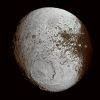
Japetus-PIA08384-2.jpgThe Other Side of Japetus (possible natural colors; elab. Lunexit)58 visitenessun commentoMareKromiumOtt 10, 2007
|
|

Enceladus-N00093658.jpgFountains in the Darkness...57 visitenessun commentoMareKromiumOtt 01, 2007
|
|
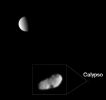
Tethys_and_Calypso-PIA09735.jpgTethys and Calypso57 visiteCaption NASA:"Two companion moons share the sky before the Cassini Spacecraft. Tethys is seen here with one of its two Trojan moons. Calypso, which trails the larger moon in its orbit by 60°, is a couple of pixels across near lower right. Telesto (not pictured) is the other Tethys co-orbital moon, leading Tethys by 60°.
The image was taken in visible light with the Cassini spacecraft narrow-angle camera on Aug. 25, 2007. The view was obtained at a distance of approx. 2,2 MKM (about 1,4 MMs) from Tethys.
Image scale is roughly 13 Km (about 8 miles) per pixel on Tethys".MareKromiumSet 28, 2007
|
|

Tethys-PIA09737.jpgCrescent Tethys56 visiteCaption NASA:"The pockmarked crescent of Tethys displays slightly darker terrain in a band at its Equator. The rim of the great crater Odysseus lurks on the Terminator.
Lit terrain seen here is on the Leading Hemisphere of Tethys. North is up.
The image was taken in visible light with the Cassini spacecraft wide-angle camera on Aug. 29, 2007. The view was obtained at a distance of approx. 56.000 Km (such as about 35.000 miles) from Tethys and at a Sun-Tethys-spacecraft, or phase, angle of 105°.
Image scale is roughly 3 Km (about 2 miles) per pixel".MareKromiumSet 28, 2007
|
|

Saturn-PIA09734.jpgTurbulences58 visiteCaption NASA:"The Cassini Spacecraft has a peek beneath the hazes in Saturn's Upper Atmosphere at the swirling vortices that lurk below.
Many vortices can be seen in this image, varying in size from small to large.
The largest one in this image exhibits a collar of bright clouds surrounding the central dark core.
The view is centered on a region about 46° South of the Planet's Equator.
The image was taken with the Cassini spacecraft narrow-angle camera on Aug. 12, 2007 using a spectral filter sensitive to wavelengths of infrared light centered at 750 nanometers. The view was acquired at a distance of approx. 4,1 MKM (such as about 2,5 MMs) from Saturn.
Image scale is roughly 24 Km (about 15 miles) per pixel".MareKromiumSet 26, 2007
|
|

Saturn-N00092694.jpgSaturnian Turbulence (Enhanced Natural Colors; credits for the additional process. and color.: Dr Paolo C. Fienga - Lunexit Team)59 visiten.a.d.MareKromiumSet 21, 2007
|
|

Japetus-Orbit-00.jpgSide view of Japetus's orbit71 visiteThe orbit of Japetus is somewhat unusual. Although it is Saturn's third-largest moon, it orbits much farther from Saturn than the next closest major moon, Titan. It has also the most inclined Orbital Plane of the regular satellites; only the irregular outer satellites like Phoebe have more inclined orbits. The cause of this is unknown.
Because of this distant, inclined orbit, Japetus is the only large moon from which the Rings of Saturn would be clearly visible; from the other inner moons, the Rings would be edge-on and difficult to see.MareKromiumSet 16, 2007
|
|

Japetus-Orbit-01.jpgPolar view of Japetus's orbit57 visitenessun commentoMareKromiumSet 16, 2007
|
|

Japetus-PIA08375.jpgThe "Voyager" Mountains57 visiteCaption NASA:"Cassini zooms in, for the first time, on the patchy, bright and dark mountains originally identified in images from the NASA Voyager spacecraft taken more than 25 years earlier. The image was acquired during Cassini's only close flyby of Iapetus, a two-toned moon of Saturn.
The terrain seen here is located on the Equator of Japetus at approximately 199° West Longitude, in the Transition Region between the moon's bright and dark Hemispheres. North is up.
The image was taken on Sept. 10, 2007, with the Cassini spacecraft narrow-angle camera at a distance of approximately 9.240 Km (5.740 miles) from Japetus. Image scale is 55 meters (180 feet) per pixel".MareKromiumSet 15, 2007
|
|
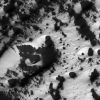
Japetus-PIA08373.jpgThe "Transition Region" of Japetus: Coated Craters59 visiteCaption NASA:"Cassini surveys a bright landscape coated by dark material on Iapetus. This image shows terrain in the Transition Region between the moon's dark Leading Hemisphere and its bright Trailing Hemisphere. The view was acquired during Cassini's only close flyby of the two-toned Saturn moon.
The image was taken on Sept. 10, 2007, with the Cassini spacecraft narrow-angle camera at a distance of approximately 5.260 Km (3.270 miles) from Japetus. Image scale is 32 meters (105 feet) per pixel".MareKromiumSet 15, 2007
|
|
| 2245 immagini su 188 pagina(e) |
 |
|
|
|
|
69 | |
|
|
|
|





