| |

| Ultimi arrivi - Saturn: the "Ringed Beauty" and His Moons |
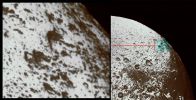
Japetus-SquaredTerrain.jpgSquares on Japetus?58 visiteUno splendido, inquietante ed...illusorio profilo individuato dal sempre bravissimo Marco Faccin. Strutture squadrate su Giapeto? Evidenze di "artificialità"?...
Ovviamente no: questo frame (e relativo detail mgnf) rappresentano solo un modo per vedere - e per far vedere! - come, volendo, si possono trovare "strutture regolari" su altri Corpi Celesti.
Illusioni determinate dalla distanza, dall'angolo di ripresa, dalla qualità del frame e dalla voglia di vedere "segni tangibili di intelligenza (passata o presente) altrove": trovare queste strutture (che appartengono alla Classe delle Strutture "Effimere") è un gioco; evidenziarle è una curiosità; spiegarle per quello che sono (senza costruirci sopra delle eso-archeo-baggianate) è, secondo noi, un dovere.
Un grazie di cuore (ed un grande BRAVO!) al Dr Faccin per aver individuato un dettaglio (comunque) intrigante e per lo spunto di riflessione che, con esso, ci ha voluto dare.MareKromiumOtt 14, 2007
|
|

Japetus-N00091967-1.jpgImage-Artifact or a New Tower on Japetus?58 visiteUn nuovo e bellissimo esempio di quanto sia importante avere degli Amici Lettori i quali non si limitano a "guardare", ma che "cercano": in questo frame CASSINI, infatti, il bravissimo Antonio Fedele ha individuato due dettagli sui quali ha chiesto il nostro parere. Ebbene, se il dettaglio visibile sulla Dx del frame è, a nostro avviso, la traccia di un semplice Raggio Cosmico, il dettaglio di Sx è MOLTO più intrigante!
Osservate bene: nel frame originale NASA in b/n, la carenza di contrasto e la scarsa raffinazione del frame non permettevano grandi osservazioni; ma nel frame risultante da nostro coloring ed additional processing, il Sig. Fedele ha visto qualcosa che a noi era completamente sfuggita: ha visto un qualcosa che sembra essere una sorta di "Torre". Noi, allora, abbiamo ripreso il frame originale e tentato una verifica: ebbene la "Torre" non è il prodotto del nostro additional processing: essa, infatti, era già (sia pure solo appena) visibile nel frame di partenza.
Che cos'è? E' il Secondo Monolito di Giapeto (il primo venne individuato, ci pare, dal Prof. Hoagland, qualche anno fa)?
E' una Struttura Colonnare affine alle Blair Cuspids? E' qualcosa di simile al Monolito di Phobos? O forse è una Struttura Effimera o, magari, solo un image-artifact?
A noi non sembra un image-artifact (anche se non possiamo escluderlo al 100%). Poi, per quanto attiene la natura di questo (se reale) incredibile rilievo Giapetiano, non ci sentiamo di esprimerci: abbiate pazienza, ma gli elementi che abbiamo sono davvero troppo pochi e l'immagine, in sè, non è sufficiente per risolvere i nostri dubbi.
Un GRANDE complimento al Sig. Fedele e, per il resto, provate Voi stessi a guardare, analizzare e speculare...Se volete. Noi siamo qui, per condividere e commentare le Vostre (eventuali) scoperte!MareKromiumOtt 12, 2007
|
|

Enceladus-PIA08385.jpgThe sources of Enceladus' Fountains60 visiteCaption NASA:"This map of the South Polar Region of Enceladus shows the correlation between jet sources identified in Cassini imaging data and hot spots on the surface located by the Composite Infrared Spectrometer Instrument.
To identify jet source locations on the surface, imaging scientists carefully measured the locations and orientations of individual jets observed along the moon's limb in Cassini images taken from multiple viewing angles. For each jet measurement, the researchers then computed a curve, or ground track, on the surface of Enceladus along which that jet might lie. The ground tracks from all of the measurements made in the various images produced many intersections on this map. By considering the jet directions at every possible intersection, the researchers isolated 8 clusters of ground track intersections as jet sources.
The 8 identified jet source locations are labeled with yellow roman numerals. Composite Infrared Spectrometer hot spots are red boxes labeled with green capital letters.
The line-of-sight intersections indicating the measurements of each source in individual images are shown as colored diamonds.
White circles indicate the uncertainty in the locations of those sets of intersections.
The map is a polar stereographic projection of Cassini imaging data.
The 4 Tiger Stripe fractures, or sulci, are labeled here.
The South Pole is the dead center on the map.
Key longitudes are also labeled around the perimeter of the map".MareKromiumOtt 12, 2007
|
|

Enceladus-PIA08386.jpgThe Blue Fountains of Enceladus (false colors; elab. NASA)66 visiteThis false-color view was created by combining 3 clear filter images taken at nearly the same time of PIA07759. This image product was then specially processed to enhance the individual jets that compose the plume (while PIA07759 was instead processed to reveal subtleties in the brightness of the overall plume that comprises the jets).
Some artifacts due to the processing are present in the image. The final product was colored as blue for dramatic effect.
The images were acquired with the Cassini spacecraft narrow-angle camera on Nov. 27, 2005 at a distance of approx. 148.000 Km (about 92.000 miles) from Enceladus and at a Sun-Enceladus-Spacecraft, or phase, angle of 161°.
Scale in the original images is about 880 meters (0,5 mile) per pixel.
This view has been magnified by a factor of two from the original images".MareKromiumOtt 12, 2007
|
|

Enceladus-N00093896.jpgThe Gem in the Sky of Saturn... (possible true colors; elab. Lunexit)56 visiteE così come è stato per Marte ed il Paving di Victoria Crater, oggi abbiamo il piacere e l'onore di proporVi quella che - ovviamente a nostro parere - riteniamo essere la migliore interpretazione dei Colori (e delle sfumature...) di Encelado: un'autentica Gemma di Neve che splende nel Cielo di Saturno.
Attendiamo i Vostri commenti!MareKromiumOtt 10, 2007
|
|

Enceladus-N00093907.jpgThe Gem in the Sky of Saturn... (possible true colors; elab. Lunexit)57 visitenessun commentoMareKromiumOtt 10, 2007
|
|

Japetus-PIA08378.jpgSo close, and yet so far...59 visiteThis mosaic of Cassini images shows the smallest details ever observed on Saturn's moon Japetus.
Visible here are small craters as well as the base of a large mountain ridge located just South of the mosaic. At several places, bright spots about 20 to 50 meters (66 to 164 feet) across are visible. At these locations, more recent impactors have punched through the overlying blanket of dark material to reveal brighter, cleaner ice beneath.
Since the bright craters are relatively small and very shallow, it is likely that the dark blanket is rather thin in this area; it is assumed that its actual average thickness might be on the order of a foot.
The small crater at the upper left edge of the mosaic has a diameter of about 50 meters (164 feet) and shows a distinct ray pattern from excavated ice. This feature is so bright in comparison to the dark surrounding terrain that it had to be darkened manually so as not to look overexposed in this mosaic.
The mosaic consists of 8 image footprints across the surface of Japetus, presented here in simple cylindrical projection. The view is centered on terrain near 0° North Latitude, 164,9° West Longitude, within the dark Leading Hemisphere of Japetus. Image scale is approx. 10 meters (33 feet) per pixel.
The clear spectral filter images in this mosaic were obtained with the Cassini spacecraft narrow-angle camera on Sept. 10, 2007, at distances ranging from 1.627 to 2.040 Km (such as from about 1.011 to 1.268 miles) from Japetus.MareKromiumOtt 10, 2007
|
|
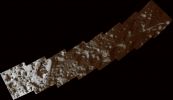
Japetus-PIA08380.jpgThe "Transition Region of Japetus" (possible natural colors - elab. Lunexit)56 visiteSoaring above the alien, icy wastelands of Saturn's moon Japetus, NASA's Cassini spacecraft captured a series of HR images of the Transition Region from dark to bright terrain at Southern Middle Latitudes that have been mosaicked together in this view.
An important characteristic of the terrain in the boundary region is that the isolated bright patches are mainly found on slopes facing toward the bright Trailing Hemisphere or toward the South Pole. The same polarity is found within the bright terrain, where the dark material can be seen at the bottom of craters and on Equator-facing slopes. These indicate that thermal effects are at play in painting the surface of Japetus.
The mosaic consists of 8 image footprints across the surface of Japetus. The view is centered on terrain near 38,6° South Latitude, 171,3° West Longitude. Image scale is approx. 52 meters (171 feet) per pixel.
The clear spectral filter images in this mosaic were obtained with the Cassini spacecraft narrow- angle camera on Sept. 10, 2007, at a distance of approx. 5,000 Km (about 3.100 miles) from Japetus.
MareKromiumOtt 10, 2007
|
|

Japetus-PIA08382.jpgJapetus' Spots (HR - possible natural colors; elab. Lunexit)59 visiteAt high resolution, terrain in the Transition Region between bright and dark Hemispheres on Saturn's moon Japetus reveals a spotty appearance reminiscent of a Dalmatian. The bright material on the frozen surface of Iapetus is water ice, and the dark material is likely carbonaceous in composition.
The dark material is preferentially found at the bottoms of craters. Bright water ice forms the "bed rock" on Japetus, while the dark, presumably loose material apparently lies on top of the ice (the terrain seen here is also visible in PIA08383, but it is viewed here at higher resolution).
The mosaic consists of 2 image footprints across the surface of Japetus. The view is centered on terrain near 42° South Latitude and 209,3° West Longitude, on the anti-Saturn facing Hemisphere. Image scale is approx. 32 meters (105 feet) per pixel.
The clear spectral filter images in this mosaic were obtained with the Cassini spacecraft narrow-angle camera on Sept. 10, 2007, at distances ranging from 5.363 to 5.884 Km from Japetus.MareKromiumOtt 10, 2007
|
|

Japetus-PIA08377.jpgCraterland... (HR - possible natural colors; elab. Lunexit)57 visiteThis HR view shows a vast range of crater sizes in the dark terrain of the Leading Hemisphere of Saturn's moon Japetus.
Across the scene, a few small bright spots indicate fresh, rayed craters where impactors have punched through the thin blanket of dark material to the cleaner ice beneath.
The slight elevation on the bottom half of the image is part of the giant Equatorial Ridge that spans a wide fraction of Japetus' circumference. The numerous craters on top of the ridge indicate that it is an old surface feature.
The mosaic consists of three image footprints across the surface of Japetus.
The view is centered on terrain near 0,5° North Latitude and 141,6° West Long.
Image scale is approx. 22 meters (72 feet) per pixel. Illumination is from the left.
The clear spectral filter images in this mosaic were obtained with the Cassini spacecraft narrow-angle camera on Sept. 10, 2007, at a distance of approx. 63.000 Km (such as about 39.000 miles) from Japetus and at a phase angle of about 125°.MareKromiumOtt 10, 2007
|
|

Japetus-PIA08381.jpgThe "Transition Region of Japetus" (possible natural colors - elab. Lunexit)60 visiteThe Transition Region from Saturn's moon Japetus' dark Leading Hemisphere to its bright Trailing Hemisphere is a complicated patchwork of craters and highlands, with low elevations filled in by dark material.
An explanation of the pattern visible here might be key to a full understanding of the bright/dark dichotomy on Japetus (about 1468 Km across).
The view is centered on the Equator and covers an area 711 Km wide by 417 Km tall (such as about 442 x 259 miles).
The giant Equatorial Ridge visible on the dark Leading Hemisphere is not present anymore in this Region. Instead, large, isolated mountains more than 10 Km tall are spread along the Equator. These mountains show bright western flanks, while the surrounding lowlands are generally dark.
This mosaic is an orthographic projection consisting of 21 image footprints across the surface of Japetus. The view is centered on terrain near 0,1° North Latitude and 199° West Longitude, in the quadrant of Japetus that faces away from Saturn. Image scale is approx. 83 meters (272 feet) per pixel. An orthographic view is most like the view seen by a distant observer looking through a telescope.
The clear spectral filter images in this mosaic were obtained with the Cassini spacecraft narrow- angle camera on Sept. 10, 2007, at distances ranging from 13.857 to 21.846 Km (such as about 8.610 to 13.574 miles) from Japetus.
MareKromiumOtt 10, 2007
|
|

Japetus-PIA08376-1.jpgRising Japetus (false colors - elab. NASA)58 visiteThe slim crescent of Iapetus looms before the Cassini spacecraft as it approaches the mysterious moon.
Iapetus, 1,468 kilometers (912 miles) across, seen here in false color, is unique in its dramatic variation in brightness between the northern polar region and the middle and low latitudes. Equally prominent is the moon's equatorial ridge of towering mountains. The profile of the ridge against the darkness of space reveals that it is topped by a cratered plateau approximately 15 kilometers (9 miles) wide. Further west, the profile of the ridge changes from a long plateau to discrete peaks.
The mosaic consists of four image footprints across the surface of Iapetus and has a resolution of 489 meters (0.3 miles) per pixel.
A full-resolution clear filter image was combined with half-resolution images taken with infrared, green and ultraviolet spectral filters (centered at 752, 568 and 338 nanometers, respectively) to create this full-resolution false color mosaic.
The color seen in this view represents an expansion of the wavelength region of the electromagnetic spectrum visible to human eyes. The intense reddish-brown hue of the dark material is far less pronounced in true color images. The use of enhanced color makes the reddish character of the dark material more visible than it would be to the naked eye. In addition, the scene has been brightened to improve the visibility of surface features.
This view was acquired with the Cassini spacecraft narrow-angle camera on Sept. 10, 2007, at a distance of about 83,000 kilometers (51,600 miles) from Iapetus.
MareKromiumOtt 10, 2007
|
|
| 2245 immagini su 188 pagina(e) |
|
|
|
|
|
68 | |
|
|
|
|
|
|





