| Ultimi arrivi - Saturn: the "Ringed Beauty" and His Moons |

Atlas_Pan-PIA08405.jpgJust like Flying Saucers: Atlas and Pan60 visiteCaption NASA:"These HR images of Pan and Atlas reveal distinctive "flying saucer" shapes created by prominent Equatorial Ridges not seen on the other small moons of Saturn.
From left to right: a view of Atlas' Trailing Hemisphere, with North up, at a spatial scale of about 1 Km (0,6 mile) per pixel; Atlas seen at about 250 meters (820 feet) per pixel from Mid-Southern Latitudes, with the Sub-Saturn Hemisphere at the top and Leading Hemisphere to the left; Pan's Trailing Hemisphere seen at about 3 Km (about 2 miles) per pixel from low Southern Latitudes; an Equatorial view, with Saturn in the background, of Pan's Anti-Saturn Hemisphere at about 1 Km (0.6 mile) per pixel.
On Atlas, the ridge extends 20 to 30° in latitude on either side of the Equator; on Pan, its latitudinal extent is 15 to 20°. Atlas shows more asymmetry than Pan in having a more rounded ridge in the Leading and Sub-Saturn Quadrants.
The heights of the Ridges can be crudely estimated by assuming (ellipsoidal) shapes that lack ridges and vary smoothly cross the Equator. Heights of Atlas' Ridge range from about 3 Km (about 2 miles) at 270° West Long. to 5 Km (approx. 3 miles) at 180 and 0°. Pan's Ridge reaches about 4 Km (about 2,5 miles) at 0° West Long. and is about 1,5 Km (0,9 mile) high over most of the rest of the Equator.
The ridges represent about 27% of Atlas' volume and 10% of Pan's volume.
The images were acquired with the Cassini Spacecraft narrow-angle camera between 2005 and 2007. Pan is about 33 Km (apprx. 20,5 miles) across at its Equator and about 21 Km (approx. 13 miles) across at its Poles; Atlas is 39 Km (such as about 24 miles) across at its Equator and 18 Km (approx. 11 miles) across at its Poles".MareKromiumDic 07, 2007
|
|
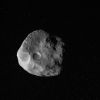
Epimetheus-N00098337.jpgEpimetheus (1)57 visiteCaption NASA:"N00098337.jpg was taken on December 03, 2007 and received on Earth December 04, 2007. The camera was pointing toward EPIMETHEUS that, at the time, was approx. 39.290 Km away, and the image was taken using the P120 and GRN filters.
This image has not been validated or calibrated".MareKromiumDic 06, 2007
|
|

Epimetheus-N00098342.jpgEpimetheus (2)55 visiteCaption NASA:"N00098342.jpg was taken on December 03, 2007 and received on Earth December 04, 2007. The camera was pointing toward EPIMETHEUS that, at the time, was approximately 40.388 Km away, and the image was taken using the RED and CL2 filters.
This image has not been validated or calibrated".MareKromiumDic 06, 2007
|
|
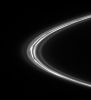
The_Rings-PIA09782.jpgPrometheus' Trail58 visiteCaption NASA:"Seen here is the end result of the process that occurs every time the moon Prometheus closely approaches Saturn's F-Ring. The moon cuts a dark channel in the ring's inner edge that then shears out over successive orbits, giving the inner edge of the ring the grooved appearance seen here.
This process is described in detail, along with a movie of Prometheus creating one of the streamer/channel features, in Soft Collision.
The view is toward the sunlit side of the Rings from about 3° below the Ring-Plane.
The image was taken in visible light with the Cassini spacecraft narrow-angle camera on Oct. 25, 2007. The view was acquired at a distance of approx. 624.000 Km (such as about 388000 miles) from Saturn and at a Sun-Ring-Spacecraft, or phase, angle of 23°.
Image scale is roughly 3 Km (about 2 miles) per pixel".MareKromiumNov 30, 2007
|
|
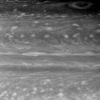
Saturn-PIA09778.jpgMonitoring the Maelstrom67 visiteCaption NASA:"Clouds and vortices churn in this beautiful, close-up view of Saturn. This image is part of a series of important Cassini observations designed to provide information about winds and convection on Saturn.
The view is centered on a Region 44° North of Saturn 's Equator.
The image was taken with the Cassini spacecraft narrow-angle camera on Nov. 7, 2007 using a spectral filter sensitive to wavelengths of infrared light centered at 750 nanometers. The view was acquired at a distance of approx. 2,9 MKM (such as about 1,8 MMs) from Saturn.
Image scale is roughly 17 Km (11 miles) per pixel".MareKromiumNov 26, 2007
|
|

Sky-N00097768.jpgStar-trail; moon-trail or in-transit UFO?59 visiteCaption NASA:"N00097768.jpg was taken on November 24, 2007 and received on Earth November 25, 2007. The camera was pointing toward JAPETUS that, at the time, was approx. 1.401.647 Km away, and the image was taken using the CL1 and IR1 filters. This image has not been validated or calibrated".MareKromiumNov 26, 2007
|
|
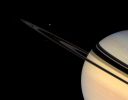
Saturn-PIA09776.jpgJust like the Solar System!58 visiteCaption NASA:"Saturn's icy satellites wheel about the colorful Giant Planet, while the Rings shine dimly in scattered sunlight. The Ringed Planet is, in many ways, a laboratory for investigating the history of our Solar System and how planets form around other stars. There are 4 moons visible in this view. Tethys (1071 Km, or 665 miles across), largest in the scene, is on the far side of the Ring-Plane. Mimas (397 Km, or 247 miles across), is the one on the near side of the Rings, below Tethys. Janus (181 Km, or 113 miles across), is left of the Rings' edge. Pandora (84 Km, or 52 miles across) is a speck below the Rings' edge, between Janus and Mimas. Mimas casts a shadow onto Saturn's bluish Northern Hemisphere.
This view looks toward the unilluminated side of the Rings from about 2° above the Ring-Plane. Images taken using red, green and blue spectral filters were combined to create this natural color view. The view was acquired with the Cassini spacecraft wide-angle camera on Oct. 30, 2007.
The view was taken at a distance of approx. 2,6 MKM (such as about 1,6 MMs) from Saturn.
Image scale is roughly 153 Km (about 95 miles) per pixel on the Planet".MareKromiumNov 22, 2007
|
|

Dione-PIA09772.jpgThe "Face" of Dione (HR)58 visiteCaption NASA:"Canyons slink southward on Dione, while bright-walled craters gleam in the Sun. (...) This view is centered on 9° North Latitude and 51° West Longitude.
North on Dione is up.
The image was taken in polarized green light with the Cassini spacecraft narrow-angle camera on Sept. 30, 2007. The view was acquired at a distance of approx. 197.000 Km (such as about 122.000 miles) from Dione and at phase angle of 25°.
Image scale is roughly 1 Km (about 0,6 mile) per pixel".MareKromiumNov 15, 2007
|
|
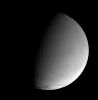
Enceladus-PIA09770.jpgThe "fresh" face of Enceladus60 visiteCaption NASA:"The Leading Hemisphere of Enceladus displays a remarkably fresh-looking surface in this recent Cassini view. At this resolution, only a few craters can be made out in this wrinkled region of the geologically active moon's surface.
A far more heavily cratered, and older, terrain region is visible to the North-West.
This view is centered on 15° North Latitude, 109° West Longitude.
North on Enceladus is up.
The image was taken in visible light with the Cassini spacecraft narrow-angle camera on Sept. 30, 2007. The view was acquired at a distance of approx. 108.000 Km (such as about 67.000 miles) from Enceladus and at a Sun-Enceladus-spacecraft, or phase, angle of 75°.
Image scale is roughly 646 meters (2.119 feet) per pixel".MareKromiumNov 14, 2007
|
|

Dione-PIA09764.jpgThe "spiderweb like" streaks on Dione62 visiteCaption NASA:"Bright, wispy fractures streak across Dione's trailing side. Following the Voyager flybys of the early 80s, scientists considered the possibility that the streaks were bright material extruded by cryovolcanism. A quarter-century later, Cassini's close passes and sharp vision showed these features to be a system of braided canyons with bright walls.
North on Dione is up.
The image was taken in visible light with the Cassini spacecraft wide-angle camera on Sept. 30, 2007. The view was acquired at a distance of approx. 45.000 Km (such as about 28.000 miles) from Dione and at a Sun-Dione-spacecraft, or phase, angle of 36°.
Image scale is roughly 3 Km (about 2 miles) per pixel".MareKromiumNov 08, 2007
|
|

Tethys-PIA09766.jpgThe "Dark Belt" of Tethys125 visiteCaption NASA:"Around the Equator on its Leading Side, Tethys wears a band of slightly darker surface material. Cassini Imaging Scientists suspect that the darkened region may represent an area of less contaminated ice with differently sized grains than the material at higher latitudes on either side of the band.
Lit terrain seen here is on the Saturn-facing side of Tethys. North is up. Part of the great canyon system Ithaca Chasma can be seen near the eastern limb in this frame-filling view.
The image was taken with the Cassini spacecraft narrow-angle camera on Sept. 30, 2007 using a spectral filter sensitive to wavelengths of infrared light centered at 930 nanometers. The view was acquired at a distance of approx. 186.000 Km (such as about 116.000 miles) from Tethys and at a Sun-Tethys-spacecraft, or phase, angle of 62°.
Image scale is roughly 1 Km (about 0,6 mile) per pixel".MareKromiumNov 08, 2007
|
|
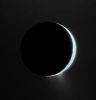
Enceladus-PIA09761.jpgThe "Fountains" of Enceladus (again)59 visiteCaption NASA:"With Enceladus nearly in front of the Sun from Cassini's viewpoint, its icy jets become clearly visible against the background.
The view here is roughly perpendicular to the direction of the linear "tiger stripe" fractures, or sulci, from which the jets emanate. The jets here provide the extra glow at the bottom of the moon. The general brightness of the sky around the moon is the diffuse glow of Saturn's E-Ring, which is an end product of the jets' material being spread into a "torus", or doughnut shape, around Saturn.
North on Enceladus is up and rotated 20° to the left.
The image was taken in visible light with the Cassini spacecraft narrow-angle camera on Sept. 30, 2007. The view was obtained at a distance of approx. 187.000 Km (such as about 116,000 miles) from Enceladus and at a Sun-Enceladus-spacecraft, or phase, angle of 157°.
Image scale is about 1 Km (apprx. 0,6 mile) per pixel".MareKromiumNov 07, 2007
|
|
| 2245 immagini su 188 pagina(e) |
 |
|
|
|
|
66 | |
|
|
|
|





