| Ultimi arrivi - Saturn: the "Ringed Beauty" and His Moons |

Epimetheus-PIA09813.jpgEpimetheus, from about 37.000 Km (enhanced - but natural - colors; credits: NASA)56 visiteCaption NASA:"The Cassini spacecraft's close flyby of Epimetheus in December 2007 returned detailed images of the moon's South Polar Region.
The view shows what might be the remains of a large impact crater covering most of this face, and which could be responsible for the somewhat flattened shape of the Southern part of Epimetheus (116 Km, or about 72 miles across) seen previously at much lower resolution.
The image also shows two terrain types: darker, smoother areas, and brighter, slightly more yellowish, fractured terrain. One interpretation of this image is that the darker material evidently moves down slopes, and probably has a lower ice content than the brighter material, which appears more like "bedrock". Nonetheless, materials in both terrains are likely to be rich in water ice. (...)".
MareKromiumGen 12, 2008
|
|

Dione-N00098970.jpgDione is missing a piece...57 visiteCaption NASA:"N00098970.jpg was taken on December 19, 2007 and received on Earth December 20, 2007. The camera was pointing toward DIONE that, at the time, was approximately 243.552 Km away, and the image was taken using the P60 and UV3 filters.
This image has not been validated or calibrated".MareKromiumDic 28, 2007
|
|

Dione-PIA09801.jpgWhite Scars...59 visiteCaption NASA:"The Cassini spacecraft catches a glimpse of the bright fractures that adorn the Trailing Side of icy Dione.
North on Dione (1126 kilometers, or about 700 miles across) is up.
The image was taken in visible light with the Cassini spacecraft narrow-angle camera on Nov. 18, 2007. The view was obtained at a distance of approx. 1 MKM (such as about 623.000 miles) from Dione and at a Sun-Dione-spacecraft, or phase, angle of 45°.
Image scale is roughly 6 Km (about 4 miles) per pixel".MareKromiumDic 28, 2007
|
|

Rhea-PIA09799.jpgRising Rhea (natural colors; credits: Lunexit)78 visiteCaption NASA:"The low illumination angle near the Terminator makes visible the steep topography of craters on Rhea's battered surface. This view is centered on 10° North Latitude, 128° West Longitude.
The image was taken in visible light with the Cassini spacecraft narrow-angle camera on Nov. 16, 2007. The view was obtained at a distance of approx. 313.000 Km (such as about 195.000 miles) from Rhea and at a Sun-Rhea-spacecraft, or phase, angle of 128°. Image scale is 2 Km (a little more than 1 mile) per pixel".MareKromiumDic 24, 2007
|
|
Saturn-PIA08394.jpgMoons... (natural colors; credits: NASA)59 visiteCaption NASA:"This colorful view, taken from edge-on with the Ring-Plane, contains 4 of Saturn's attendant moons. Tethys is seen against the black sky to the left of the Gas Giant's limb. Brilliant Enceladus sits against the Planet near right.
Irregular Hyperion is at the bottom of the image, near left. Much smaller Epimetheus is a speck below the Rings directly between Tethys and Enceladus. Epimetheus casts an equally tiny shadow onto the blue Northern Hemisphere, just above the thin shadow of the F-Ring.
Images taken using red, green and blue spectral filters were combined to create this natural color view. The images were acquired with the Cassini spacecraft wide-angle camera on July 24, 2007 at a distance of approx. 2 MKM (about 1,2 MMs) from Saturn. Image scale is 116 kilometers (72 miles) per pixel on Saturn".MareKromiumDic 24, 2007
|
|

Saturn-PIA08396.jpgSquashed and Colourful (natural colors; credits: NASA)59 visiteCaption NASA:"Saturn in the Cassini era has proved to be an unexpectedly colorful place, compared to the browns and golds imaged by the two Voyager spacecraft. Saturn is headed toward Equinox in 2009, followed by Springtime in the Northern Hemisphere. Having a spacecraft in orbit while such changes occur will be of great benefit in scientists' quest to understand the atmospheres of the Giant Planets.
The Planet's oblate, or squashed, shape is clearly visible in this view.
The low-density Planet rotates so fast (in about 10,5 hours) that it flattens out slightly around its middle. The bluish tint of the Northern Latitudes is presumed to be a seasonal effect and will likely disappear entirely as the North receives increasingly greater amounts of sunlight.
Images taken using red, green and blue spectral filters were combined to create this natural color view.
The images were obtained with the Cassini spacecraft wide-angle camera on July 29, 2007 at a distance of approx. 3,1 MKM (about 2 MMs) from Saturn"MareKromiumDic 24, 2007
|
|
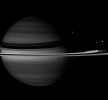
Saturn-PIA09795.jpgObscure Planet, Bright Moons... (IR)57 visiteCaption NASA:"Just before Rhea slipped behind Saturn, the Cassini Spacecraft captured the moon in its disappearing act.
Along with the partly obscured Rhea are Tethys, at right, and Enceladus, left of Tethys.
At the wavelength in which this image was taken, absorption of Sunlight by Methane gas in Saturn's Atmosphere is strong, causing the Planet to appear darker than at other wavelengths.
This view looks toward the unilluminated side of the Rings from about 4° above the Ring-Plane. The image was taken with the Cassini spacecraft wide-angle camera on Nov. 9, 2007 using a spectral filter sensitive to wavelengths of Infrared Light centered at 890 nanometers. The view was acquired at a distance of approx. 2,8 MKM (about 1,7 MMs) from Saturn and at a Sun-Saturn-spacecraft, or phase, angle of 44°.
Image scale is roughly162 Km (such as about 101 miles) per pixel".MareKromiumDic 23, 2007
|
|

Rhea-N00098758.jpgGibbous Rhea (natural colors; credits: Lunexit)58 visiteCaption NASA (relativa al frame di Sx):"Bright, wispy markings cover the Trailing Hemisphere of Rhea. The features are thought to be similar in nature to the bright, icy canyons seen on Dione.
North on Rhea is up and rotated 17° to the left.
The image was taken in visible green light with the Cassini spacecraft narrow-angle camera on July 22, 2007. The view was acquired at a distance of approx. 1,2 MKM (about 700.000 miles) from Rhea and at a Sun-Rhea-spacecraft, or phase, angle of 42°.
Image scale is roughly 7 Km (approx. 4 miles) per pixel".MareKromiumDic 22, 2007
|
|
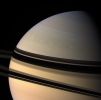
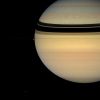
Saturn-PIA09793.jpgThe Northern Hemisphere of Saturn (natural colors; credits: NASA/Space Science Inst.)59 visiteCaption NASA:"Dark ring shadows adorn the Northern Hemisphere of Saturn.
The shadows have loosened their grip on the North compared to when Cassini arrived in 2004, and presently continue to slide farther South.
This view looks toward the unilluminated side of the rings from about 5° above the Ring-Plane. Images taken using red, green and blue spectral filters were combined to create this Natural Color View. The view was acquired with the Cassini spacecraft wide-angle camera on Oct. 22, 2007, at a distance of approx. 1,3 MKM (such as about 839.000 miles) from Saturn.
Image scale is roughly 77 Km (about 48 miles) per pixel".MareKromiumDic 15, 2007
|
|

Hyperion-PIA09790.jpgHyperion: the "Floating Column"58 visiteCaption NASA:"Saturn's irregularly shaped moon Hyperion is completely covered with large pits from which much of its material has been blasted by impacts, never to return. The moon's surface gravity is so low that crater-ejected material often escapes Hyperion entirely.
Hyperion is 280 Km (about 174 miles) across on average.
The image was taken in visible light with the Cassini spacecraft narrow-angle camera on Oct. 21, 2007. The view was obtained at a distance of approx. 151.000 Km (such as about 94.000 miles) from Hyperion and at a Sun-Hyperion-Spacecraft, or phase, angle of 111°.
Image scale is 906 meters (0,6 mile) per pixel".MareKromiumDic 14, 2007
|
|
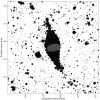
The_Rings-PIA10083.jpgFrom "Clump" to "Moonlet"62 visiteCaption NASA:"This is a computer simulation of the final stage of the growth of a "clump" in Saturn's Rings. The gravity from a hypothesized moonlet (solid gray sphere in frame center) has collected smaller ring particles (black) to form a temporary aggregation. The particles shown in the simulation are from centimeters to meters (su ch as inches to yards) across. The gray moonlet is 61 meters (200 feet) across". MareKromiumDic 13, 2007
|
|
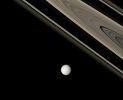
Tethys-PIA09788.jpgTrue Colors?56 visiteCaption NASA:"As seen from the side not illuminated by the Sun, Saturn's thinner Rings are highlighted in shades of brown and gold, contrasting with the more neutral appearance of the icy moon Tethys. The A-Ring and Cassini Division are separated by the optically thick B-Ring, which does not permit sunlight to penetrate and appears as the broad, dark lane between them in this view.
This view looks toward the anti-Saturn side of Tethys.
North is up and rotated 35° to the right.
The view looks toward the unilluminated side of the rings from about 2° above the Ring-Plane.
Images taken using red, green and blue spectral filters were combined to create this natural color view. The view was acquired with the Cassini spacecraft narrow-angle camera on Oct. 29, 2007, at a distance of approx. 2,1 MKM (about 1,3 MMs) from Tethys and at a Sun-Tethys-spacecraft, or phase, angle of 21°.
Image scale is roughly 12 kilometers (8 miles) per pixel".MareKromiumDic 08, 2007
|
|
| 2245 immagini su 188 pagina(e) |
 |
|
|
|
|
65 | |
|
|
|
|





