| |

| Ultimi arrivi - Saturn: the "Ringed Beauty" and His Moons |

Saturn_Titan-PIA09856.jpgFather and Son (natural colors; credits: NASA)57 visiteCaption NASA:"The Cassini Spacecraft captured this color portrait of Saturn and Titan only a few minutes before the haze-enshrouded moon slipped behind the planet's enormous bulk. The view looks toward the sunlit side of the Rings from about 5° below the Ring-Plane.
The Northern Hemisphere of Titan presently appears darker than the Southern, a feature presumed to be a seasonal effect.
Images taken using red, green and blue spectral filters were combined to create this natural color view. The images were acquired with the Cassini spacecraft wide-angle camera on Jan. 29, 2008 at a distance of approx. 2,3 MKM (such as about 1,4 MMs) from Titan and approx. 1 MKM (about 630.000 miles) from Saturn.
Image scale is roughly 135 Km (about 84 miles) per pixel on Titan and approx. 61 Km (about 38 miles) per pixel on Saturn".MareKromiumMar 12, 2008
|
|
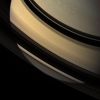
Saturn-PIA09854.jpgThe Southern Hemisphere of Saturn (natural colors - credits: NASA/SSI)59 visiteCaption NASA:"Saturn's Southern Hemisphere is glimpsed through the Gossamer Veil of its Rings. Ring shadows adorn the low Northern Latitudes.
This view looks toward the unilluminated side of the Rings from about 22° above the Ring-Plane. Images taken using red, green and blue spectral filters were combined to create this natural color view.
The images were acquired with the Cassini spacecraft wide-angle camera on Dec. 16, 2007 at a distance of approx. 1,5 MKM (about 908.000 miles) from Saturn.
Image scale is roughly 84 Km (approx. 52 miles) per pixel".MareKromiumMar 11, 2008
|
|

Rhea-PIA10246.jpgThe "IMPOSSIBLE" Rings of Rhea147 visiteLa notizia è di quelle che suscitano clamore e che hanno il "profumo" della Scoperta Epocale: dunque una luna di Saturno - Rhea - avrebbe un debole sistema di anelli che ruota attorno ad essa!
Meraviglia, ovviamente, alla prima lettura. ma poi...Poi subentra la riflessione. Una riflessione che ho condiviso con gli Amici del Forum di UFO-ONLINE e che vorrei riproporre a tutti gli Amici di Lunar Explorer Italia.
Ecco quello che ho scritto per UFO-ONLINE:"...Oggi mi permetto questa intrusione per segnalare un particolare che, a quanto pare, è "sfuggito" alla NASA ed a tutti gli Astronomi che si occupano di Scienze Planetarie.
Rhea, si diceva, così come lo suggeriscono degli elementi "indiretti" raccolti dalla Sonda Cassini durante i suoi fly-byes nelle prossimità di questa luna, potrebbe avere dei deboli anelli.
Parlo di elementi indiretti poichè l'unico elemento diretto di cui potremmo davvero disporre (ossìa l'osservazione "remota" di particelle o corpuscoli aggregati a formare anche delle mere "sezioni di anello" - come accade per Urano e Nettuno - intorno a Rhea), in vero, ci manca.
Ma pure ammettendo che le riflessioni NASA sulle evidenze indirette (quote:"...Due to a decrease in the number of electrons detected by NASA's Cassini spacecraft on either side of the moon, scientists suggest that rings are the likeliest cause of these electrons being blocked before they reach Cassini...") della presenza di "anelli" (o forse sarebbe meglio parlare di "detriti orbitali") intorno a Rhea fossero corrette, ebbene sapete qual'è la cosa veramente curiosa?
E' che questi "anelli" (o "detriti", se sposate la terminologia che suggerisco) NON POTREBBERO/ NON POSSONO ESISTERE.
Ed il perchè è questo (cerco di spiegarmi in maniera lineare, e scusate se oversemplifico): pensate alla Luna. Alla nostra Luna.
Perchè essa non può avere anelli?
Perchè, ci insegnano le Scienze Planetarie, essa in primo luogo possiede solo una "micro-attrazione gravitazionale" (o micro-gravità) la quale NON BASTA a tenere in equilibrio perpetuo corpi orbitali anche di dimensioni ridottissime.
E questo è il motivo per cui le Sonde terrestri che studiano la Luna - tipo SMART-1 o KAGUYA o CLEM in passato - necessitano di mini-propulsori: perchè, una volte entrate in orbita, esse restano in equilibrio stabile per pochissimo tempo e poi, senza "correzioni di rotta", finirebbero inevitabilmente con il precipitare sulla Luna.
D'altro canto, se la spinta fornita dai propulsori fosse anche solo in minima parte "eccessiva", ecco che la Sonda sfuggirebbe all'attrazione lunare, perdendosi nello Spazio. Chiaro, quindi: queste sono due evidenti implicazioni/conseguenze della micro-gravità.
Secondo punto: si dice (anzi: si studia) che la Luna non può avere anelli (o micro-corpi in orbita stabile attorno ad essa) a causa degli influssi mareali della Terra, la quale, ora avvicinandosi ed ora allontanandosi, "turba" i già precari equilibri gravitazionali che caratterizzano lo spazio circum-lunare.
Giustissimo: le "Onde di Marea" (Gravitazionale) fanno proprio questo: interagiscono con altre onde ed equilibri e si disturbano vicendevolmente.
Il Corpo Maggiore (che emana le Onde Maggiori), come ovvio, disturba di più il Corpo Minore (che emana le Onde Minori).
Morale numero 1: la Luna non ha, non ha avuto nè avrà mai "anelli" o cose simili. Non stabilmente, comunque.
Ora trasportate questo ragionamento ed i due principii che ho cercato di esprimere nel contesto Rhea/Saturno, laddove le proporzioni CAMBIANO in maniera sfavorevolissima per Rhea, la quale non solo possiede una micro-gravità anch'essa, ma è pure soggetta a perturbazioni mareali - a causa di Saturno - enormemente più grandi di quelle che la nostra Terra cagiona alla nostra Luna.
Morale numero 2: ma se la nostra Luna, date le circostanze di cui sopra, non può avere anelli nè corpi orbitali stabili intorno ad essa (neppure artificiali e quindi piazzati in orbita da noi e con precisione millimetrica), come potrà mai averli Rhea la quale si trova in una situazione enormemente MENO FAVOREVOLE???
Conclusioni. Mi permetto due ipotesi e poi, se vorrete, se ne potrà discutere.
Ipotesi 1: l'evidenza indiretta della presenza di corpuscoli orbitali intorno a Rhea (anelli o sezioni di anelli o detriti) in equilibrio gravitazionale stabile è errata, poichè poggia su basi assurde (per la nostra Scienza);
Ipotesi 2: L'evidenza indiretta di cui sopra è ESATTA, ma i "corpuscoli" rilevati da Cassini sono l'evidenza di un fenomeno MERAMENTE TRANSITORIO, il quale svanirà nel giro di pochissimo tempo (settimane, al massimo). Quindi no anelli ma, al limite, una temporanea aggregazione di detriti erranti i quali, forse, sono il prodotto della disintegrazione di un mini-asteroide che non ha felicemente superato il Limite di Roche e si è quindi frantumato nei pressi di Rhea.
Spero che questa piccola annotazione Vi interessi e Vi faccia pensare a come, tantissime volte, i nostri Amici Scienziati (quelli famosi e "certificati", come gli Scienziati NASA), dicono delle cose che, onestamente, sono molto discutibili.
Le differenze fra noi, Liberi Ricercatori, e loro? Beh, mezzi e competenze a parte, ne evidenzio una: se una teoria come quella degli Anelli di Rhea l'avessi tirata fuori io, o il mio Caro Amico e Collega Dr Barca, o qualsiasi altro Ricercatore "free", ci saremmo beccati al volo - molto probabilmente - degli incompetenti.
Ma se una storia come questa la esprime chi lavora alla NASA, allora, per quanto IMPROBABILE (a dire poco), diventa un qualcosa di (forse) epocale.
O mi sbaglio?..."
Pensateci anche Voi e poi, se vorrete, scriveteci/mi!
Dr Paolo C. FiengaMareKromiumMar 09, 2008
|
|

Pseudo-UFO.gifLook: a "Pseudo-UFO"!!! (GIF-Movie - credits: Dr Gianluigi Barca)56 visiteGrazie all'ottimo Lavoro del Dr Gigi Barca, ecco che possiamo illustrarVi in maniera precisa, puntuale ed adeguata un nuovo (e triste) esempio di (dis)informazione becera e malfatta: molti Appassionati, infatti, spinti dalle solite (in un sol tempo sensazionalistiche e clamorosamente superficiali) dichiarazioni di qualche "pseudo-ricercatore", starebbero osservando lo "sbuffo" (!) lasciato da un'astronave che si allontana dall'Anello "G" di Saturno.
Ebbene NO: SBAGLIATO! A costo di risultare - purtroppo è così... - "antipatici" a molti, dobbiamo fare ancora una volta i de-bunkers. "Sbuffo" di plasma-energia (alla Star-Trek)?
No, cari Amici. Proprio no.
Si tratta del solito effetto prismatico che si produce quando la luce proveniente da un corpo molto luminoso (ivi, ipotizziamo, Rhea od Encelado - o, comunque, una luna di Saturno, e questo lo capirebbe anche uno studente di Astronomia alle primissime armi...) passa attraverso la porzione esterna delle ottiche che lo riprendono.
Osservare l'Universo è bellissimo; cercare il Mistero nell'Universo, si sa, fa parte della Natura dell'Uomo.
Così come fa pure parte della Natura Umana (per lo meno: della Natura di alcuni...) lo "sparare scemenze" senza neppure pensare un attimo a ciò che si guarda ed a ciò che si dice.
Peccato. Peccato perchè è sempre facendo così che si crea ignoranza e delusione. Certo, "smontando", "razionalizzando" e "spiegando" - come tentiamo di fare noi - non si matura molta "audience" ma, detto sinceramente, di un'audience che poggia sul "niente", in fondo, a noi non importa nulla.
Un grande complimento al Dr Barca per l'ennesimo OTTIMO Lavoro!
MareKromiumMar 08, 2008
|
|
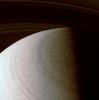
Saturn-PIA09828.jpgNorthern Latitudes (possible natural colors; credits: Lunexit)57 visiteCaption NASA:"As seasons change on Saturn, and sunlight creeps farther north, the region surrounding the North Pole is steadily coming to light. This scene reveals many features in Saturn's dynamic and beautiful Atmosphere, including a detail largely obscured from the imaging cameras until now: on the Terminator at center right is part of the Polar Hexagon, which was previously observed by Cassini's Visible and Infrared Mapping Spectrometer (VIMS) and Composite Infrared Spectrometer (CIRS).
These instruments used heat radiated from Saturn to observe the Polar Hexagon (rather than reflected sunlight, as is the case in this view). The Hexagon was first imaged by the Voyager spacecraft more than 25 years ago.
The view looks toward the unilluminated side of the Rings from about 38° above the Ring-Plane and is centered on a region 63° north of the Saturnian Equator.
The image has been brightened to show details at high Northern Latitudes, where solar illumination is presently weak.
The image was taken with the Cassini spacecraft wide-angle camera on Jan. 2, 2008 using a combination of spectral filters sensitive to wavelengths of polarized infrared light centered at 752 and 705 nanometers. The view was acquired at a distance of approx. 930.000 Km (about 578.000 miles) from Saturn.
Image scale is roughly 52 Km (approx. 32 miles) per pixel".MareKromiumFeb 14, 2008
|
|
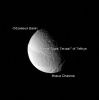
Tethys-PIA09835.jpgThe Main Surface Features of Tethys54 visiteCaption NASA:"This view of Tethys displays 3 of the moon's most notable surface features. At upper left is the giant Odysseus impact basin. At lower right is the great scar of Ithaca Chasma. Extending from east to west across the moon is the great swath of terrain that appears slightly darker than the rest of the moon's surface.
This view looks toward the Saturn-facing side of Tethys (1071 Km, or approx. 665 miles across) from 33° above the Equator. North is up.
The image was taken in visible light with the Cassini spacecraft narrow-angle camera on Jan. 14, 2008. The view was obtained at a distance of approx. 1,2 MKM (such as about 715.000 miles) from Tethys and at a Sun-Tethys-Spacecraft, or phase, angle of 70°.
Image scale is roughly 7 Km (about 4 miles) per pixel".MareKromiumFeb 13, 2008
|
|

Prometheus-PIA09834.jpgThe "visual meaning" of Gravity72 visiteCaption NASA:"Two dark gores in Saturn's F-Ring demonstrate the gravitational influence of the shepherd moon Prometheus.
The older gore at the top of this view is at a steeper angle than the newer addition just above and to the left of Prometheus, since the former has sheared out over the course of an orbit: particles on the inner (right) side of the F-Ring travel faster in the same amount of time than the particles on the outer (left) side, leaving the outer particles behind. Prometheus (102 Km, or about 63 miles across) is lit at left by direct sunlight and at right by reflected light from Saturn. The bright, sunlit portion of the moon is overexposed.
Two background stars are captured above Prometheus in this view, which looks toward the unilluminated side of the Rings from about 33° above the Ring-Plane.
The image was taken in visible light with the Cassini spacecraft narrow-angle camera on Jan. 1, 2008. The view was acquired at a distance of approx. 1,5 MKM (such as Rabout 956.000 miles from Saturn and at a Sun-Saturn-spacecraft, or phase, angle of 62°.
Image scale is roughly 9 Km (approx. 6 miles) per pixel".
MareKromiumFeb 12, 2008
|
|

EnceladusPlume-IMG002944-br500.jpgEnceladus' Plume Mechanics57 visiteCaption NASA:"This graphic shows how the ice particles and water vapor observed spewing from geysers on Saturn's moon Enceladus may be related to liquid water beneath the surface.
The large number of ice particles and the rate at which they are produced require high temperatures, close to the melting point of water. These warm temperatures indicate that there may be an internal lake of liquid water at or near the moon's South Pole, where the geysers are present.
This internal lake could be similar to Earth's Lake Vostok, where liquid water is locked in ice beneath Antarctica. The presence of liquid water inside Enceladus would have major implications for future studies of the possibility of life in the outer solar system". MareKromiumFeb 09, 2008
|
|

TheRings_Antares-PIA09829.jpgAntares, through the Rings (MULTISPECTRUM; credits: Lunexit)57 visiteCpation NASA:"A point of light flickers behind Saturn's Rings as multiple instruments on the Cassini Spacecraft observe a stellar occultation of Antares (or alpha Scorpii).
Such observations are designed to understand the fine-scale structure of the Rings. Scientists look at variations in the observed brightness of the star (whose actual brightness is well known) to determine the opacity of the Rings in different places.
Among other things, Cassini's prior stellar occultations have been used to examine density and bending waves induced in the A-Ring by Saturn's various moons.
This view looks toward the unilluminated side of the Rings from about 34° above the Ring-Plane.
The image was taken in visible light with the Cassini spacecraft narrow-angle camera on Jan. 3, 2008. The view was obtained at a distance of approx. 541.000 Km (such as about 336.000 miles) from Saturn.
Image scale is about 4 Km (a little less than 3 miles) per pixel".MareKromiumFeb 09, 2008
|
|
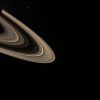
The_Rings-PIA09824.jpgThe Golden Rings of Saturn and some of His Moons... - (natural colors; credits: NASA)57 visiteCaption NASA:"A color portrait of Saturn's sunlight-scattering Rings hosts a group of several moons.
Enceladus (505 Km, or 314 miles across) is visible at top. At bottom, in increasing distance from the Rings, are Pandora (84 Km, or 52 miles across), Janus (181 Km, or 113 miles across) and Mimas (397 Km, or 247 miles across).
This view looks toward the unilluminated side of the Rings from about 10° above the Ring-Plane. Saturn's shadow can be seen on the Rings at upper left.
Images taken using red, green and blue spectral filters were combined to create this composite color view.
The images were taken with the Cassini spacecraft wide-angle camera on Dec. 22, 2007. The view was acquired at a distance of approx. 1,8 MKM (such as about 1,1 MMs) from Saturn. Image scale is about 110 Km (approx. 68 miles) per pixel". MareKromiumGen 30, 2008
|
|
W00041312.jpgReflections in the Space of Saturn59 visitenessun commentoMareKromiumGen 26, 2008
|
|

Dione-PIA09821.jpgDione (HR)58 visiteCaption NASA:"The Cassini spacecraft surveys the Southern Hemisphere on Dione's anti-Saturn side, spying a broad impact basin near bottom.
Most of the medium-sized craters visible here have pointed central peaks, owing to the rebound of material following the craters' initial formation.
(in this picture) North on Dione is up.
The image was taken in visible light with the Cassini spacecraft narrow-angle camera on Dec. 19, 2007. The view was obtained at a distance of approx. 240.000 Km (such as about 149.000 miles) from Dione and at a Sun-Dione-spacecraft, or phase, angle of 44°.
Image scale is roughly 1 Km (about 0,6 mile) per pixel".MareKromiumGen 24, 2008
|
|
| 2245 immagini su 188 pagina(e) |
|
|
|
|
|
64 | |
|
|
|
|
|
|





