| |

| Ultimi arrivi - Saturn: the "Ringed Beauty" and His Moons |

Enceladus-PIA10361-1.jpgJet Spots in Tiger Stripes62 visiteCaption NASA:"Heat radiating from the entire length of 150 Km (about 95 mile)-long fractures is seen in this best-yet heat map of the active South Polar Region of Saturn's ice moon Enceladus. The warmest parts of the fractures tend to lie on locations of the plume jets identified in earlier images, shown in the annotated version with yellow stars. The measurements were obtained by the Cassini Spacecraft's Composite Infrared Spectrometer from the spacecraft's close flyby of the moon on March 12, 2008.
Remarkably high temperatures, at least 180 Kelvin (such as -135 degrees Fahrenheit) were registered along the brightest fracture, named Damascus Sulcus, in the lower left portion of the image. For comparison, surface temperatures elsewhere in the South Polar Region of Enceladus are below 72 Kelvin (such as -330 degrees Fahrenheit).
Heat is escaping from Enceladus' interior along these warm fractures, dubbed "Tiger Stripes", which are also the source of the geysers that erupt from the Polar Region.
The infrared radiation was mapped at wavelengths between 12 and 16 microns. The infrared data, shown in false color, are superimposed on a grayscale image mosaic of the South Pole obtained by Cassini's cameras on July 14, 2005, during the previous close Enceladus flyby. Numbers on the map indicate Latitude and Longitude.
This new view shows that at least 3 of the South Polar fractures are active along almost their full lengths - the 4th one, on the right, was only partially covered by this scan. The level of activity varies greatly along the fractures. The warmest parts of the fractures tend to lie on locations of the plume jets identified in earlier images. The main "Tiger Stripe" fractures are not the only sources of heat, however; additional warm spots are seen in the upper right part of the scan.
The warm regions are probably concentrated within less than a few hundred meters (a few hundred yards) of the fractures, and their apparent width in this image results from the relatively low resolution of the infrared data.
This map was made by scanning the South Pole during the period from 16' to 37' (minutes) after closest approach to Enceladus, at a distance between 14.000 and 32.000 Km (about 8.700 and 20.000 miles) as Cassini rapidly receded from its close (50-Km or about 32-miles) flyby".MareKromiumMar 28, 2008
|
|

Enceladus-PIA10354.jpgStellar Data on "Enceladus Plume"123 visiteCaption NASA:"New structure, density and composition measurements of Enceladus' water plume were obtained when the Cassini Spacecraft's Ultraviolet Imaging Spectrograph observed the star "Zeta Orionis" pass behind the plume Oct. 24, 2007, as seen in this frame.
Changes in the starlight as it dimmed while passing through the plume allowed the spectrograph to identify the plume's physical and chemical composition.
The spectrograph detected 4 high-density gas streams composed of Water Vapor. The density of the Water Vapor is twice that of the broad plume of gas that surrounds each jet.
This measurement confirms the theoretical analysis performed prior to the flyby that showed it was safe for Cassini to fly very closely past Enceladus, even through part of the plume, during the March 12, 2008 flyby".MareKromiumMar 28, 2008
|
|

Enceladus-PIA10355.jpgGas and Dust Jets Match Up!58 visiteCaption NASA:"Jets of high-density gas detected by Cassini's Ultraviolet Imaging Spectrograph on Saturn's moon Enceladus match the locations of dust jets determined from Cassini images, labeled here with Roman numerals. The spectrograph pinpointed the locations of individual gas streams in the plume in a "stellar occultation", which involves measuring the light of a star (in this case, Zeta Orionis), as it passed behind the plume from Cassini's viewpoint.
The blue line in this projection shows the path of the starlight through the plume, over the South Polar Region of Enceladus.
The instrument looked at the star across this path in the direction indicated by the short blue lines.
Some of the dust jets appear to merge together in stellar occultation data. The dimming of starlight labeled "a" was caused by dust jets V and VII. The dimming of starlight marked as feature "b" may be associated with dust jet I if the jet is not perfectly vertical.
Dimming of starlight labeled "c" corresponds to dust jet VI, and "d" is dust jet III, with dust jet II in between. The individual jets come from sources with an area of less than 300 by 300 meters (such as about 1000 feet square) - about the size of half a tennis court - probably stretched out rectangularly along the Tiger Stripes.
The new data indicate that the water molecules are blasting off from Enceladus at faster than 600 meters per second (about 1200 mph)".MareKromiumMar 28, 2008
|
|

Enceladus-PIA10356.jpgWhat's in "Enceladus Plume"?61 visiteCaption NASA:"The lower panel is a Mass Spectrum that shows the chemical constituents sampled in Enceladus' plume by Cassini's Ion and Neutral Mass Spectrometer during its fly-through of the plume on Mar. 12, 2008.
Shown are the amounts, in atomic mass per elementary charge (Daltons [Da]), of Water Vapor, Methane, Carbon Monoxide, Carbon Dioxide, simple organics and complex organics identified in the plume".MareKromiumMar 28, 2008
|
|
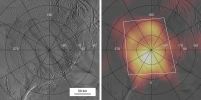
Enceladus-PIA10360.jpgStripes and Heat Map Side-by-Side72 visiteCaption NASA:"Cassini's March 12, 2008, flyby of Enceladus provided the best view yet of the heat radiation from the active South Pole of the satellite. These images summarize what was learned about the South Polar landscapes and heat radiation during the previous close flyby on July 15, 2005.
The left panel shows a map of the South Pole constructed from images taken by the Spacecraft's Imaging System. Four prominent fractures, informally called "Tiger Stripes", cut diagonally across the South Polar Region. In the right-hand panel, a July 2005 map of the south polar heat radiation, obtained by Cassini's Composite Infrared Spectrometer, is superimposed in false color on the visible images.
The observations revealed a prominent warm region centered on the South Pole, appearing yellow and orange in this view, which coincides with the locations of the tiger stripes. However, these data were taken from too far away from Enceladus (about 80.000 Km) to distinguish the fine details of the heat radiation.
The July 2005 flyby also included some scattered close-up snapshots by the Composite Infrared Spectrometer; these showed that the heat radiation was concentrated along the Tiger Stripe fractures, but those snapshots covered only a small fraction of the South Polar Region.
The white lines enclose the area covered by the much more detailed view of the South Pole obtained by the spectrometer during the March 12, 2008, flyby.
Numbers on the map show Latitude and Longitude".MareKromiumMar 28, 2008
|
|

Saturn-PIA09864.jpgNever "Dark Nights"... (natural colors; credits: NASA)57 visiteCaption NASA:"Titan emerges from behind Saturn, while Tethys streaks into view, in this colorful scene. Saturn's shadow darkens the far arm of the Rings near the Planet's limb. Titan is about 5150 Km (approx. 3200 miles) wide; Tethys is 1071 Km (such as approx. 665 miles) wide.
This view looks toward the unilluminated side of the Rings from about 3° above the Ring-Plane. Images taken using red, green and blue spectral filters were combined to create this natural color view. The images were acquired with the Cassini spacecraft wide-angle camera on Jan. 30, 2008 at a distance of approx. 1,3 MKM (such as about 800.000 miles) from Saturn.
Image scale is roughly 77 Km (about 48 miles) per pixel on Saturn".MareKromiumMar 26, 2008
|
|
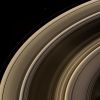
TheRings-PIA09865.jpgRings and Companions (natural colors; credits: NASA)55 visiteCaption NASA:"From on high, the Cassini spacecraft spies a group of 3 Ring Moons in their travels around Saturn. Janus (181 Km, or 113 miles across) is seen at top, while Pandora (84 Km, or 52 miles across) hugs the outer edge of the narrow F-Ring. More difficult to spot is Pan (26 Km, or 16 miles across), which is a mere speck in this view. Pan can be seen in the Encke Gap, near center left.
The speck seen between the A and F-Rings at left is a background star.
This view looks toward the unilluminated side of the Rings from about 40° above the Ring-Plane. Images taken using red, green and blue spectral filters were combined to create this natural color view.
Bright clumps of material in the narrow F-Ring moved in their orbits between each of the color exposures, creating a chromatic misalignment that provides some sense of the continuous motion in the Ring System.
The images were obtained with the Cassini spacecraft wide-angle camera on Feb. 7, 2008 at a distance of approx. 1,1 MKM (about 700.000 miles) from Saturn. Image scale at the center of the view is roughly 74 Km (about 46 miles) per pixel in the radial, or outward from Saturn, direction".MareKromiumMar 26, 2008
|
|
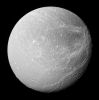
Dione-PIA09861.jpgDione60 visiteCaption NASA:"This southerly view of Dione shows enormous canyons extending from Mid-Latitudes on the Trailing Hemisphere, at right, to the moon's South Polar Region.
This view looks toward the Saturn-facing side of Dione (about 1126 Km, or 700 miles across) and is centered on 22° South Latitude, 359° West Longitude. North on Dione is up; the moon's south pole is seen at bottom.
The image was taken in visible light with the Cassini spacecraft narrow-angle camera on Feb. 8, 2008. The view was obtained at a distance of approx. 211.000 Km (such as about 131.000 miles) from Dione and at a Sun-Dione-Spacecraft, or phase, angle of 20°.
Image scale is roughly 1 Km (0,6 mile) per pixel".MareKromiumMar 21, 2008
|
|

Enceladus-5-CASSINI-big.jpgOver and Above... (natural colors; credits: Lunexit)60 visiteCaption NASA:"What does the surface of Saturn's ice-spewing moon Enceladus look like? To help find out, the robotic Cassini Spacecraft now orbiting Saturn was sent soaring past the cryovolcanic moon and even right through one of Enceladus' ice plumes.
Cassini closed to about 52 Km during its closest encounter to date. The above unprocessed image was taken looking down from the North, from about 30.000 Km away. Visible are at least two types of terrain.
The first type of terrain has more craters than occur near Enceladus' South Pole.
The other type of terrain has few craters but many ridges and grooves that may have been created by surface-shifting tectonic activity.
Exogeologists are currently poring over this and other Cassini images from last Wednesday's flyby to better understand the moon's patch-work surface, its unusual ice-geysers, and its potential to support life. Cassini is scheduled to fly by Enceladus at least 9 more times, including an even closer pass of just 25 Km in October 2008".MareKromiumMar 19, 2008
|
|
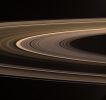
The_Rings-PIA09860.jpgRings Aglow (natural colors; credits: NASA)59 visiteCaption NASA:"Saturn's softly glowing Rings shine in scattered Sunlight. The B-Ring presents a remarkable difference in brightness between the near and far arms (bottom and top of the image, respectively). The strong variation in brightness could be due to the presence of wake-like features in the B-Ring.
This view looks toward the unilluminated side of the Rings from about 5° above the Ring-Plane. Images taken using red, green and blue spectral filters were combined to create this natural color view. The images were acquired at a distance of approx. 574.000 Km (about 357.000 miles) from Saturn.
At the center of the image, the Sun-Ring-Spacecraft Angle - or Phase Angle - is 114°, and the image scale is roughly 34 Km (about 21 miles) per pixel in the radial, or outward from Saturn, direction".
Nota Lunexit: ATTENZIONE! La NASA, riteniamo con questo frame, ha finalmente iniziato a fornire qualche dettaglio in più allorchè vengono comunicate al Pubblico delle info le quali, in sè, e laddove non adeguatamente precisate, finivano con il dire poco: si tratta del punto di riferimento del frame considerato per il calcolo dell'Angolo di Fase (che è il suo centro) e la direzione di riferimento del frame in ordine alla Scala pixel/Km. Non male, considerato che avevamo iniziato proprio noi, circa tre anni fa, a dare informazioni contestuali di supporto a svariati frames NASA-CASSINI (non queste info, comunque).MareKromiumMar 19, 2008
|
|

Enceladus-IMG002995-br500.jpgArabian Nights...On Enceladus!57 visiteCaption NASA:"This 3-image mosaic is the highest resolution view yet obtained of Enceladus' North Polar Region. The view looks southward over cratered plains from high above the North Pole of Enceladus.
Cassini's March 2008 flyby of Enceladus was designed to directly investigate the ongoing plume activity at the moon’s South Pole, but the path of the spacecraft allowed investigation of older evidence for internal activity near the North Pole.
Compared to much of the moon's Southern Hemisphere - the South Polar Region in particular - the North Polar Region is much older and covered with craters. These craters are captured at different stages of disruption and alteration by tectonic activity and probably past heating from below. Many of the craters seen here are sliced by small parallel cracks that seem to be ubiquitous throughout the old cratered terrains on Enceladus. The mosaic also shows a variety of impact crater shapes, some with bowed-up floors and smaller craters within, very likely indicating that the icy crust in this area was at some time warmer than at present. While this conclusion was previously reached from NASA Voyager spacecraft images, these new data provide a much more detailed look at the fractures that modify the surface. This data will give a significantly improved comparison of the geologic history at the satellite's north pole with that at the South Pole.
Two prominent craters in this view, Ali Baba and Aladdin (the two overlapping craters near center), are among the largest craters known on Enceladus.
Several areas of much younger terrain are visible in this mosaic, including Samarkand Sulci, an area of disrupted terrain that runs North-South at left of center, and the "Leading Hemisphere Terrain", a region, seen at right, filled with tectonic fractures, ridges and "ridged terrain".
Samarkand Sulci slices through some prominent craters that were seen in Voyager images. At that time, it was thought that the portions of the craters that extend into Samarkand were completely destroyed by whatever process formed Samarkand. However, Cassini images show remnants of the crater rims that have survived. This new insight provides a benchmark for measuring how tectonic processes modify older terrains, and will also help imaging scientists develop a more accurate timeline for the geologic history of these terrains.
Lit terrain seen here is on the Saturn-Facing Hemisphere of Enceladus.
The image was taken in visible light with the Cassini spacecraft narrow-angle camera on March 12, 2008. The view was acquired at a distance of approx. 32.000 Km (about 20.000 miles) from Enceladus and at a Sun-Enceladus-spacecraft, or phase, angle of 115°.
Image scale is roughly 176 meters (577 feet) per pixel".MareKromiumMar 14, 2008
|
|

Rhea-PIA09819.jpgTalking about Rhea...108 visiteCari Amici, l'ultimo articoletto che ho scritto per TruePlanets (il nostro Blog) e che è stato gentilmente pubblicato da NEXUS, sembra che abbia suscitato le ire funeste di un probabile e futuro Premio Nobel il quale, attraverso le pagine del Forum di NEXUS, ha pesantemente insultato il sottoscritto (vabbè, succede...) al punto da farsi (in parte) censurare il suo acuto intervento da uno dei Moderatori del Forum stesso.
Perchè Vi racconto questo? Perchè non tutto il male vien per nuocere!
E' stato infatti grazie al messaggio dell'Illustre Sconosciuto e futuro Nobel per la Fisica che io ho potuto riflettere un pò sul ruolo non solo del sottoscritto ma anche, di conseguenza, su quello del Ricercatore/Divulgatore Indipendente e "out" dal mainstream della Scienza Convenzionale.
Qui di seguito Vi riporto la mia risposta al (presumo) ragazzino/adolescente che, forte dei suoi lunghi studi e della sua grande cultura, mi ha dato dell'idiota.
Buona lettura!
"Buongiorno a tutti gli Amici del Forum,
ho letto (ieri sera) le annotazioni svolte a proposito del mio articoletto e, dopo un attimo di ovvia perplessità, mi sono reso conto che, nonostante la mia ritrosìa a rispondere e dialogare allorchè vengo - letteralmente (e gratuitamente) - aggredito, una qualche riga di replica si impone.
Ma non per chi ha espresso perplessità in maniera spettacolarmente aggressiva, arrogante e villana su quanto ho scritto (e sul cui contenuto io sono l'ultima persona a potersi pronunciare), ma per coloro che hanno svolto - in mia assenza - il ruolo di Difensori del mio lavoro.
Parlo di Gnorri, di Armando, di Guastardo e di Ariete, che ringrazio di cuore.
Parlare di me non fa parte del mio carattere; farlo "pubblicamente", in un Forum, anche meno, però un paio di informazioni sul mio background, a questo punto, le devo a tutti.
Ho 45 anni (quasi) ed una duplice formazione, culminata nel (faticoso) conseguimento di due lauree: una in Giurisprudenza (AD 1987 - Italia) ed una in Astrofisica (AD 1998 - Olanda). La prima laurea è stata il portato di un retaggio familiare, come spesso accade; la seconda, che mi ha richiesto ben 12 anni di viaggi e sacrifici (lavoravo, nel frattempo, come Tecnico Contratti in una Società Petrolifera e poi, dal '95, come Libero Professionista), è stata un tributo alla mia passione per l'Universo.
E' evidente che quanto sopra non significa che sono un "Buon Giurista" e/o un "Buon Astrofisico", anzi: conosco svariate persone, con titoli e credenziali ben maggiori delle mie, che hanno difficoltà ad esprimersi in un Italiano apprezzabile e che, quando scrivono, evidenziano lacune grammaticali e sintattiche da paura.
Le lauree, in sè, non significano "competenza" nè "genialità".
Però indicano, se non altro, dedizione e sacrificio.
E poi, se mi si concede un pizzico di credito, significano anche voglia/volontà di apprendere e di migliorarsi.
Quando scrivo di Diritto - più che altro studi e commenti su recenti legislazioni richiestimi dai miei studenti (nella Vita, oltre che il Ricercatore ed il Divulgatore, insegno) - uso un determinato approccio; quando scrivo di Scienza di Confine (sulle pagine di NEXUS c'è una discreta raccolta dei miei lavoretti, gli altri sono sul Blog della Fondazione che dirigo - Lunar Explorer Italia è la Fondazione e TruePlanets il blog), ne uso un altro.
Comune ai due approcci, c'è uno stile dialogico il quale (se poi mi sbaglio e/o nel caso non siate d'accordo, correggetemi) è improntato al Legittimo Dubitare, di quasi Cartesiana memoria. Dubitare con Ragione, tenendo sempre a mente che lo studio acritico non fa crescere, ma si trasforma, nel tempo, in mero nozionismo.
Ora, dato che faccio questo lavoro da parecchi anni, so benissimo che, a volte, ho scritto cose giuste ed apprezzabili ed altre volte cose meno giuste e meno apprezzabili. Altre volte ancora ho commesso errori, che mi sono stati fatti presenti e che hanno, poi, costituito materia di ulteriore studio ed arricchimento.
Qualche volta, i miei Interlocutori mi hanno convinto del mio errore, altre volte è accaduto il contrario, ed altre volte ancora, c'est la Vie, ognuno è rimasto sulle sue posizioni.
Ma SEMPRE il dialogo/critica/replica si è svolto all'insegna del rispetto reciproco e dell'educazione.
Ricevo lettere, da svariati Lettori, in cui sono contenute critiche ed elogi: rispondo a tutte, a patto che non contengano insulti (che qualificano chi li pronuncia e non chi li riceve) nè strumentalizzazioni più o meno becere di quello che ho scritto.
Nel caso di specie, io mi sono riletto con calma il pezzo "incriminato" e, a parte una sequela di insulti più o meno espliciti, non ho trovato nulla che potesse giustificare le dichiarazioni dell'Illustre Sconosciuto che mi ha "dedicato" questo post.
E' evidente che chi si muove, come me, tra Scienza Convenzionale ed Ipotesi (provocatorie) di Confine, la strada è dura e difficile, ma è pure vero che, per scrivere un articoletto come il mio - quand'anche fosse infarcito di "bislacche teorizzazioni" e di "dichiarazioni da mitomane" - occorre un pizzico comunque di Competenza (magari fraintesa, ma ci vuole) e tanto Coraggio.
Competenza e Coraggio che, nella "critica" rivoltami, proprio non vedo.
Non posso spiegare in un margine accettabile di tempo il substrato di tutto quanto dedotto nell'articolo, ma vorrei evidenziare solo questi 4 aspetti:
1) non ho mai messo in dubbio le Leggi della Fisica; metto in dubbio la loro assolutezza ed applicabilità nell'intero Universo che, mi pare, siamo ancora ben lontani dal poter dire di conoscere;
2) le orbite stabili in ambienti planetari caratterizzati da micro-gravità e non solo, ma anche distinti da interazioni con altri Corpi Maggiori e prossimi, non esistono (se non sulla carta e nella testa di qualche LabRat che opera in condizioni controllate ed in Sistemi Statici);
3) il compito del Ricercatore/Divulgatore in questo campo e nel campo della Scienza di Confine non ricalca il compito dello Scienziato Convenzionale: le "Leggi" che si applicano alle due figure professionali, al pari dei contesti in cui essi operano, sono molto diverse;
4) la Ragione, l'Umiltà ed il Possibilismo, a mio parere, porteranno, un giorno, la nostra Scienza ad essere davvero "Umana" e "Vicina all'Uomo"; l'arroganza e la cieca certezza, invece, sono solo due portati transitori della "Cultura" (Scientifica e non) di oggi e, sempre a mio parere, non avranno vita lunghissima.
Tutto qui. Per dialogare sul "merito" del mio lavoro (senza annoiare tutti, anche i non interessati a Newton & C.), mi si può scrivere a Sugarmoon@intercom.it.
Per dissentire, non c'è problema: lo si può fare ovunque.
Per insultare ed aggredire, senza neppure presentarsi con nome e cognome (e, magari, anche un pizzico di CV...), credo che non esista un "posto giusto". Certo non lo è questo Forum.
Grazie ancora a tutti ed un caro saluto
Dr Paolo C. Fienga/Arcadia" (Arcadia è il mio nickname sul Forum di NEXUS)
Una considerazione finale: Diritto di Critica? SI, SEMPRE!
Diritto di insulto? Beh, quello lo lascio ai fenomeni che nobilitano il nostro Paese con la loro sola presenza...MareKromiumMar 14, 2008
|
|
| 2245 immagini su 188 pagina(e) |
|
|
|
|
|
63 | |
|
|
|
|
|
|





