| Ultimi arrivi - Saturn: the "Ringed Beauty" and His Moons |

Tehys-N00110912.jpgTethys in the Saturnshine!62 visitenessun commentoMareKromiumMag 20, 2008
|
|

Tethys-PIA09903.jpgIcy Impact: the Odysseus Basin on Tethys56 visiteCaption NASA:"The enormous Impact Basin Odysseus sits on the Eastern Limb of icy Tethys.
This view looks toward the Anti-Saturn side of Tethys and North is toward the top of the picture.
The image was taken with the Cassini Spacecraft narrow-angle camera on April 14, 2008 using a spectral filter sensitive to wavelengths of ultraviolet light centered at 338 nanometers. The view was obtained at a distance of approx. 1,1 MKM (such as about 714.000 miles) from Tethys and at a Phase Angle of 26°.
Image scale is roughly 7 Km (about 4 miles) per pixel".MareKromiumMag 20, 2008
|
|
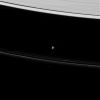
Daphnis-PIA09902.jpgDaphnis and a Little Star...59 visiteCaption NASA:"The Cassini Spacecraft captures a view showing two of Saturn's moons and their gravitational effects on nearby Rings.
At top, Daphnis (about 8 Km, or 5 miles across at its widest point) streaks through the Keeler Gap, with its ever-present edge waves. At center, Prometheus (about 86 Km, or 53 miles across at its widest point) pulls away from a recent encounter with the F-Rring. A bright background star is visible below the F-Ring.
This view looks toward the unilluminated side of the Rings from about 41° above the Ring-Plane. The image was taken in visible light with the Cassini spacecraft narrow-angle camera on April 8, 2008. The view was acquired at a distance of approx. 1,3 MKM (such as about 788.000 miles) from Prometheus and at a Sun-Prometheus-Spacecraft, or phase, angle of 53°.
Image scale is roughly 8 Km (about 5 miles) per pixel".
Nota Lunexit: noi vediamo Daphnis, la "Piccola Stella" in basso rispetto all'Anello "F" e la scia lasciata da Prometheus (sull'estrema Sx del frame) a seguito del suo transito ma, di Prometheus...nessuna traccia! E Voi? Lo vedete Prometheus?MareKromiumMag 16, 2008
|
|
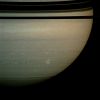
Saturn-PIA09900.jpgContinuing or Perpetual Storm? (MULTISPECTRUM; credits: Lunexit)56 visiteCaption NASA:"The longest-lived continuously monitored electrical storm ever observed on Saturn continues to churn through the tempest-tossed region nicknamed "Storm Alley" because of its preponderance of storm activity. This image of the storm was taken about 5 months after it was first detected by Cassini's Imaging Cameras and the Radio and Plasma Wave Science Experiment.
This view looks toward the unilluminated side of the Rings from about 1° above the Ring-Plane. The bands of the Ring shadows blanket the Planet at the top of the scene.
The image was taken with the Cassini spacecraft wide-angle camera on April 23, 2008 using a combination of spectral filters sensitive to wavelengths of polarized infrared light centered at 752 nanometers. The view was acquired at a distance of approx. 1,2 MKM (such as about 760.000 miles) from Saturn.
Image scale is roughly 70 Km (about 43 miles) per pixel".MareKromiumMag 14, 2008
|
|

Rhea-PIA09898.jpgThe South Polar Region of Rhea57 visiteCaption NASA:"The Cassini Spacecraft surveys the South Polar Region of icy Rhea.
Cassini flybys have shown that Rhea is not differentiated, or separated into distinct layers; instead, it appears to be a mixture of approx. 75% ices and 25% rock and metal. Saturn's second-largest moon, Rhea, is about 1528 Km (approx. 949 miles) wide.
The image was taken with the Cassini Spacecraft narrow-angle camera on April 12, 2008 using a spectral filter sensitive to wavelengths of ultraviolet light centered at 338 nanometers. The view was acquired at a distance of approx. 345.000 Km (such as about 214.000 miles) from Rhea and at a Sun-Rhea-Spacecraft, or Phase, angle of 73°.
Image scale is roughly 2 Km (a little more than 1 mile) per pixel".MareKromiumMag 11, 2008
|
|

Janus-Rotating-20080220.gifJanus "in motion" (GIF-Movie)89 visitenessun commentoMareKromiumMag 08, 2008
|
|

Saturn-PIA10358.jpgSaturn's Infrared Temperature Snapshot (Labeled)61 visiteCaption NASA:"Scientists have discovered a wave pattern, or oscillation, in Saturn's atmosphere only visible from Earth every 15 years. The pattern ripples back and forth like a wave within Saturn's upper atmosphere. In this region, temperatures switch from one altitude to the next in a candy cane-like, striped, hot-cold pattern.
The temperature "snapshot" shown in these two images captures two different phases of this wave oscillation: the temperature at Saturn's Equator switches from hot to cold, and temperatures on either side of the Equator switch from cold to hot every Saturn half-year.
The image on the left was taken in 1997 and shows the temperature at the equator is colder than the temperature at 13° South Latitude. Conversely, the image on the right taken in 2006 shows the temperature at the Equator is warmer.
These images were taken with NASA's Infrared Telescope Facility in Mauna Kea, Hawaii".MareKromiumMag 08, 2008
|
|
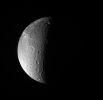
Dione-PIA09886~0.jpgJaniculum Dorsa56 visiteCaption NASA:"The Cassini spacecraft looks down, almost directly at the North Pole of Dione. The feature just left of the Terminator at bottom is Janiculum Dorsa, a long, roughly North-South trending ridge.
Lit terrain seen here is on the anti-Saturn and trailing sides of Dione (1126 Km, or approx. 700 miles across).
This image was taken with the Cassini spacecraft narrow-angle camera on March 22, 2008 using a spectral filter sensitive to wavelengths of ultraviolet light centered at 338 nanometers. The view was acquired at a distance of approx. 650.000 Km (about 404.000 miles) from Dione and at a Sun-Dione-Spacecraft, or phase, angle of 99°.
Image scale is roughly 4 Km (about 2 miles) per pixel".MareKromiumMag 07, 2008
|
|

Mimas-PIA09880.jpgMimas is on Sight!58 visiteCaption NASA:"The Cassini spacecraft looks toward the high north on heavily cratered Mimas. The unmistakable Herschel impact crater is seen at lower left.
Lit terrain seen here is on the anti-Saturn side of Mimas (397 Km, or about 247 miles across).
Nota Lunexit: osservate bene la linea che disegna il profilo visibile di Mimas (se over-saturate il frame il lavoro sarà perfetto) e quindi notate la forma vagamente ovoidale di questa piccola luna.
Ed è proprio nella forma non sferica, comunque, che si cela la differenza tra "corpo celeste planetario" (piccolo o grande non importa) e "planetoide".
The moon's North Pole is up and tilted slightly toward Cassini. The image was taken in visible light with the Cassini spacecraft narrow-angle camera on March 11, 2008. The view was acquired at a distance of approx. 795.000 Km (about 494.000 miles) from Mimas and at a Sun-Mimas-Spacecraft, or Phase, angle of 88°.
Image scale is roughly 5 Km (about 3 miles) per pixel".MareKromiumMag 07, 2008
|
|
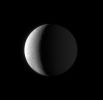
Enceladus-PIA09882.jpgEnceladus58 visiteCaption NASA:"The Cassini spacecraft acquired this view 15 hours before closest approach to Enceladus as the Spacecraft dove toward its thrilling March 2008 encounter with the ice-particle-spewing moon. The cratered terrain of the North is seen at top, and is even dimly visible on the moon's night side, which is lit by reflected sunlight coming from Saturn.
North on Enceladus (505 Km, or approx. 314 miles across) is up and rotated 22° to the left. The North Pole is tilted slightly toward Cassini.
The image was taken in visible green light with the Cassini spacecraft narrow-angle camera on March 12, 2008. The view was acquired at a distance of approx. 612.000 Km (about 380.000 miles) from Enceladus and at a Sun-Enceladus-Spacecraft, or Phase, angle of 114°.
Image scale is roughly 4 Km (about 2 miles) per pixel".MareKromiumMag 07, 2008
|
|

Rhea-PIA09895.jpgThe Ancient Plains of Rhea75 visiteCaption NASA:"Densely cratered plains cover the ancient surface of Saturn's moon Rhea. Following the Voyager Spacecraft encounters with Saturn, cryovolcanism was suggested as a source for the wispy markings on both Rhea and Dione.
Cassini has shown that Rhea's bright streaks are, like those on Dione, tectonic features and planetary scientists now think it is unlikely that cryovolcanic activity has ever occurred on this moon.
This view looks toward the Trailing Hemisphere of Rhea (1528 Km, or about 949 miles across). North is up.
The image was taken in visible light with the Cassini Spacecraft narrow-angle camera on April 4, 2008. The view was acquired at a distance of approx. 1,2 MKM (such as about 735.000 miles) from Rhea and at a Sun-Rhea-Spacecraft, or Phase, angle of 39°.
Image scale is roughly 7 Km (about 4 miles) per pixel".MareKromiumMag 07, 2008
|
|

The_Rings-PIA09894.jpgThe A-Ring in 16:9 (natural colors + MULTISPECTRUM; credits: Lunexit)60 visiteCaption NASA:"Spiral density waves in Saturn's A-Ring reveal the gravitational signatures of distant moons as they subtly tug on the countless particles orbiting in the Ring-Plane.
Resulting from a process called orbital resonance, a spiral density wave is a spiral-shaped massing of particles that tightly winds many times around the Planet. Thus, the wave patterns seen here represent successive windings of each wave, like a close-up view of a watch spring.
Ring scientists can read these patterns, learning from them how quickly the Rings are spreading and the amount of mass contained in a region.
This view looks toward the sunlit side of the Rings from about 42° below the Ring-Plane. The image was taken in visible light with the Cassini spacecraft narrow-angle camera on April 1, 2008. The view was obtained at a distance of approx. 268.000 Km (about 167.000 miles) from Saturn.
Image scale is roughly 1 Km (0,6 miles) per pixel".MareKromiumMag 06, 2008
|
|
| 2245 immagini su 188 pagina(e) |
 |
|
|
|
|
61 | |
|
|
|
|





