| Ultimi arrivi - Saturn: the "Ringed Beauty" and His Moons |

Pandora-N00111362.jpgPandora?56 visiteCaption NASA:"N00111362.jpg was taken on May 30, 2008 and received on Earth May 31, 2008. The camera was pointing toward PANDORA, and the image was taken using the CL1 and CL2 filters. This image has not been validated or calibrated".MareKromiumGiu 01, 2008
|
|

Prometheus-N00111364.jpgUnbelievable Disturbances...56 visiteCaption NASA:"N00111364.jpg was taken on May 30, 2008 and received on Earth May 31, 2008. The camera was pointing toward PROMETHEUS, and the image was taken using the CL1 and CL2 filters. This image has not been validated or calibrated".MareKromiumGiu 01, 2008
|
|
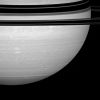
Saturn-PIA09913.jpgJust a Matter of "Proportions"...57 visiteCaption NASA:"A great, eye-like vortex stares out of Saturn's roiling atmosphere. The storm is wide enough to span the distance from Washington, DC to London. Bright Enceladus drifts past in the foreground.
This view looks toward the unilluminated side of the Rings from about 3° above the Ring-Plane.
The image was taken with the Cassini Spacecraft wide-angle camera on April 23, 2008 using a combination of spectral filters sensitive to wavelengths of polarized infrared light centered at 752 nanometers. The view was acquired at a distance of approx. 1,3 MKM (such as about 783.000 miles) from Saturn.
Image scale is roughly 72 Km (about 45 miles) per pixel".MareKromiumGiu 01, 2008
|
|
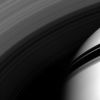
Saturn-PIA09908.jpgThrough the Rings...58 visiteCaption NASA:"The Cassini spacecraft peers through the Gossamer Strands of Saturn's innermost rings, whose own shadows adorn the Planet beyond.
This view looks toward the sunlit side of the rings from about 35° below the Ring-Plane. The image was taken in visible light with the Cassini Spacecraft wide-angle camera on April 21, 2008. The view was obtained at a distance of approximately 620.000 Km (approx. 385.000 miles) from Saturn.
Image scale is roughly 67 Km (approx. 42 miles) per pixel".MareKromiumGiu 01, 2008
|
|

Pan-PIA09911.jpgAlmost invisible...61 visiteCaption NASA:"Pan coasts down its private highway within the Encke Gap.
The process by which Pan (about 28 Km, or 17 miles across) maintains the gap, clearing the neighborhood around its orbit, is believed to be similar to the way that planets clear gaps in debris disks around young stars. This view looks toward the unilluminated side of the Rings from about 11° above the Ring-Plane.
The limb of Saturn is seen through the Rings, at the upper left.
The image was taken in visible light with the Cassini Spacecraft narrow-angle camera on April 24, 2008. The view was obtained at a distance of approx. 1,3 MKM (such as about 784.000 miles) from Pan.
Image scale is roughly 8 Km (approx. 5 miles) per pixel".MareKromiumMag 29, 2008
|
|
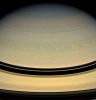
Saturn-PIA09910.jpgThe "Head" of Saturn (Natural Colors; credits: NASA/Space Science Institute)56 visiteCaption NASA:"Bright puffs and ribbons of cloud drift lazily through Saturn's murky skies. In contrast to the bold red, orange and white clouds of Jupiter, Saturn's clouds are overlain by a thick layer of haze. The visible cloud tops on Saturn are deeper in its atmosphere due to the Planet's cooler temperatures.
This view looks toward the unilluminated side of the Rings from about 18° above the Ring-Plane. Images taken using red, green and blue spectral filters were combined to create this natural color view. The images were acquired with the Cassini spacecraft wide-angle camera on April 15, 2008 at a distance of approx. 1,5 MKM (such as about 906,000 miles) from Saturn.
Image scale is roughly 84 Km (about 52 miles) per pixel".MareKromiumMag 28, 2008
|
|

Atlas-PIA09818~0.jpgAtlas (MULTISPECTRUM; credits: Lunexit)56 visitenessun commentoMareKromiumMag 25, 2008
|
|

Unknown-N00111005.jpgStar-Trails? (1)57 visiteOnde evitare spiacevoli malintesi, precisiamo che gli oggetti puntiformi i quali disegnano un piccolo segmento d'arco e che, a nostro avviso, potrebbero e dovrebbero essere degli "Star-Trails", sono a Dx dell'Osservatore, in alto (il più luminoso) ed a Sx dell'Osservatore, uno in alto ed uno in basso (molto deboli). La loro incredibile somiglianza ci ha fatto anche pensare all'ipotesi per cui si tratti di un solo Star-Trail (quello luminoso a Dx) e di due riflessi del medesimo attraverso le ottiche di Cassini (i due di Sx).
L'Anomalìa del frame, infine - sia che gli Star-Trails sìano tre, sia che si tratti di uno solo -, è data dalla circostanza per cui la forma dello/degli Star-Trail/s è il chiaro indice di un movimento della Sonda Cassini. Un movimento che è avvenuto DURANTE la ripresa. Ora, a nostro avviso, è curioso che il brusco cambio di traiettoria della Sonda abbia prodotto la distorsione di un dettaglio (la stella - o le stelle - che è diventata una striscia curva) e non del corpo principale ripreso (una porzione degli Anelli di Saturno).
E' stata questa specifica considerazione che ci ha lasciati un pò perplessi sulla natura dei tre segmenti luminosi curvi (i quali, ribadiamo e chiudiamo, potrebbero e dovrebbero COMUNQUE essere delle semplici Star-Trails).
E Voi che ne pensate?
Caption NASA:"N00111005.jpg was taken on May 10, 2008 and received on Earth on May 11, 2008. The camera was pointing toward the F-RING of Saturn which, at the time that the picture was taken, was about 387.626 Km away.
This image was taken using the CL1 and CL2 filters and it has not been validated or calibrated".MareKromiumMag 23, 2008
|
|

Unknown-N00111006.jpgStar-Trails? (2)58 visiteCaption NASA:"Caption NASA:"N00111006.jpg was taken on May 10, 2008 and received on Earth on May 11, 2008. The camera was pointing toward the F-RING of Saturn which, at the time that the picture was taken, was about 454.646 Km away.
This image was taken using the CL1 and CL2 filters and it has not been validated or calibrated".MareKromiumMag 23, 2008
|
|

Atlas-PIA09818.jpgIn the Night...61 visiteCaption NASA:"Two of Saturn's ring moons draw close momentarily, before the inner of the pair moves off alone.
Atlas passes Prometheus (about 86 Km, or approx. 53 miles across, at center left) about once a month, then slowly and steadily pulls ahead of its slower moving sibling.
This view looks toward the unilluminated side of the Rings from about 23° above the Ring-Plane. The image was taken in visible light with the Cassini spacecraft narrow-angle camera on April 6, 2008. The view was acquired at a distance of approx. 1,6 MKN (such as about 975.000 miles) from Atlas.
Image scale is roughly 9 Km (about 6 miles) per pixel".MareKromiumMag 23, 2008
|
|

Atlas-PIA09907.jpgBrothers in the Night: Atlas and Daphnis58 visiteCaption NASA:"Looking upward from beneath the Ring-Plane, the Cassini Spacecraft spies Saturn's "Wave Maker" and "Flying Saucer" moons.
Daphnis (8 Km, or about 5 miles across at its widest point) and its gravitationally induced edge waves are seen at left within the Keeler Gap. The equatorial bulge on Atlas (30 Km, or about 19 miles across at its widest point) is clearly visible here.
This view looks toward the sunlit side of the Rings from about 16° below the Ring-Plane. The image was taken in visible light with the Cassini spacecraft narrow-angle camera on April 22, 2008. The view was acquired at a distance of approx. 898.000 Km (such as about 558.000 miles) from Saturn.
Image scale is roughly 5 Km (about 3 miles) per pixel".MareKromiumMag 23, 2008
|
|
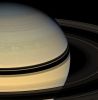
Saturn-PIA09906.jpgNorthern Latitudes (approx. true colors; credits: NASA)59 visiteCaption NASA:"Stately Saturn sits surrounded by its darkened disk of ice. An increasing range of hues has become visible in the Northern Hemisphere as Spring approaches and the Ring shadows slide southward.
This view looks toward the unilluminated side of the rings from about 17° above the Ring-Plane. Images taken using red, green and blue spectral filters were combined to create this natural color view. The images were acquired with the Cassini Spacecraft wide-angle camera on April 15, 2008 at a distance of approx. 1,5 MKM (such as about 906.000 miles) from Saturn.
Image scale is roughly 84 Km (about 52 miles) per pixel".MareKromiumMag 22, 2008
|
|
| 2245 immagini su 188 pagina(e) |
 |
|
|
|
|
60 | |
|
|
|
|





