| Ultimi arrivi - Saturn: the "Ringed Beauty" and His Moons |
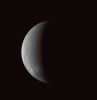
Enceladus-PIA10422.jpgCrescent Enceladus (MULTISPECTRUM-2; credits: Lunexit)83 visiteCaption NASA:"The Cassini Spacecraft observes the wrinkled surface of Enceladus.
The geologically active South Polar Region is visible at bottom.
This view looks toward the Saturn-facing side of Enceladus (about 504 Km, or 313 miles across). Lit terrain is on the moon's Leading Hemisphere. North is up and rotated 16° to the right.
The image was taken in visible green light with the Cassini Spacecraft narrow-angle camera on June 2, 2008. The view was obtained at a distance of approx. 285.000 Km (such as about 177.000 miles) from Enceladus and at a Sun-Enceladus-Spacecraft, or Phase, Angle of 108°.
Image scale is roughly 2 Km (a little more than 1 mile) per pixel".MareKromiumLug 12, 2008
|
|

Mimas-PIA09806.jpgMimas through the Rings (MULTISPECTRUM-2; credits: Lunexit)90 visitenessun commentoMareKromiumLug 09, 2008
|
|

Saturn-PIA09908~0.jpgThrough the Rings... (MULTISPECTRUM; credits: Lunexit)58 visitenessun commentoMareKromiumLug 09, 2008
|
|

The_Rings-PIA10419.jpgOn the edge... (MULTISPECTRUM-2; credits: Lunexit)69 visiteCaption NASA:"This detailed look at Saturn's A-Ring captures Daphnis in the narrow Keeler Gap. The small moon creates complex wave patterns in the gap edges that Cassini scientists are working to understand. To the right of the Keeler Gap, the outer A-Ring edge is significantly brighter than the rest of the Ring.
This view looks toward the unilluminated side of the Rings, from about 32° above the Ring-Plane. Daphnis is about 8 Km (approx. 5 miles) wide.
The image was taken in visible light with the Cassini Spacecraft narrow-angle camera on May 31, 2008. The view was acquired at a distance of approx. 1 MKM (about 629.000 miles) from Saturn.
Image scale is roughly 6 Km (about 4 miles) per pixel".MareKromiumLug 08, 2008
|
|
Tethys-W00047018.jpgTethys and the Stars beyond...59 visitenessun commentoMareKromiumLug 06, 2008
|
|

Sky-W00041672.jpgSaturnian Sky58 visitenessun commentoMareKromiumLug 06, 2008
|
|

Sky-W00041674.jpgSaturnian Sky59 visitenessun commentoMareKromiumLug 06, 2008
|
|

Sky-W00047012.jpg"?"92 visiteUn ovvio tentativo di messa a fuoco, riuscito proprio male, su un oggetto particolarmente luminoso (riteniamo che si tratti di una delle maggiori lune di Saturno). Comunque un'immagine intrigante ed interessante.MareKromiumLug 06, 2008
|
|

Sky-W00047013.jpg"?"58 visitenessun commentoMareKromiumLug 06, 2008
|
|

Dione-N00099381.jpgThe Cratered Surface of Dione (MULTISPECTRUM-2; credits: Lunexit)57 visitenessun commentoMareKromiumLug 06, 2008
|
|

Dione-PIA09838.jpgDione (MULTISPECTRUM-2; credits: Lunexit)57 visiteCaption NASA:"The Cassini Spacecraft looks down from high latitude over Dione and the system of wispy fractures that coats the moon's Trailing Side.
This view looks toward Dione from 43° above the Equator. North is up.
The image was taken in visible light with the Cassini Spacecraft narrow-angle camera on Jan. 14, 2008. The view was acquired at a distance of approx. 938.000 Km (such as about 583.000 miles) from Dione and at a Sun-Dione-Spacecraft angle of 54°.
Image scale is roughly 6 Km (a little less than 4 miles) per pixel".MareKromiumLug 06, 2008
|
|

Dione-PIA10409.jpgDione (MULTISPECTRUM-2; credits: Lunexit)60 visiteCaption NASA:"The bright fractures on Dione's Trailing Side slice across terrain that is darker than the rest of the surface. Cassini scientists are working to understand the nature of the dark material that appears to coat the surfaces of several of Saturn's moons. Only after the Cassini Spacecraft began imaging Dione did they realize that the prominent "streaks" shown here are fractures on the surface.
Lit terrain seen here is on the Saturn-Facing Side of Dione. North is up.
The image was taken in visible light with the Cassini spacecraft narrow-angle camera on May 17, 2008. The view was acquired at a distance of approx. 873.000 Km (such as about 543.000 miles) from Dione and at a Phase Angle of 47°.
Image scale is roughly 5 Km (a little less than 3 miles) per pixel".MareKromiumLug 06, 2008
|
|
| 2245 immagini su 188 pagina(e) |
 |
|
|
|
|
57 | |
|
|
|
|





