| Ultimi arrivi - Saturn: the "Ringed Beauty" and His Moons |

Sky-W00049978.jpgBizarre Reflection in the Space of Saturn...60 visiteCaption NASA:"W00049978.jpg was taken on October 09, 2008 and received on Earth October 09, 2008. The camera was pointing toward ENCELADUS that, at the time, was approx. 536.451 Km away. The image was taken using the CL1 and CL2 filters".MareKromiumOtt 10, 2008
|
|
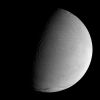
Enceladus-PIA10483.jpgThe Leading Hemisphere of Enceladus57 visiteCaption NASA:"During a distant flyby encounter with Enceladus, Cassini imaged the moon's wrinkled Leading Hemisphere.
At the scale visible here, this region of the surface is generally devoid of impact craters, suggesting that the terrain has been modified and renewed during the moon's history.
To the North lies a heavily cratered and presumably older Region. The sinuous boundary of the geologically active South Polar Region is seen at bottom. North on Enceladus is toward the top of the image.
The image was taken in visible green light with the Cassini Spacecraft narrow-angle camera on Sept. 30, 2007. The view was acquired at a distance of approx. 108.000 Km (such as about 67.000 miles) from Enceladus and at a Sun-Enceladus-Spacecraft, or phase, angle of 75°.
Image scale is 644 meters (2111 feet) per pixel".MareKromiumOtt 04, 2008
|
|

SaturnSpaceN00115280-N00115290.gifThrough the "Eyes" of Cassini... (GIF-Movie; credits: Dr G. Barca)59 visiteSuggestivo, affascinante e, alla fine - semplicemente -, bello! (repetita iuvant)MareKromiumSet 29, 2008
|
|

SaturnSpace-N00115343-N00115349.gifThrough the "Eyes" of Cassini... (GIF-Movie; credits: Dr G. Barca)58 visiteSuggestivo, affascinante e, alla fine - semplicemente -, bello!MareKromiumSet 29, 2008
|
|

Saturn-PIA10478.jpgSaturn and Mimas (natural colors; credits: NASA/JPL/Space Science Institute )56 visiteCaption NASA:"The Cassini Spacecraft looks beyond Saturn's limb toward the icy face of Mimas, the innermost of the Planet's major moons.
This view looks toward the sunlit side of the rings from about 3° below the Ring-Plane. Mimas is about 396 Km (approx. 246 miles) across.
Images taken using red, green and blue spectral filters were combined to create this natural color view. The images were acquired with the Cassini Spacecraft narrow-angle camera on Sept. 4, 2007 at a distance of approx. 2,7 MKM (such as about 1,7 MMs) from Saturn and 2,8 MKM (such as about 1,8 MMs) from Mimas.
Image scale is roughly 16 Km (about 10 miles) per pixel on Saturn and approx. 17 Km (such as about 11 miles) per pixel on Mimas". MareKromiumSet 27, 2008
|
|

JanusandPan-PIA10475.jpgOne is "Surrounded" and the other is "Free": Pan and Prometheus58 visiteCaption NASA:"Two of Saturn's moons coast along the outer edge of the Main Ring System. The orbits of seven small moons cluster just outside the F-Ring -- between the orbits of Pan and the co-orbital moons Janus and Epimetheus.
Pan (approx. 28 Km, or about 17 miles across at its widest point) appears as a bright dot within the Encke Gap, right of center. Janus (about 179 Km, or approx. 111 miles across at its widest point) lies outside the A and F-Rings, below center.
This view looks toward the sunlit side of the rings from about 2° below the Ring-Plane. The image was taken in visible light with the Cassini Spacecraft narrow-angle camera on Aug. 22, 2008. The view was obtained at a distance of approx. 1,3 MKM (such as about 808.000 miles) from Janus.
Image scale is roughly 8 Km (5 miles) per pixel".MareKromiumSet 24, 2008
|
|

Saturn-PIA10476.jpgSaturn in the Ringshine (natural colors; credits: NASA)58 visiteCaption NASA:"Large regions of Saturn's night side are illuminated by the Planet's gleaming Rings. Except for a sliver of the sunlit crescent at left, this view shows a part of the Planet lit almost entirely by "Ringshine".
The Southern Hemisphere, at bottom, receives its illumination from sunlight that strikes the Rings' southern face and is reflected onto the Planet. The Northern Hemisphere, at top, is lit by the feeble light that wends its way through countless ring particles to emerge on the Rings' north face. Despite the dim lighting on the northern part of the Planet, many cloud features can be seen there nevertheless.
This view was acquired from about 44° above the Ring-Plane. At bottom, the Planet's shadow stretches across the D and C-Rings.
Images taken using red, green and blue spectral filters were combined to create this natural color view. The images were obtained with the Cassini Spacecraft wide-angle camera on April 23, 2007 at a distance of approx. 901.000 Km (about 560.000 miles) from Saturn.
Image scale is roughly 50 Km (about 31 miles) per pixel".MareKromiumSet 24, 2008
|
|

Rhea-PIA10474.jpgRhea57 visiteCaption NASA:"The sun's low angle near the Terminator highlights the topography of craters within Rhea's wispy terrain. (...)
This view looks toward the Trailing Hemisphere of Rhea (approx. 1528 Km, or 949 miles across). North is toward the top of the image.
The image was taken in visible light with the Cassini Spacecraft narrow-angle camera on June 10, 2008. The view was acquired at a distance of approx. 758.000 Km (such as about 471.000 miles) from Rhea and at a Phase Angle of 51°.
Image scale is roughly 5 Km (a little more than 3 miles) per pixel".MareKromiumSet 24, 2008
|
|

PanandPrometheus-PIA10468.jpgGravitational Disturbances56 visiteCaption NASA:"This mosaic of two Cassini images shows Pan and Prometheus creating features in nearby Rings.
Pan (approx. 28 Km, or about 17 miles across), in the Encke Gap at left, is trailed by a series of edge waves in the outer boundary of the gap. Prometheus (approx. 86 Km, or about 53 miles across at its widest point) just touches the inner edge of Saturn's F-Ring at right, and is followed by a series of dark channels in the Ring, which were caused by the passage of Prometheus through the F-Ring on previous orbits.
This view looks toward the unilluminated side of the rings from about 3° above the Ring-Plane. The images were taken in visible light with the Cassini Spacecraft narrow-angle camera on Aug. 15, 2008. The view was obtained at a distance of approx. 1,2 MKM (746.000 miles) from Pan and Prometheus.
Image scale is roughly 7 Km (about 5 miles) per pixel on both moons".MareKromiumSet 24, 2008
|
|

Mimas-intransit-N00119952-N00119954.gifQuick Transit! (GIF-Movie; credits: Dr G. Barca)61 visite...Sembra un UFO...Ma non lo è! Si tratta, a nostro avviso, della luna Saturniana Mimas, ben riconoscibile a causa della sua forma oblunga e del suo "occhio" (!) che appare - relativamente chiaro - a ridosso del Terminatore.
Un intrigante - e MOLTO ISTRUTTIVO! - GIF-Movie, del sempre puntualissimo Dr Barca!MareKromiumSet 22, 2008
|
|

Enceladus-N00118469.jpgStars?56 visitenessun commentoMareKromiumSet 21, 2008
|
|
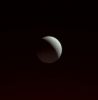
Enceladus-PIA10471.jpgDouble "Space-Lights" on Enceladus! (natural colors; credits: Lunexit)63 visiteCaption NASA:"As the Cassini Spacecraft began its August 2008 flyby of Enceladus, the spacecraft approached over the moon's cratered North Pole. Cassini acquired this view as the icy moon grew ever larger in its field of view.
In addition to the sunlit crescent at upper right, the faint glow at bottom indicates a secondary source of illumination: reflected sunlight from Saturn (a.k.a.: "Saturnshine").
The view looks toward high Northern Latitudes on Enceladus from a perspective of 71° North of the moon's Equator.
The North Pole is in shadow at center.
The image was taken in visible light with the Cassini Spacecraft narrow-angle camera on Aug. 11, 2008. The view was obtained at a distance of approx. 448.000 Km (such as about 278.000 miles) from Enceladus and at a Phase Angle of 113°.
Image scale at maximum resolution is approx. 3 Km (a little less than 2 miles) per pixel".MareKromiumSet 17, 2008
|
|
| 2245 immagini su 188 pagina(e) |
 |
|
|
|
|
51 | |
|
|
|
|





