| |

| Ultimi arrivi - Saturn: the "Ringed Beauty" and His Moons |

MimasandPrometheus-N00121933.jpgSpace Encounter: Mimas and Prometheus (1)57 visiteCaption NASA:"N00121933.jpg was taken on October 20, 2008 and received on Earth October 21, 2008.
The camera was pointing toward MIMAS that, at the time, was approx. 1.052.776 Km away.
This image was taken using the CL1 and CL2 filters and it has not been validated or calibrated." MareKromiumOtt 22, 2008
|
|

MimasandPrometheus-N00121936.jpgSpace Encounter: Mimas and Prometheus (2)57 visiteCaption NASA:"N00121933.jpg was taken on October 20, 2008 and received on Earth October 21, 2008.
The camera was pointing toward MIMAS that, at the time, was approx. 1.054.003 Km away.
This image was taken using the CL1 and CL2 filters and it has not been validated or calibrated." MareKromiumOtt 22, 2008
|
|

MimasandPrometheus-N00121942.jpgSpace Encounter: Mimas and Prometheus (3)59 visiteCaption NASA:"N00121933.jpg was taken on October 20, 2008 and received on Earth October 21, 2008.
The camera was pointing toward MIMAS that, at the time, was approx. 1.056.495 Km away.
This image was taken using the CL1 and CL2 filters and it has not been validated or calibrated." MareKromiumOtt 22, 2008
|
|
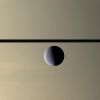
Rhea-IMG003277.jpgSliding Away... (natural colors; credits: NASA)57 visiteCaption NASA:"The Cassini Spacecraft looks toward Rhea's cratered, icy landscape with the dark line of Saturn's Ring-Plane and the Planet's murky atmosphere as a background.
Rhea is Saturn's second-largest moon, at about 1528 Km (approx. 949 miles) across.
This view looks toward the unilluminated side of the Rings from less than 1° above the Ring-Plane.
Images taken using red, green and blue spectral filters were combined to create this natural color view. The images were acquired with the Cassini spacecraft narrow-angle camera on July 17, 2007 at a distance of approx. 1,2 MKM (such as about 770.000 miles) from Rhea.
Image scale is roughly 7 Km (about 4,5 miles) per pixel"MareKromiumOtt 20, 2008
|
|

Saturn-PIA10493.jpgSaturn (natural colors; credits: NASA)60 visiteCaption NASA:"The Cassini Spacecraft looks toward the sunlit face of Saturn's Rings, whose shadows continue to slide southward on the Planet toward their temporary disappearance during equinox in August 2009.
This two-frame color mosaic was created from images taken as part of a photometry observation of the Rings. Photometry observations are useful for determining a host of ring particle properties.
This view looks toward the sunlit side of the Rings from about 3° below the Ring-Plane. Images taken using red, green and blue spectral filters were combined to create this natural color view. The images were acquired with the Cassini Spacecraft wide-angle camera on Aug. 22, 2008 at a distance of approx. 1,2 MKM (such as about 728.000 miles) from Saturn.
Image scale is roughly 66 Km (about 41 miles) per pixel".MareKromiumOtt 19, 2008
|
|
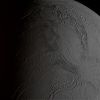
Enceladus-9_cassini_big.jpgEnceladus (natural colors; credits: Lunexit)74 visiteCaption NASA:"What telling impurities taint the ice plumes of Enceladus? To help answer this question, the robotic Cassini spacecraft dove last week to within 30 kilometers of Saturn's ice-plume emitting moon. At this closest-ever approach, Cassini attempted to sniff and obtain chemical data on particles ejected from Enceladus' regular surface, while at other times Cassini flew right through -- and sampled -- ice geysers directly. Searches in the data for impurity clues in the water-ice dominated plumes and surface ejecta are progressing. Although the main purpose of this flyby was particle analysis, several interesting images are emerging. Visible in the above image, for example, is an unusual gray sheen running vertically up the image center that might be water vapor escaping from surface canyons. Other notable features visible above include vast plains of craterless icy grooves, the day-night terminator across the image left, and an area near the top comparatively rich in craters. Cassini is scheduled to buzz by Enceladus in an imaging run near the end of this month".MareKromiumOtt 14, 2008
|
|

Saturn-RingPlane_cassini_big.jpgAlong the Ring-Plane of Saturn (natural colors; credits: NASA)58 visiteCaption NASA originale:"When Saturn's appendages disappeared in 1612, Galileo did not understand why. Later that century, it became understood that Saturn's unusual protrusions were Rings and that when the Earth crosses the Ring-Plane, the edge-on rings will appear to disappear.
This is because Saturn's Rings are confined to a plane many times thinner, in proportion, than a razor blade. In modern times, the Cassini Spacecraft orbiting Saturn now also crosses Saturn's Ring-Plane. A series of plane crossing images from late February (2006) was dug out of the vast online Cassini raw image archive by interested Spanish amateur Fernando Garcia Navarro.
Pictured above, digitally cropped and set in representative colors, is the striking result. Saturn's thin Ring-Plane appears in blue, bands and clouds in Saturn's Upper Atmosphere appear in gold and dark shadows of the Rings curve across the top of the Gas Giant Planet. Moons appear as bumps in the Rings". MareKromiumOtt 14, 2008
|
|
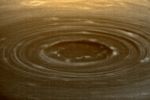
Saturn-SP-PIA11103.jpgSouthern Turbulence (natural colors; credits: Lunexit)58 visiteCaption NASA:"Shadows reveal the topography of Saturn's South Polar Vortex. At high resolution, a new, inner ring of isolated, bright clouds is seen. These clouds are localized regions of convective upwelling, an important clue to understanding how heat energy is transported in Saturn's Atmosphere.
See PIA11104 for a high-resolution Cassini view that looks more directly down onto the vortex, compared to this oblique perspective. Sunlight illuminates the scene from upper right, and the higher altitude rings of clouds surrounding the pole cast shadows toward lower left. North on Saturn is up.
The image was taken with the Cassini Spacecraft narrow-angle camera on July 15, 2008, with a combination of spectral filters sensitive to wavelengths of polarized infrared light centered at 746 and 938 nanometers. The grainy quality of the image is due primarily to the low signal-to-noise ratio of images taken with the 938 nanometer spectral filter, which is near the upper limit of the wavelength range the camera can see. "Signal-to-noise" is a term scientists use to refer to the amount of meaningful or useful information (signal) in their data versus the amount of background noise. A higher signal-to-noise ratio yields sharper, clearer views of features in the atmosphere.
The view was acquired from 24° below the Ring-Plane, at a distance of approx. 778.000 Km (about 483.000 miles) from Saturn.
The Sun-Saturn-Spacecraft, or Phase, Angle is about 30°.
Image scale is 4 Km (about 3 miles) per pixel".MareKromiumOtt 14, 2008
|
|
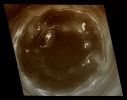
Saturn-SP-PIA11104.jpgSouthern Turbulence (False Colors; credits: Lunexit)57 visiteCaption NASA:"This detailed Cassini view of the monstrous vortex at Saturn's South Pole provides valuable insight about the mechanisms that power the Planet's Atmosphere.
This view is 10 times more detailed than any previous image of the Polar Vortex. See PIA11103 for a more oblique, wide-angle view that provides context for this close-up.
Previous images revealed an outer ring of high clouds surrounding a Region previously thought to be mostly clear air interspersed with a few puffy clouds that circulate around the center. This new image shows that what looked like puffy clouds at lower resolution are actually vigorous convective storms that form yet another distinct, inner ring. In other words, they are deep convective structures seen through the atmospheric haze. One of the deeper structures (at the 10 o'clock position) has punched through to a higher altitude and created its own little vortex. The ring is similar to the eyewall of a terrestrial hurricane, but much larger. The clear air there is warm, like the eye of a terrestrial hurricane, but on Saturn it is locked to the pole, whereas a terrestrial hurricane drifts around.
Convective structures are small regions of intense upwelling air, but the clear air of the vortex eye indicates that this is generally an area of downwelling. Convection is an important part of the planet's energy budget because the warm upwelling air carries heat from the interior. In a terrestrial hurricane, the convection occurs in the eyewall. Here it seems to occur in the eye as well. The camera filter used for this image captures light at wavelengths where atmospheric gases like Methane are fairly transparent, allowing for detailed views of deep cloud features. Other filters (see PIA09859) use light that is strongly absorbed by Methane gas; the light bounces off the high clouds, making them visible, but gets absorbed before it reaches the low clouds. Such "Methane-Band" images of the South Polar Vortex reveal that the convective clouds do not reach up to the base of the stratosphere, as convective clouds on Earth do. This view was acquired from 56° below the Ring-Plane. The image has been digitally reprojected to show the scene as it would appear to an observer positioned directly above the Pole.
The image was taken with the Cassini Spacecraft narrow-angle camera on July 14, 2008, using a combination of two spectral filters sensitive to wavelengths of polarized visible light centered at 617 and infrared light centered at 750 nanometers. The view was obtained at a distance of approx. 392.000 Km (243.000 miles) from Saturn and at a Sun-Saturn-Spacecraft, or Phase, Angle of 60°.
Image scale is roughly 2 Km (a little more than 1 mile) per pixel".MareKromiumOtt 14, 2008
|
|

Sky-W00049976.jpgBizarre Reflection in the Space of Saturn...85 visiteSembrerebbe, a prima vista, un riflesso generato dalla lente della camera che riprende (una sorta di "Lens Flare"), ma non lo è.
Sembra il residuo luminescente che caratterizza le esplosioni che occorrono in atmosfera rarefatta o nel vuoto, ma si tratta di un'idea davvero insostanziabile e MOLTO esotica.
Forse è solo un vizio dell'immagine oppure - anche se stentiamo a crederlo - un riflesso generato dalle Fontane di Encelado (lontane oltre mezzo milione di Km da CASSINI, al momento dello scatto): un riflesso generato da miliardi di microparticelle di ghiaccio che, illuminate dalla luce di Saturno - e da quella di un Sole molto lontano -, prima di perdersi nello Spazio, sembrano disegnare una sorta di scia di luce.
Chissà...
Caption NASA:"W00049976.jpg was taken on October 09, 2008 and received on Earth October 09, 2008. The camera was pointing toward ENCELADUS that, at the time, was approx. 537.268 Km away.
The image was taken using the CL1 and CL2 filters".MareKromiumOtt 10, 2008
|
|
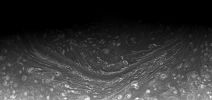
Saturn-PIA10486.jpgTwo sides of Saturn's "Hexagon"57 visiteCaption NASA:"Saturn's North Polar Hexagon appears to be a long-lived feature of the Atmosphere, having been spotted in images of Saturn in the early 1980s, again in the 1990s, and then by the Cassini Spacecraft in the past several years.
The persistent nature of the Hexagon in imaging observations implies that it is present throughout Saturn's 29-year seasonal cycle. Two sides of the Hexagon are seen here.
This view was obtained from about 67° above the Equator. The image was taken with the Cassini Spacecraft wide-angle camera on Aug. 25, 2008 using a spectral filter sensitive to wavelengths of infrared light centered at 752 nanometers. The view was acquired at a distance of approx. 566.000 Km (about 352.000 miles) from Saturn.
Image scale is roughly 31 Km (about 19 miles) per pixel".MareKromiumOtt 10, 2008
|
|

Saturn-PIA10487.jpgMany Colors for Many Moons... (natural colors; credits: NASA)58 visiteCaption NASA:"Four moons huddle near Saturn's multi-hued disk.
The coloration of the planet's northern hemisphere has changed noticeably since the Cassini Spacecraft's arrival in orbit in mid-2004. Imaging scientists are working to understand the causes of this change, which is suspected to be a seasonal effect.
Giant Titan (5150 Km, or approx. 3200 miles across), with its darker Winter Hemisphere, dominates the smaller moons in the scene. Beneath and left of Titan is Janus (181 Km, or about 113 miles across). Mimas (397 Km, or approx. 247 miles across) appears as a bright dot close to the Planet and beneath the Rings. Prometheus (102 Km, or about 63 miles across) is a faint speck hugging the Rings between the two small moons.
This view looks toward the unilluminated side of the Rings from less than 1° above the Ring-Plane.
Images taken using red, green and blue spectral filters were combined to create this natural color view. The view was acquired with the Cassini spacecraft wide-angle camera on Oct. 26, 2007, at a distance of approx. 1,5 MKM (such as about 920.000 miles) from Saturn and 2,7 MKM (about 1,7 MMs) from Titan.
Image scale is roughly 89 Km (approx. 55 miles) per pixel on Saturn and 164 Km (about 102 miles) per pixel on Titan".MareKromiumOtt 10, 2008
|
|
| 2245 immagini su 188 pagina(e) |
|
|
|
|
|
50 | |
|
|
|
|
|
|





