| Ultimi arrivi - Saturn: the "Ringed Beauty" and His Moons |
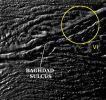
Enceladus-PIA11134.jpgBaghdad Sulcus59 visiteCaption NASA:"Like hunters sighting a clay duck flying fast in the sky, this mosaic of Cassini images was made from 'skeet shoot' narrow-angle images 1, 2, 3 and 4, all captured during the Oct. 31, 2008, flyby of Saturn's moon Enceladus.
The resolution of this mosaic is 12,3 meters (41 feet) per pixel and jet source VI (see also PIA08385) is identified in the upper right".MareKromiumNov 03, 2008
|
|
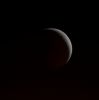
Enceladus-PIA10498.jpgNorthern Craters of Enceladus (natural colors; credits: Lunexit)60 visiteCaption NASA:"This image is part of an observation designed to view the moon's plume of icy particles at a moderately High Phase Angle.
The "Phase Angle" is the angle formed between the Sun, the target being imaged, and the Spacecraft, and it ranges from 0 to 180°. Tiny particles, like those in the plume, brighten substantially at high phase angles.
This view was taken from a vantage point 37° above the Equator of Enceladus (about 504 Km, or approx. 313 miles across). Reflected light from Saturn dimly illuminates the moon's dark side.
The image was taken in visible light with the Cassini Spacecraft narrow-angle camera on Sept. 17, 2008. The view was acquired at a distance of approx. 262.000 Km (such as about 163.000 miles) from Enceladus and at a Phase Angle of 140°.
Image scale is roughly 2 Km (5137 feet) per pixel".MareKromiumOtt 30, 2008
|
|

MimasandPrometheus-N00121924-N00121943.gif"Space Runners" (GIF-Movie; credits: Dr G. Barca)57 visitenessun commentoMareKromiumOtt 30, 2008
|
|

Enceladus-PIA11119.jpgEnceladus Oct. 9, 2008 Flyby58 visiteCaption NASA:"This image was taken during Cassini's extremely close encounter with Enceladus on Oct. 9, 2008.
The image was taken with the Cassini Spacecraft narrow-angle camera on Oct. 9, 2008, a distance of approx. 40.000 Km (such as about 25.000 miles) from Enceladus.
Image scale is approx. 477 meters (1566 feet) per pixel". MareKromiumOtt 29, 2008
|
|

Enceladus-PIA11120.jpgEnceladus Oct. 9, 2008 Flyby58 visiteCaption NASA:"This image was taken with the Cassini Spacecraft narrow-angle camera on Oct. 9, 2008, from a distance of approx. 26.000 Km (16,000 miles) from Enceladus. Image scale is 312 meters (1024 feet) per pixel".MareKromiumOtt 29, 2008
|
|

Enceladus-PIA11121.jpgEnceladus Oct. 9, 2008 Flyby60 visiteCaption NASA:"The image was taken with the Cassini Spacecraft narrow-angle camera on Oct. 9, 2008, a distance of approx. 42.000 Km (about 26.000 miles) from Enceladus.
Image scale is 503 meters (1650 feet) per pixel".MareKromiumOtt 29, 2008
|
|

Enceladus-PIA11123.jpgEnceladus Oct. 9, 2008 Flyby59 visiteCaption NASA:"The image was taken with the Cassini Spacecraft narrow-angle camera on Oct. 9, 2008, from a distance of approx. 47.000 Km (about 29.000 miles) from Enceladus.
Image scale is 279 meters (916 feet) per pixel".MareKromiumOtt 29, 2008
|
|

UnusualObject-N00122114-1.jpgUnusually-looking "Object" in the Space of Saturn58 visiteSi tratta, senza dubbio (!), di una delle tantissime Lune Saturniane, ma quale? Scherzi ed ironie a parte, l'Oggetto Anomalo che Vi proponiamo appare solo in un frame, ottenuto dalla distanza di 433.941 Km dall'Anello "F" di Saturno.
Nel frame successivo (distanza 433.359 Km) e nel frame precedente (distanza 434.224 Km dal Main Target) nulla appare nella porzione alta dell'inquadratura.
L'Oggetto Anomalo, come l'edm ci mostra, possiede una forma piuttosto allungata ed irregolare (e attenzione: l'irregolarità del Corpo Celeste NON E' stata creata, ma solo ACCENTUATA dalla circostanza per cui il frame è leggermente "mosso") e la sua albedo ci sembra alquanto alta.
Non si distinguono (o almeno: noi non riusciamo a distinguere) rilievi superficiali idonei a consentirci l'identificazione dell'Oggetto, ma la nostra sensazione è che POTREBBE trattarsi della Luna Saturniana "Hyperion" (la quale, in determinate inquadrature, pare effettivamente assomigliare ad una sorta di "oliva" - un pà raggrinzita).
Ad ogni modo, questo frame è indubbiamente interessante e meriterebbe qualche approfondimento...MareKromiumOtt 29, 2008
|
|

Dione-PIA10500.jpgCross-Worlds: the Answer!59 visiteRicordate la sequenza (intitolata, appunto, Cross-Worlds) che pubblicammo qualche settimana fa (era il 14 Settembre 2008, per l'esattezza) e che ci mostrava (ovviamente nell'ottica di CASSINI) Dione mentre eclissava un'altra Luna non identificata?
Noi ipotizzammo che si potesse trattare di Mimas o di Encelado. La NASA, oggi, tramite il suo Planetary Photojournal, ci ha risposto: si trattava di Encelado.
Un grazie alla NASA (che, quando vuole, sa anche rispondere) ed un 6+ a noi perchè, anche se non siamo riusciti ad identificare con sicurezza assoluta la seconda luna "misteriosa" in transito, siamo stati comunque abbastanza bravi dal ridurre la rosa dei "candidati" a due soli Corpi Celesti.
Insomma...Non male!MareKromiumOtt 28, 2008
|
|
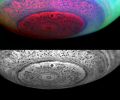
Saturn-SouthPole_cassini_big.jpgBeneath the South Pole of Saturn59 visiteCaption NASA:"What clouds lurk beneath Saturn's unusual South Pole?
To help find out, the robotic Cassini Spacecraft currently orbiting Saturn imaged the nether region of the gigantic ringed orb in infrared light.
There thick clouds appear dark as they mask much of the Infrared Light emitted from warmer regions below, while relatively thin clouds appear much lighter. Bands of clouds circle Saturn at several latitudes, while dark ovals indicate many dark swirling storm systems. Surprisingly, a haze of upper level clouds visible towards Saturn's Equator disappears near the Pole, including over Saturn's strange Polar Vortex.
Cassini entered orbit around Saturn in 2004, and recorded the above image last year (2007)". MareKromiumOtt 28, 2008
|
|
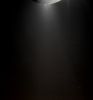
Enceladus-PIA10502.jpgIcy Plume in the Saturnshine! (natural colors; credits: Lunexit)57 visiteCaption NASA:"The active Surface Jets on Enceladus collectively form a brilliant, extended Plume that is made visible as sunlight scatters among the microscopic particles of ice.
The Plume is more easily seen with the Sun directly, or almost directly, behind Enceladus, as is the case here. The moon's surface is lit here by reflected light from Saturn.
The image was taken in visible light with the Cassini Spacecraft narrow-angle camera on Sept. 17, 2008. The view was obtained at a distance of approx. 235.000 Km (such as about 146.000 miles) from Enceladus and at a Sun-Enceladus-Spacecraft angle of 140°.
Image scale is approx. 1 Km (0,6 mile) per pixel".MareKromiumOtt 25, 2008
|
|

Dione-PIA10496.jpgThe Bright Canyons of Dione60 visiteCaption NASA:"Dione's defining feature, the fractures on its Trailing Side, shine brilliantly in this Cassini Spacecraft view.
The view was acquired from a position 33° South of the moon's Equator. Lit terrain seen here is on the Trailing Side of Dione (approx. 1123 Km, or about 698 miles across). North is up and rotated 8° to the right.
The image was taken in visible light with the Cassini spacecraft narrow-angle camera on Sept. 11, 2008. The view was obtained at a distance of approximately 833,000 kilometers (517,000 miles) from Dione and at a Phase Angle of 67°. Image scale is about 5 Km (a little more than 3 miles) per pixel.
The image was taken with the Cassini Spacecraft wide-angle camera on Aug. 26, 2008 using a spectral filter sensitive to wavelengths of infrared light centered at 752 nanometers.
The view was acquired at a distance of approx. 397.000 Km (about 246.000 miles) from Saturn.
Image scale is roughly 20 Km (about 13 miles) per pixel".MareKromiumOtt 22, 2008
|
|
| 2245 immagini su 188 pagina(e) |
 |
|
|
|
|
49 | |
|
|
|
|





