| Ultimi arrivi - Saturn: the "Ringed Beauty" and His Moons |

Mimas-PIA10517.jpgCrescent Mimas (possible natural colors; credits: Lunexit)65 visiteCaption NASA:"Mimas's lit crescent has the appearance of a golf ball thanks to its heavily cratered surface.
This image was taken with the Cassini Spacecraft narrow-angle camera on Oct. 24, 2008 using a spectral filter sensitive to wavelengths of IR light centered at 752 nanometers.
The view was obtained at a distance of approx. 189.000 Km (such as about 117.000 miles) from Mimas and at a Phase Angle of 136°.
Image scale is about 1 Km (such as 3707 feet) per pixel".MareKromiumNov 21, 2008
|
|

Enceladus-00063371.jpgHiding behind the Rings... (3D - credits: Dr M. Faccin)57 visitenessun commentoMareKromiumNov 19, 2008
|
|
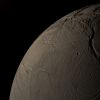
Enceladus-PIA10515.jpgEnceladus (natural colors; credits: Lunexit)56 visiteCaption NASA:"The Cassini Spacecraft acquired this view of Enceladus just after the Spacecraft passed within 25 Km (approx. 15 miles) of the surface on Oct. 9, 2008. Remarkably, only a handful of craters are visible in this view, indicating the relatively young age of this surface.
The image was taken in Visible Light with the Cassini Spacecraft narrow-angle camera on Oct. 9, 2008 at a distance of approx. 38.000 Km (about 24.000 miles) from Enceladus and at a Sun-Enceladus-Spacecraft, or Phase, Angle of 73°.
Image scale is 228 meters (746 feet) per pixel".MareKromiumNov 19, 2008
|
|

The_Rings-N00124200-N00124206.gifAnother UFO in the Space of Saturn? (GIF-Movie; credits: Dr G. Barca)73 visiteQuesto GIF-Movie costituisce una (bella!) risposta del Dr Barca al quesito posto in sede di commento ai frames che potrebbero raffigurare un OVNI che sfreccia nello Spazio di Saturno, a ridosso del suo Anello "F": osservate la traiettoria dell'oggetto.
Essa è palesemente iperbolica (nota: "...in Astrodinamica ed in Meccanica Celeste una Traiettoria Iperbolica è un'orbita con eccentricità maggiore di 1. Sotto le ipotesi standard, un corpo che viaggia lungo una Traiettoria Iperbolica arriverà all'infinito con una Velocità Orbitale (detta anche Velocità d'Eccesso Iperbolica, Eccesso Iperbolico o Terza Velocità Cosmica), rispetto al Corpo Centrale, non nulla (ricorda: la Velocità Orbitale di un Corpo Celeste, generalmente un pianeta, un satellite naturale, un satellite artificiale o una stella parte di un sistema multiplo, è la velocità con cui esso orbita attorno al Baricentro del Sistema - ed in genere attorno ad un corpo con massa maggiore. Il termine può riferirsi sia alla Velocità Orbitale Media (misurata su un'intera orbita), sia alla Velocità Istantanea in un certo punto dell'orbita).
Analogamente alle Traiettorie Paraboliche, quelle Iperboliche sono Orbite di Fuga e l'energia specifica di una Traiettoria Iperbolica è positiva...") e quindi - come ben spiegato dalla definizione estrapolata da Wikipedia - del tutto incoerente rispetto alle orbite e traiettorie (dette "Stazionarie") proprie dei satelliti (naturali e non) di un Corpo Celeste.
E questo è un PRIMO elemento che ci porta ad escludere l'eventualità che il Corpo Anomalo in transito sia una Luna Saturniana...Altre idee?MareKromiumNov 19, 2008
|
|

The_Rings-N00123890-N00123900.gifPossible UFO (and Cosmic Ray) in the Space of Saturn (GIF-Movie: credits: Dr G. Barca)69 visitenessun commentoMareKromiumNov 18, 2008
|
|

The_Rings-N00124198.jpgMore UFO's in the Space of Saturn?63 visiteCaption NASA:"N00124198.jpg was taken on November 16, 2008 and received on Earth November 17, 2008. The camera was pointing toward SATURN-RINGS that, at the time, were approx. 387.642 Km away, and the image was taken using the CL1 and CL2 filters. This image has not been validated or calibrated". MareKromiumNov 18, 2008
|
|

The_Rings-N00124202.jpgAnother UFO in the Space of Saturn?118 visiteCaption NASA:"N00124202.jpg was taken on November 16, 2008 and received on Earth November 17, 2008. The camera was pointing toward SATURN-RINGS that, at the time, were approx. 384.802 Km away, and the image was taken using the CL1 and CL2 filters. This image has not been validated or calibrated".MareKromiumNov 18, 2008
|
|
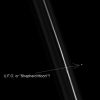
The_Rings-N00124203.jpgAnother UFO in the Space of Saturn?87 visiteCaption NASA:"N00124204.jpg was taken on November 16, 2008 and received on Earth November 17, 2008. The camera was pointing toward SATURN-RINGS that, at the time, were approx. 384.329 Km away, and the image was taken using the CL1 and CL2 filters. This image has not been validated or calibrated". MareKromiumNov 18, 2008
|
|
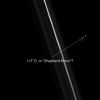
The_Rings-N00124204.jpgAnother UFO in the Space of Saturn?68 visiteCaption NASA:"N00124204.jpg was taken on November 16, 2008 and received on Earth November 17, 2008. The camera was pointing toward SATURN-RINGS that, at the time, were approx. 383.855 Km away, and the image was taken using the CL1 and CL2 filters. This image has not been validated or calibrated". MareKromiumNov 18, 2008
|
|
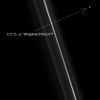
The_Rings-N00124205.jpgAnother UFO in the Space of Saturn?85 visiteCaption NASA:"N00124205.jpg was taken on November 16, 2008 and received on Earth November 17, 2008. The camera was pointing toward SATURN-RINGS which, at the time, were approximately 382.907 Km away, and the image was taken using the CL1 and CL2 filters. This image has not been validated or calibrated".MareKromiumNov 18, 2008
|
|

Helene-N00123958.jpgHelene58 visiteHelene is one of the named Minor Moons of Saturn. Also known as Saturn XII (or S12), Helene is an irregularly shaped (---> nonspherical) body measuring about 22 miles (such approx. 36 Km), by about 20 miles (approx. 32 Km), by about 18 miles (approx. 30 Km).
Helene orbits Saturn at a mean distance of about 234.500 miles (approx. 377.400 Km) and has an Orbital Period of 2,7369 Earth Days — the Rotational Period is unknown but is assumed to be the same as the Orbital Period (meaning that Helene shall always show the same side to Saturn - just like the Moon does to Earth).
Helene was discovered by French astronomers P. Laques and J. Lecacheaux in 1980 during ground-based observations of Saturn.
Another moon, Dione, is co-orbital with Helene: that is, Helene orbits Saturn at the same distance as Dione but precedes Dione by about 60°.
Before the present name was adopted, the moon was referred to as "Dione-B" or also "Electra".MareKromiumNov 17, 2008
|
|

The_Rings-ERing-W00051101.jpgThe tenuous E-Ring of Saturn (RAW frame)58 visiteCaption NASA:"W00051101.jpg was taken on November 12, 2008 and received on Earth November 13, 2008. The camera was pointing toward SATURN's E-RING that, at the time, was approx. 1.234.847 Km away.
The image was taken using the CL1 and BL1 filters".
Nota Lunexit: in questo frame potete osservare una serie impressionante di image-artifacts (noise, per lo più, come spesso si vede nei frames CASSINI).MareKromiumNov 17, 2008
|
|
| 2245 immagini su 188 pagina(e) |
 |
|
|
|
|
46 | |
|
|
|
|





