| Ultimi arrivi - Saturn: the "Ringed Beauty" and His Moons |

Enceladus-PIA10562.jpgCrescent Enceladus58 visiteCaption NASA:"In the boundary between light and shadow on Enceladus, run the Anbar Fossae — a series of narrow, shallow depressions.
Like other features on this geologically active moon, the fossae are named after a location in The Arabian Nights. In this case, they are named after Anbar, Iraq.
Another Iraqi namesake, the Baghdad Sulcus, is one of several warm `Tiger Stripe' fractures at the moon's South Pole from which emanate heat and icy particles (see also PIA11114).
North is up in this image, and Julnar is the largest crater visible in the Northern Hemisphere. One of the women in The Arabian Nights lends her name to this crater which is about 20 Km (about 12 miles) wide.
Fewer craters mark the Southern Hemisphere because they have been erased by later tectonic forces.
The image was taken in Visible Light with the Cassini Spacecraft narrow-angle camera on Dec. 17, 2008. The view was obtained at a distance of approx. 385.000 Km (about 239.000 miles) from Enceladus and at a Phase Angle of 104°.
Image scale is roughly 2,5 Km (about 1,6 miles) per pixel".MareKromiumGen 28, 2009
|
|

The_Rings-PIA10561.jpgSpokes in the Rings of Saturn (Natural Colors; credits: Lunar Explorer Italia)60 visiteCaption NASA:"On November 2008 Cassini snapshot showcases a classic view of the triangular shape typical of many of the spokes in Saturn's outer B-Ring. Small particles in the Ring compose the Spokes and these wedge-shaped patterns seem to be appearing more often as Saturn approaches Equinox.
The moons Pan, Pandora and Janus are also visible. Janus is the farthest outside the Rings. Pandora orbits outside the faint F-Ring. Pan is near the top right of the image and can be seen as a faint sphere cutting a path in the thin black strip of the Encke Gap in the A-Ring.
This view looks toward the sunlit side of the rings from about 12° below the Ring-Plane.The image was taken in visible light with the Cassini Spacecraft wide-angle camera on Nov. 10, 2008 at a distance of approx. 1 MKM (about 639.000 miles) from Saturn and at a Phase Angle of 29°.
Image scale is roughly 58 Km (about 36 miles) per pixel".MareKromiumGen 25, 2009
|
|
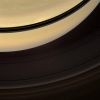
The_Rings-PIA10563.jpgThe Rings of Saturn (Natural Colors; credits: NASA/JPL/Space Science Institute)59 visiteCaption NASA:"Shadows cast onto Saturn by its Rings, visible here as dark bands, move steadily towards the Equator and grow thinner as Equinox approaches.
The Sun will cross Saturn's Ring-Plane on Aug. 10, 2009. Color variations between clouds in the Northern Hemisphere are more apparent than those in the Southern Hemisphere, which seems relatively bland, as Spring arrives in the North and Fall in the South.
Images taken using red, green and blue spectral filters were combined to create this natural color view. The images were acquired with the Cassini spacecraft wide-angle camera on Nov. 22, 2008 at a distance of approx. 859.000 Km (about 533.000 miles) from Saturn and at a Phase Angle of 56°.
Image scale is roughly 48 Km (about 30 miles) per pixel".MareKromiumGen 25, 2009
|
|

Saturn-PIA10558.jpgPolar Blue (possible True Colors; credits: NASA/JPL/Space Science Institute)58 visiteCaption NASA:"Saturn's North Pole retains its bluish hue in this true color Cassini image, even as Northern Winter is coming to an end. The azure blue of Saturn's Winter Hemisphere during the early Cassini prime mission still remains a puzzle. Over the course of time, the blue color has faded and has been replaced with bands of other hues (see also PIA11141).
The North Pole is in shadow here, but a portion of its oscillating hexagonal pattern is visible. Storms create the look of a pockmarked surface.
Images taken using red, green and blue spectral filters were combined to create this Natural Color view. The images were acquired with the Cassini Spacecraft wide-angle camera on Nov. 29, 2008 at a distance of approx. 1,1 MKM (about 683.000 miles) from Saturn and at a Sun-Saturn-Spacecraft, or Phase, Angle of 38°.
Image scale is roughly 62 Km (about 39 miles) per pixel".MareKromiumGen 17, 2009
|
|
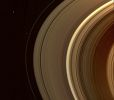
The_Rings-PIA10556.jpgFantastic View (possible True Colors; credits: Lunar Explorer Italia)57 visiteCaption NASA:"Three of Saturn's satellites are visible in this snapshot from the Cassini Spacecraft. Janus (approx. 179 Km, or about 111 miles across) is in the top left of the image. Pandora (approx. 81 Km, or about 50 miles across) is just outside the F-Ring and Pan (approx. 28 Km, or about 17 miles across) is the small moon that has cut a path inside the Rings below the center of the image.
This view looks toward the unilluminated side of the Rings from about 27° above the Ring-Plane. The image was taken in visible light with the Cassini Spacecraft wide-angle camera on Dec. 7, 2008 using clear filters: CL1 (635 nm) and CL2 (635 nm). It was obtained from a distance of approx. 1 MKM (such as about 641.000 miles) from Pan and at a Sun-Pan-Spacecraft, or Phase, Angle of 33°. Image scale is roughly 62 Km (about 38 miles) per pixel".MareKromiumGen 16, 2009
|
|

The_Rings-Shadow-N00127580.jpgEclipsing the Rings (1)60 visiteL'impressione iniziale? C'è un (gigantesco!) UFO nei pressi dell'Anello "B" di Saturno!
La realtà? Si tratta dell'ombra, affusolata, di una delle tante lune del Gigante Anellato (onestamente non abbiamo idea di quale sia, ma ci sembra logico pensare ad una Luna Pastore e, vista la forma dell'ombra, a Prometeo od Epimeteo) che, con il suo passaggio davanti al Sole, sta creando e provocando una splendida eclissi su una modestissima porzione degli Anelli di Saturno.
Insomma: "la Natura al lavoro"!MareKromiumGen 13, 2009
|
|

The_Rings-Shadow-N00127581.jpgEclipsing the Rings (2)56 visitenessun commentoMareKromiumGen 13, 2009
|
|

The_Rings-Shadow-N00127582.jpgEclipsing the Rings (3)58 visitenessun commentoMareKromiumGen 13, 2009
|
|

The_Rings-Shadow-N00127583.jpgEclipsing the Rings (4)60 visitenessun commentoMareKromiumGen 13, 2009
|
|
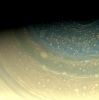
Saturn-PIA10553-1.jpgThe Blue Pole of Saturn (natural colors; credits: NASA/JPL/Space Science Institute and Lunar Explorer Italia)58 visiteCaption NASA:"Saturn's North Pole is littered with storms, as we see in this color view of it. A bit of the North Polar Hexagon is also visible at the upper-right. Cassini scientists are looking forward to sunrise on this Pole next year so that they can better study it in Visible Light.
Images taken using red, green and blue spectral filters were combined to create this full color view. The images were obtained with the Cassini Spacecraft wide-angle camera on Nov. 16, 2008 at a distance of approx. 673.000 Km (such as about 418.000 miles) from Saturn and at a Sun-Saturn-Spacecraft, or Phase, Angle of 71°.
Image scale is roughly 37 Km (about 23 miles) per pixel".MareKromiumGen 13, 2009
|
|
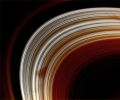
The_Rings-PIA10550.jpgA "Ghost" in the B-Ring (True - but strongly enhanced - Colors; credits: Lunar Explorer Italia)89 visiteCaption NASA:"The ghostly features in Saturn's B-Ring called "Spokes" are making an appearance again as the Cassini Spacecraft continues its tour of the Saturn System.
These dusty features on the Rings are often wedge-shaped, as this one is, with the inner portions of the Spoke being wider than the outer portions due to electromagnetic effects on the dust particles.
The image was taken in Visible Light with the Cassini Spacecraft wide-angle camera on Nov. 26, 2008 at a distance of approximately 922,000 kilometers (573,000 miles) from Saturn and at a Sun-Saturn-Spacecraft, or Phase, Angle of 39°.
Image scale is roughly 52 Km (about 32 miles) per pixel".MareKromiumGen 07, 2009
|
|

Mimas-PIA10548.jpgMimas over the Rings (possible True Colors credits: Lunar Explorer Italia69 visiteCaption NASA:"Gray Mimas appears to hover above the colorful Rings. The large crater seen on the right side of the moon is named for William Herschel, who discovered Mimas in 1789.
The image was taken using red, green and blue spectral filters; it was acquired with the Cassini Spacecraft narrow-angle camera on Sept. 9, 2007 at a distance of approx. 3,1 MKM (such as about 1,9 MMs) from Mimas and at a Sun-Mimas-Spacecraft, or Phase, Angle of 34°. Image scale is roughly 19 Km (about 12 miles) per pixel".MareKromiumGen 06, 2009
|
|
| 2245 immagini su 188 pagina(e) |
 |
|
|
|
|
43 | |
|
|
|
|





