| Ultimi arrivi - Saturn: the "Ringed Beauty" and His Moons |
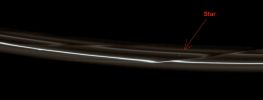
PIA10587.jpgThe "Fragile" F-Ring56 visiteCaption NASA:"Set starkly against the blackness of space are the F-Ring's delicate strands which are periodically gored by its shepherding moon, Prometheus.
Prometheus (approx. 86 Km, or about 53 miles across) and Pandora (approx. 81 Km, or about 50 miles across) both interact with the F-Ring but neither is visible here. Prometheus has the larger effect (see, for instance, PIA08397 for a movie of Prometheus creating a Streamer-Channel in the ring).
A star can be seen through the ring on the right side (Dx) of the image.
This view looks toward the unilluminated side of the Rings from about 33° above the Ring-Plane. The image was taken in visible light with the Cassini Spacecraft narrow-angle camera on Jan. 11, 2009.
The view was acquired at a distance of approx. 1 MKM (such as about 620,000 miles) from Saturn and at a Sun-Saturn-Spacecraft, or Phase, Angle of 37°.
Image scale is roughly 6 Km (about 4 miles) per pixel".MareKromiumFeb 26, 2009
|
|

Rhea-PIA10586.jpgRhea (Natural Colors; credits: Lunar Explorer Italia)58 visiteCaption NASA:"A wide crater dominates the lower right of this image while part of Rhea's brightly lit, wispy terrain can still be seen near the limb of the moon.
Smaller craters are overprinted upon this crater, telling the story of an extremely old feature that has collected impacts over the eons. Younger craters also have been collected on another of Rhea's large basins — Tirawa (see also PIA08976).
North on Rhea (approx. 1528 Km, or about 949 miles across) is up. This view looks toward the Saturn facing-Side of Rhea. The image was taken in visible light with the Cassini Spacecraft narrow-angle camera on Aug. 27, 2008. The view was acquired at a distance of approx. 1,1 MKM (such as about 680,000 miles) from Rhea and at a Sun-Rhea-Spacecraft, or Phase, Angle of 56°.
Image scale is roughly 6 Km (about 4 miles) per pixel".MareKromiumFeb 26, 2009
|
|

Saturn-PIA10585.jpgSaturnian Terminator (Natural Colors; credits: Lunar Explorer Italia)58 visiteCaption NASA:"The Terminator nearly covers the South Pole of Saturn and its stormy vortex in darkness.
As the Southern Hemisphere moves toward Winter in the Planet's 29-year orbit, darkness eventually will consume the vortex. But this seasonal change also will bring the North Pole into the light.
This view looks toward the sunlit side of the Rings from about 69° below the Ring-Plane.
The image was taken with the Cassini Spacecraft wide-angle camera on Jan. 6, 2009 using a spectral filter sensitive to wavelengths of near-InfraRed Light centered at 752 nanometers. The view was acquired at a distance of approx. 761.000 Km (about 473.000 miles) from Saturn and at a Phase Angle of 96°.
Image scale is roughly 42 Km (approx. 26 miles) per pixel.MareKromiumFeb 25, 2009
|
|

Tethys-PIA10582.jpgGibbous Tethys57 visiteCaption NASA:"Like the lengthy story of its Greek king namesake, the humongous Odysseus Impact Basin stretches on and on across Tethys.
The approx. 450-Km (about 280-mile) wide Odysseus Crater is a well-preserved example of an ancient multi-ringed Impact Basin. The Outer Ring's steep, cliff-like walls descend to broad internal terraces. The Inner Ring consists of a circular band of icy mountains creating a crown shape with a diameter of about 140 Km (approx. 87-miles).
This view looks toward the leading hemisphere of Tethys (1062 kilometers, or 660 miles across). North on Tethys is up and rotated 2 degrees to the right.
The image was taken in visible light with the Cassini Spacecraft narrow-angle camera on Jan. 2, 2009. The view was obtained at a distance of approx. 816.000 Km (about 507.000 miles) from Tethys and at a Sun-Tethys-Spacecraft, or Phase, Angle of 58°.
Image scale is roughly 5 Km (about 3 miles) per pixel".MareKromiumFeb 20, 2009
|
|
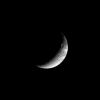
Dione-PIA10577.jpgCrescent Dione57 visiteCaption NASA:"This high-phase view of Dione shows the great contrast between the highly reflective "wisps" and the surrounding terrain. These wispy lines are geologically young fractures exposing the icy surface of the moon.
Lit terrain seen here is on the Trailing Hemisphere of Dione (about 1123 Km, or approx. 698 miles, across). North on Dione is up.
The view was acquired from a position 39° South of the moon's Equator. The image was taken in Visible Light with the Cassini Spacecraft narrow-angle camera on Dec. 26, 2008. The view was obtained at a distance of approx. 789.000 Km (about 490.000 miles) from Dione and at a Sun-Dione-spacecraft, or Phase, Angle of 124°
Image scale is roughly 5 Km (about 3 miles) per pixel".MareKromiumFeb 20, 2009
|
|

TheRings-PIA10581.jpgBright Spokes (Natural Colors; credits: Lunar Explorer Italia)57 visiteCaption NASA:"Signaling a return to the bright Spokes first encountered by the Cassini Spacecraft in 2005, three large white Spokes stretch out across the B-Ring. Throughout most of the last year, Cassini captured views of dark Spokes.
This image of bright Spokes was taken Jan. 14, 2009 in Visible Light with the Spacecraft's wide-angle camera.
The small moon Atlas (about 30 Km, or approx. 19 miles across) has been brightened by 30% but still appears as a faint dot between the A and F Rings in the top right quadrant of the image.
This view looks toward the sunlit side of the Rings from about 6° below the Ring-Plane. The view was acquired at a distance of approx. 551.000 Km (about 342.000 miles) from Saturn and at a Sun-Saturn-Spacecraft, or Phase, Angle of 155°. Image scale is roughly 29 Km (such as about 18 miles) per pixel".MareKromiumFeb 18, 2009
|
|
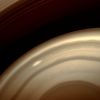
Saturn-PIA10580.jpgSouthern Atmosphere (Natural Colors; credits: Lunar Explorer Italia)58 visiteCaption NASA:"A Cassini Spacecraft image captures a bright, oblong storm swirling high through the Middle Latitudes of the Southern Hemisphere.
The image was taken through a spectral filter centered on wavelengths of light that are strongly absorbed by Methane gas. Hence, any light making it through this filter to the camera's detector has bounced off clouds that are high in the Atmosphere, making them visible, while light passing through the cloud-free surroundings gets absorbed by the Methane gas there before it reaches the lower clouds.
The image was taken with the Cassini Spacecraft wide-angle camera on Jan. 5, 2009 using a spectral filter sensitive to wavelengths of near-InfraRed Light centered at 890 nanometers. The view was acquired at a distance of approx. 711.000 Km (such as about 442.000 miles) from Saturn and at a Sun-Saturn-Spacecraft, or Phase, Angle of 106°.
Image scale is roughly 39 Km (about 24 miles) per pixel".MareKromiumFeb 18, 2009
|
|
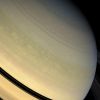
Saturn-PIA10578.jpgThe Northern Hemisphere of Saturn (Natural Colors; credits: NASA/JPL/Space Science Institute)58 visiteCaption NASA:"A chef's bounty of colors is represented in this full color view of Saturn's Northern Hemisphere.
Butternut, peach, and olive hues have replaced the azure blue of Winter. The blue of Saturn's Winter Hemisphere during the early Cassini Prime Mission still remains a puzzle. Over the course of time, the blue color has faded and has been replaced with bands of other hues (see also PIA11141).
This picture is a combination of images taken in red, green and blue light with the Cassini spacecraft wide-angle camera on Jan. 1, 2009. The view was obtained at a distance of approx. 1,1 MKM (such as about 680.000 miles) from Saturn and at a Sun-Saturn-Spacecraft, or Phase, Angle of 28°.
Image scale is roughly 65 Km (about 40 miles) per pixel".MareKromiumFeb 14, 2009
|
|
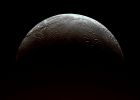
Enceladus-PIA10573.jpgCrescent Enceladus (Natural Colors; credits: Lunar Explorer Italia)60 visiteCaption NASA:"Sunrise uncovers both old and new Enceladus in this image from the Cassini Spacecraft. The lit side of the moon faces Saturn in this view of the Trailing Hemisphere. Old craters still pockmark the Northern Hemisphere while more recent geologic activity has swept them away in the South. North is on the right (Dx) in this image.
Mountain Ranges, a.k.a. "Dorsae", undulate across the moon's surface near the Equator.
From this high northern viewing angle, the South Pole's fascinating "Tiger Stripe Area" lies just out of view. Sulci, a.k.a. "furrows", in that area, are the sources of icy plumes being studied by Cassini scientists.
(See also PIA07800 and PIA09761).
Also near the Tiger Stripes are rift segments that resemble the zigzag patterns seen on Earth of sea-floor spreading from upwelling magma. See PIA11138 for a comparison of the phenomena.
Like outstretched fingers, the Samarkand Sulci reach from the West toward the North Pole, clearing their path of craters and slicing some in half.
This Natural Colors mosaic combines narrow-angle camera images obtained through UltraViolet, Green, and near-InfraRed camera filters. The images were acquired on Dec. 2, 2008 at a distance of approx. 124.000 Km (such as about 77.000 miles) from Enceladus and at a Sun-Enceladus-Spacecraft, or Phase, Angle of 116°.
Image scale is roughly 742 meters (2430 feet) per pixel".MareKromiumFeb 07, 2009
|
|

Dione-N00080526~0.jpgDione (Natural Colors; credits: Lunar Explorer Italia)58 visitenessun commentoMareKromiumFeb 06, 2009
|
|

The_Rings-PIA10571.jpgThe core of the F-Ring (Natural Colors; credits: Lunar Explorer Italia)59 visiteCaption NASA:"Structure in the tenuous F-Ring can be seen in this image of the ring's bright core.
Much of the structure in the F-Ring is created by its two shepherding moons: Prometheus (about 86 Km, or approx. 53 miles across) and Pandora (about 81 Km, or approx. 50 miles across).
The image was taken in Visible Light with the Cassini Spacecraft narrow-angle camera on Dec. 8, 2008.
The view, which looks down from about 70° above the Ring-Plane toward the unilluminated side of the Rings, was acquired at a distance of approx. 613.000 Km (about 381.000 miles) from Saturn and at a Sun-Saturn-Spacecraft, or Phase, Angle of 77°.
Image scale is roughly 3 Km (a little less than 2 miles) per pixel".MareKromiumFeb 06, 2009
|
|
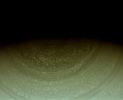
Saturn-PIA10568.jpgNorth Polar Hues (possible Natural Colors; credits: Lunar Explorer Italia)69 visiteCpation NASA:"Cassini imaging scientists have waited years for the Sun to reveal the Hexagonal Wave Pattern (a.k.a.: The Hexagon) in the clouds of Saturn's North Pole, part of which can be seen at the top of this image from the Cassini Spacecraft. This mosaic combines four separate near-InfraRed images to show one full side of the Hexagon and two partial sides cut off by shadow.
When the Spacecraft arrived in 2004, Winter darkened the North Pole. As the Planet continues its 29-year orbit, the Sun sheds more light on northern features and uncovers more of this strange, long-lived formation first observed in Voyager images of the illuminated Northern Pole from the early 1980's.
False color images made from data collected by Cassini's Visual and InfraRed Mapping Spectrometer (VIMS) have previously captured the full six-sided pattern in the IR Light. (See PIA09188)
South of the Hexagon at least five large storm systems can be seen spinning in a sea of smaller storms.
The image was taken with the Cassini Spacecraft wide-angle camera on Dec. 1, 2008 using a spectral filter sensitive to wavelengths of near-iIR Light centered at 752 nanometers. The view was obtained at a distance of approx. 712.000 kilometers (442,000 miles) from Saturn and at a Sun-Saturn-spacecraft, or phase, angle of 69 degrees. Image scale is 39 Km (such as about 24 miles) per pixel".MareKromiumFeb 03, 2009
|
|
| 2245 immagini su 188 pagina(e) |
 |
|
|
|
|
42 | |
|
|
|
|





