| Ultimi arrivi - Saturn: the "Ringed Beauty" and His Moons |

Atlas-N00084627.jpgAtlas (by Dr M. Faccin)66 visitenessun commentoMareKromiumMar 12, 2009
|
|

Saturn-W00051968-70-71.jpgThe North Pole of Saturn (Natural Colors; credits: Dr M. Faccin)57 visiteCon calma, abbiamo "rivelato" quelli che, se non altro a nostro parere (ed in accordo alla nostra tecnica di colorizzazione delle immagini RAW), erano e sono i "True" e "Natural" colors di Marte.
Adesso è la volta di Saturno e delle sue mutevoli lune. In questa elaborazione, un esempio (il primo, di fatto) di processing RGB per i Colori Naturali realizzato dal nostro ECCEZIONALE Dr Faccin.
Guardate e valutate Voi.MareKromiumMar 10, 2009
|
|
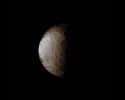
Japetus-V2-LXT.jpgJapetus (Natural Colors; credits: Lunar Explorer Italia)59 visitenessun commentoMareKromiumMar 09, 2009
|
|

Rhea.jpgTirawa Basin on Reha, from Voyager 1 (Natural Colors; credits: Ted Stryk)56 visiteAs Voyager 1 receded from its close flyby of Rhea, it snapped this view of Rhea's Tirawa Basin, a large impact structure seen on the Terminator in this crescent view.
It is on of the worst-imaged parts of this world, and this Voyager view is still the best. Rhea is a moon that shows some similar features to more active Dione and Tethys, but seems to have been inactive for longer, as evidenced by the fact that all of its surface is extremely worn from impacts and the evidences of internal activity are much more subtle.MareKromiumMar 09, 2009
|
|

Tethys.jpgTethys, from Voyager 1 (Natural Colors; credits: Ted Stryk)56 visitenessun commentoMareKromiumMar 09, 2009
|
|

Enceladus-PIA01394.jpgEnceladus, with "Pink" Nuances (by Ted Stryk)58 visitenessun commentoMareKromiumMar 08, 2009
|
|

Prometheus-PIA10593.jpgStreamer Channel (Natural Colors; credits: Lunar Explorer Italia)69 visiteCaption NASA:"Half an hour after Prometheus tore into this region of Saturn's F -Ring, the Cassini Spacecraft snapped this image just as the moon was creating a new Streamer in the Ring. The dark pattern shaped like an upside down check mark in the lower left of the image is Prometheus and its shadow.
The potato shaped moon can just be seen coming back out of the Ring. The moon's handiwork also is apparent in 2 previous Streamer-Channel formations on the right of the image. The darkest Streamer-Channel stretching from the top right to the center of the image shows Prometheus' previous apoapse passage about 15 hours earlier. A fainter, even earlier channel extends to the edge of the image.
Prometheus (about 86 Km, or approx. 53 miles across) dips into the inner edge of the F-Ring when it reaches apoapse, the moon's farthest orbital point from Saturn. At apoapse, the moon's gravity pulls particles of the ring outward into a streamer.
As Prometheus moves onward toward periapse — its orbit's closest point to the Planet — the Streamer gets longer. Then, as Prometheus moves back toward apoapse, the Streamer breaks apart which results in a dark channel.
This Streamer-Channel cycle repeats once every orbit with the Streamer-Channel features being streamers during Prometheus periapse and channels during Prometheus apoapse. The F-Ring is overexposed in this image which has been brightened to reveal the moon.
This view looks toward the unilluminated side of the Rings from about 18° above the Ring-Plane. The image was taken in Visible Light with the Cassini Spacecraft narrow-angle camera on Jan. 14, 2009.
The view was obtained at a distance of approx. 555.000 Km (345.000 miles) from Saturn and at a Sun-Saturn-Spacecraft, or Phase, Angle of 145°.
Image scale is roughly 3 Km (a little less than 2 miles) per pixel".MareKromiumMar 07, 2009
|
|

Saturn-PIA10591.jpgHigh Southern Latitudes (Natural Colors; credits: Lunar Explorer Italia)57 visiteCaption NASA:"Intricate curlicues and circular patterns of storms swirl through the High Latitudes near Saturn's South Pole in this image from the Cassini Spacecraft.
The view was obtained at a distance of approx. 588.000 Km (such as abpout 365.000 miles) from Saturn and at a Sun-Saturn-Spacecraft, or Phase, Angle of 140°. At this High Phase Angle, the Sun is illuminating the limb of the Planet from almost the opposite side of Saturn from the Spacecraft.The image was taken with the Cassini Spacecraft wide-angle camera on Jan. 5, 2009 using a spectral filter sensitive to wavelengths of near-InfraRed Light centered at 752 nanometers.
Image scale is roughly 32 Km (about 20 miles) per pixel".MareKromiumMar 05, 2009
|
|

Moonlet-PIA11148-1.jpgTiny Moonlet within a G-Ring Arc56 visiteCaption NASA:"This sequence of three images, obtained by NASA's Cassini Spacecraft over the course of about 10 minutes, shows the path of a newly found moonlet in a bright arc of Saturn's faint G-Ring.
In each image, a small streak of light within the Ring is visible. Unlike the streaks in the background, which are distant stars smeared by the camera's long exposure time of 46", this streak is aligned with the G-Ring and moves along the ring as expected for an object embedded in the Ring.
Cassini scientists interpret the moving streak to be reflected light from a tiny moon half a kilometer (a third of mile) wide that is likely a major source of material in the arc and the rest of the G-Ring.
Debris knocked off this moon forms a relatively bright arc of material near the inner edge of the G-Ring, the most visible part of the Ring in these images. That arc, in turn, leaks material to form the entire Ring.
These images were captured by Cassini's narrow-angle camera on Oct. 27, 2008.
The first image (left) was taken in Visible Light, the second image (middle) was taken in Red Light, and the third image (right) in Near-InfraRed Light centered at a wavelength of 750 nanometers.
Image scale for the first image is roughly 7 Km (a little more than 4 miles) per pixel while the second and third were taken at reduced resolution.
These spatially compressed images were captured at 14 Km (about 9 miles) per pixel and then displayed at a size equal to the first image. This view looks toward the un-illuminated side of the Rings from about 5° above the Ring-Plane.
The view was acquired at a distance of approx. 1,2 MKM (such as about 751.000 miles) from Saturn and at a sun-Saturn-Spacecraft, or Phase, Angle of 23°".MareKromiumMar 04, 2009
|
|
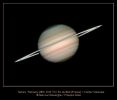
Saturn.jpgThe Lord of the Rings100 visiteCaption NASA, da "NASA - Picture of the Day" del giorno 4 Marzo 2009:"Very good telescopic views of Saturn can be expected in the coming days as the Ringed Planet nears "Opposition" on March 8th, its closest approach to Earth in 2009.
Of course, "Opposition" means opposite the Sun in planet Earth's sky - an arrangement that occurs almost yearly for Saturn. But while Saturn itself grows larger in telescopic images, Saturn's Rings seem to be vanishing as their tilt to our line-of-sight decreases.
In fact, the rings will be nearly invisible, edge-on from our perspective, by September 4, 2009.
Recorded on February 28, this sharp image was made with the 1 meter telescope at Pic Du Midi, a mountain top observatory in the French Pyrenees. The Rings are seen to be tilted nearly edge-on, but remarkable details are visible in the gas giant's cloud bands. The icy moon Tethys appears just beyond the Rings at the lower left".MareKromiumMar 04, 2009
|
|

Mimas-PIA10589.jpgSunshine v/s Saturnshine on Mimas (Natural Colors; credits: Lunar Explorer Italia)58 visiteCaption NASA:"The transition from light to dark takes place on two fronts in this image of Mimas. The two Terminators that stretch across the moon are created by Sunshine across the North and Saturn-shine in the East.
This view looks toward the Trailing Hemisphere of Mimas. North on Mimas is up and rotated 33° to the right.
The image was taken in Visible Light with the Cassini Spacecraft narrow-angle camera on Jan. 23, 2009. The view was acquired at a distance of approx. 508.000 Km (about 316.000 miles) from Mimas and at a Sun-Mimas-Spacecraft, or Phase, Angle of 152°.
Image scale is roughly 3 Km (a little less than 2 miles) per pixel".MareKromiumMar 02, 2009
|
|
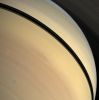
Saturn-PIA10588.jpgJust like an Iris... (Natural Colors; credits: NASA/JPL/Space Science Institute59 visiteCaption NASA:"Rendered in myriad hues, vivid details of Saturn's stormy Atmosphere play out below the shadow of the Rings. A well defined storm swirls through the atmosphere of the southern hemisphere in the lower left of the image, like the tight blue circle of an eye's iris.
This view looks toward the sunlit side of the Rings from about 36° below the Ring-Plane.
Images taken using red, green and blue spectral filters were combined to create this Natural Color view. The images were obtained with the Cassini Spacecraft wide-angle camera on Dec. 29, 2008 at a distance of approx. 1,1 MKM (such as about 680.000 miles) from Saturn and at a Sun-Saturn-Spacecraft, or Phase, Angle of 51°.
Image scale is roughly 60 Km (about 37 miles) per pixel".MareKromiumFeb 27, 2009
|
|
| 2245 immagini su 188 pagina(e) |
 |
|
|
|
|
41 | |
|
|
|
|





