| Ultimi arrivi - Saturn: the "Ringed Beauty" and His Moons |
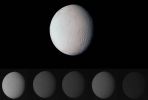
Enceladus_Approach.jpgApproaching Enceladus, from Voyager 257 visitenessun commentoMareKromiumMar 22, 2009
|
|
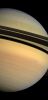
Saturn-PIA11453.jpgShadows (Natural Colors; credits: NASA/JPL/Space Science Institute)58 visiteCaption NASA:"Saturn's Rings cast a dramatic shadow separating the blues and greens of the Planet's Northern Hemisphere from the creamy pastels coloring the Southern Hemisphere.
This mosaic combines 6 images — 2 each of red, green and blue spectral filters — to create this Natural Color view. The images were obtained with the Cassini Spacecraft wide-angle camera on Dec. 30, 2008 at a distance of approx. 1,2 MKM (such as about 750.000 miles) from Saturn and at a Sun-Saturn-Spacecraft, or Phase, Angle of 30°.
Image scale is roughly 67 Km (about 42 miles) per pixel".MareKromiumMar 21, 2009
|
|

Saturn-HST-2009-12-a-full_jpg.jpgThe Ringed Beauty and (some of) His Companions (Natural Colors; credits: NASA)59 visiteCaption NASA:"On February 24, 2009, the Hubble Space Telescope took a photo of 4 moons of Saturn passing in front of their Parent Planet. In this view, the giant orange moon Titan casts a large shadow onto Saturn's North Polar hood. Below Titan, near the Ring-Plane and to the left is the moon Mimas, casting a much smaller shadow onto Saturn's equatorial cloud tops. Farther to the left, and off Saturn's disk, are the bright moon Dione and the fainter moon Enceladus.
These rare moon transits only happen when the tilt of Saturn's Ring-Plane is nearly "edge on" as seen from the Earth. Saturn's Rings will be perfectly edge on to our line of sight on August 10, 2009, and September 4, 2009. Unfortunately, Saturn will be too close to the Sun to be seen by viewers on Earth at that time.
This "Ring-Plane Crossing" occurs every 14-15 years. In 1995-96 Hubble witnessed the Ring-Plane Crossing Event, as well as many moon transits, and even helped discover several new moons of Saturn.
The banded structure in Saturn's Atmosphere is similar to Jupiter's.
Early 2009 was a favorable time for viewers with small telescopes to watch moon and shadow transits crossing the face of Saturn.
Titan, Saturn's largest moon, crossed (and shall cross) Saturn on 4 separate occasions: January 24, February 9, February 24, and March 12, although not all events were visible from all locations on Earth.
These pictures were taken with Hubble's Wide Field Planetary Camera 2 on February 24, 2009, when Saturn was at a distance of roughly 775 MMs (such as about 1,25 BKM) from Earth. Hubble can see details as small as 190 miles (such as about 300 km) across on Saturn. The dark band running across the face of the Planet slightly above the Rings is the shadow of the Rings cast on the Planet".MareKromiumMar 19, 2009
|
|
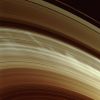
The_Rings-PIA11452.jpgSpokes in the B-Ring (Natural Colors; credits: Lunar Explorer Italia)59 visiteCaption NASA:"As Cassini sped around Saturn, the Spacecraft turned to snap this image of bright Spokes giving chase around the B-Ring.
These radial markings are appearing more often as Saturn approaches Equinox (August 2009) (see also PIA11144).
This view looks toward the sunlit side of the rings from about 31° below the Ring-Plane.
The image was taken in visible light with the Cassini Spacecraft wide-angle camera on Feb. 2, 2009. The view was acquired from a distance of approx. 578.000 Km (such as about 359.000 miles) from Saturn and at a Sun-Saturn-Spacecraft, or Phase, Angle of 144°.
Image scale is roughly 30 Km (about 20 miles) per pixel".MareKromiumMar 19, 2009
|
|

Janus-PIA10599.jpgJanus (Natural Colors; credits: Lunar Explorer Italia)59 visiteCaption NASA:"Janus imitates its two-faced Greek god namesake by catching light on two sides. The brighter side of Janus is lit by the Sun while light reflected off Saturn dimly illuminates the rest of the moon and reveals the non-spherical shape of this small satellite.
This image has been scaled to twice its original size.
This view looks toward the Leading Hemisphere of the Janus (about 179 Km, or approx. 111 miles across).
North on Janus is up and rotated 22° to the left.
The image was taken in visible light with the Cassini spacecraft narrow-angle camera on Feb. 12, 2009.
The view was obtained at a distance of approx. 1 MKM (such as about 621.000 miles) from Janus and at a Sun-Janus-Spacecraft, or Phase, Angle of 112°.
Image scale is roughly 6 Km (about 4 miles) per pixel".MareKromiumMar 17, 2009
|
|

Saturn-PIA10596.jpgSouthern Turbulence (Natural Colors; credits: Lunar Explorer Italia)63 visiteCaption NASA:"Through the Atmosphere of the Southern Hemisphere of Saturn rolls a large storm, seen here as a tight dark circle in the lower left of this image. Horizontal strands of other atmospheric formations give the image the fibrous look of travertine stone.
Prometheus (about 86 Km, or 53 miles across) is a small dark dot in the top left part of the image.
The image was taken with the Cassini spacecraft wide-angle camera on Dec. 30, 2008 using a combination of polarized and spectral filters sensitive to wavelengths of near-InfraRed Light centered at 752 nanometers.
The view was acquired at a distance of approx. 1,2 MKM (about 750.000 miles) from Saturn and at a Sun-Saturn-Spacecraft, or Phase, Angle of 27°.
Image scale is roughly 68 Km (approx. 42 miles) per pixel".MareKromiumMar 17, 2009
|
|

Saturn-W00051152.jpgSaturn: from b&w to Natural Colors (by Dr M. Faccin)57 visitenessun commentoMareKromiumMar 16, 2009
|
|

Tethys-PIA10597.jpgBetween Sunshine and Saturnshine (Natural Colors; credits: Lunar Explorer Italia)58 visiteCaption NASA:"The huge Odysseus Crater is clearly illuminated by the Sun on the Western Limb (Sx) of Tethys, but Saturn - shining from the right - makes the smaller craters on the Eastern part of the moon also visible.
The ancient Odysseus Crater is 450 Km, or about 280 miles, across and covers a sizable chunk of the moon. North on Tethys is up and rotated 31° to the left.
This view looks toward the Saturn-facing side of the moon.
The image was taken in visible light with the Cassini Spacecraft narrow-angle camera on Jan. 22, 2009. The view was acquired at a distance of approx. 793.000 Km (such as about 493.000 miles) from Tethys and at a Sun-Tethys-Spacecraft, or Phase, Angle of 112°.
Image scale is roughly 5 Km (a little more than 3 miles) per pixel".MareKromiumMar 14, 2009
|
|
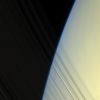
Saturn-PIA10598.jpgThe C-Ring (Natural Colors; credits: NASA/JPL/Space Science Institute)58 visiteCaption NASA:"The Cassini Spacecraft peers through Saturn's delicate, translucent inner C-Ring to see the diffuse blue limb of Saturn's Atmosphere.
This view looks toward the unilluminated side of the rings from about 20° above the Ring-Plane. Images taken using red, green and blue spectral filters were combined to create this Natural Color view. The images were obtained with the Cassini Spacecraft narrow-angle camera on April 25, 2008 at a distance of approx. 1,5 MKM (about 930.000 miles) from Saturn.
Image scale is roughly 8 Km (approx. 5 miles) per pixel".MareKromiumMar 13, 2009
|
|

Dione-N00048330.jpgThe Marvelous Face of Dione (possible True Colors; credits: Dr M. Faccin & Lunar Explorer Italia)56 visitenessun commentoMareKromiumMar 13, 2009
|
|

Enceladus-N00048288.jpgEnceladus (RAW Natural Colors; credits: Dr M. Faccin)65 visitenessun commentoMareKromiumMar 12, 2009
|
|

Dione-N00064211.jpgDione (RAW Natural Colors; credits: Dr M. Faccin)61 visitenessun commentoMareKromiumMar 12, 2009
|
|
| 2245 immagini su 188 pagina(e) |
 |
|
|
|
|
40 | |
|
|
|
|





