| Ultimi arrivi - Saturn: the "Ringed Beauty" and His Moons |

Dione-PIA11471.jpgCosmic "Smile"...150 visiteCaption NASA:"Only a sliver of Dione is visible as the Cassini Spacecraft looks at the dark side of the moon. In a high-phase viewing geometry like the one in which this picture was taken, the Sun and the Spacecraft are on nearly opposite sides of the moon. Here, only a narrow crescent reflects light forward toward Cassini's camera. The outline of a crater is just visible in the Southern Hemisphere.
This view looks toward the Leading Hemisphere of Dione. North on Dione is up and rotated 2° to the right. The image was taken in Visible Light with the Cassini Spacecraft narrow-angle camera on Feb. 25, 2009.
The view was acquired at a distance of approx. 484.000 Km (such as about 301.000 miles) from Dione and at a Sun-Dione-Spacecraft, or Phase, Angle of 166°.
Image scale is roughly 3 Km (a little less than 2 miles) per pixel".MareKromiumApr 17, 2009
|
|

The_Rings-Shadows-1.gifLooooong (!) Shadows on the Rings (GIF-Movie)75 visitenessun commentoMareKromiumApr 16, 2009
|
|

The_Rings-Shadows-2.gifLooooong (!) Shadows on the Rings (GIF-Movie)61 visitenessun commentoMareKromiumApr 16, 2009
|
|
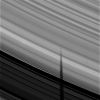
The_Rings-Shadows_cassini_big.jpgA "Wall" on the Rings59 visiteCaption NASA:"What's causing unusual jagged shadows on Saturn's Rings? No one is yet sure. As Saturn nears Equinox, its Rings increasingly show only their thin edge to the Earth and Sun. As a result, Saturn's moons now commonly cast long shadows onto the Rings. An example of this is the elongated vertical shadow of Mimas seen on the above right.
The series of shorter, jagged shadows that run diagonally, however, are more unusual. Now Saturn's Rings have been known to be made of particles for hundreds of years, but these particles have so far escaped direct imaging.
It is therefore particularly exciting that a preliminary hypothesis holds that these jagged shadows are silhouettes of transient groups of ring particles temporarily held close by their own gravity. Future work will surely continue, as the robotic Cassini Spacecraft orbiting Saturn that took the above image will continue to photograph Saturn's magnificent Rings right through Saturn's equinox this August (2009)".MareKromiumApr 15, 2009
|
|
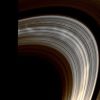
The_Rings-PIA11470.jpgMorning Spokes (Natural Colors; credits: Lunar Explorer Italia)57 visiteCaption NASA:"Bright spokes emerge from behind the shadow of the Planet and into sunlight in this view from the Cassini Spacecraft.
Saturn's long shadow covers the left side of the image. This view looks toward the sunlit side of the Rings from about 22° below the Ring-Plane.
The image was taken in visible light with the Cassini Spacecraft wide-angle camera on Feb. 26, 2009. The view was acquired at a distance of approx. 821.000 Km (about 510.000 miles) from Saturn and at a Sun-Saturn-Spacecraft, or Phase, Angle of 150°.
Image scale is roughly 46 Km (about 29 miles) per pixel".MareKromiumApr 14, 2009
|
|

Janus-PIA11469.jpgJanus' Polar Crater58 visiteCaption NASA:"A large crater on Saturn's tiny moon Janus is distinctly visible in this Cassini Spacecraft image. Lit terrain seen here is on the Leading Hemisphere of Janus (approx. 179 Km, or about 111 miles across). North on Janus is up and rotated 7° to the left.
The image was taken in Visible Light with the Cassini Spacecraft narrow-angle camera on March 5, 2009. The view was acquired at a distance of approx. 1,1 MKM (about 684.000 miles) from Janus and at a Sun-Janus-Spacecraft, or Phase, Angle of 53°. Resolution in the original image was roughly 6 Km (about 4 miles) per pixel.
The image has been magnified by a factor of two to aid visibility".MareKromiumApr 14, 2009
|
|
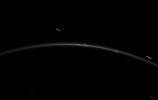
The_Rings-PIA11467.jpgMoonlet in the "G"-Ring58 visiteCaption NASA:"The faint "G"-Ring surrounding Saturn offers up a glimpse of its newfound tiny moonlet. The moonlet is near the center of this image.
A long exposure of 46" was required to capture the light from this tiny object and "G"-Ring, so the moonlet and a few stars have been smeared by motion, the stars showing up as short diagonal dashes.
The moonlet has also been smeared and appears to be a short vertical dash that is aligned with the Ring.
In August 2008 Cassini scientists spotted this moonlet, dubbed S/2008 S 1. It orbits in an arc, or partial ring, within the "G"-Ring. Imaging team scientists estimated the moonlet's diameter at about half a kilometer (one-third mile). For earlier images of this moonlet, see PIA11148.
This view looks toward the unilluminated side of the Rings from about 14° above the Ring-Plane. The image was taken in Visible Light with the Cassini Spacecraft narrow-angle camera on Feb. 20, 2009. The view was acquired at a distance of approx. 1,2 MKM (about 746.000 miles) from Saturn. Image scale is roughly 7 Km (a little more than 4 miles) per pixel".MareKromiumApr 12, 2009
|
|

Saturn-PIA11464.jpgDaybreak from above60 visiteCaption NASA:"Day breaks on the Northern Hemisphere of Saturn in this image from Cassini. The D-Ring is hidden below the horizon, but, working outward from the Planet, this image shows the C, B, A and F-Rings. The moon Prometheus is a faint speck inside the thin F-Ring in the upper left of the image.
This view looks toward the unilluminated side of the Rings from about 39° above the Ring-Plane. The image was taken with the Cassini Spacecraft wide-angle camera on March 20, 2009 using a spectral filter sensitive to wavelengths of Near-InfraRed Light centered at 853 nanometers.
The view was obtained at a distance of approx. 888.000 Km (such as about 552.000 miles) from Saturn and at a Sun-Saturn-Spacecraft, or Phase, Angle of 121°.
Image scale is roughly 50 Km (about 31 miles) per pixel".MareKromiumApr 07, 2009
|
|

Space.gifLight-vawe (GIF-Movie; credits: Dr M. Faccin)104 visitenessun commentoMareKromiumApr 06, 2009
|
|

The_Rings-PIA11462.jpgGhostly Spokes (Natural Colors; credits: Lunar Explorer Italia)111 visiteCaption NASA:"Faint, ghostly Spokes dapple the dark side of Saturn's A-Ring as the Planet's shadow makes a sharp diagonal cut across this image from Cassini.
The image was taken in Visible Light with the Cassini Spacecraft wide-angle camera on April 30, 2008.
This view looks toward the unilluminated side of the rings from about 26° above the Ring-Plane. The view was obtained at a distance of approx. 316.000 Km (such as about 196.000 miles) from Saturn and at a Sun-Saturn-Spacecraft, or Phase, Angle of 147°. Image scale is roughly 15 Km (about 9 miles) per pixel".MareKromiumApr 04, 2009
|
|

Saturn-PIA11461.jpgBlack Shadow from the "White Moon" (Natural Colors; credits: Lunar Explorer Italia)58 visiteCaption NASA:"The shadow of Saturn's moon Enceladus cast onto the Planet's Atmosphere appears like a drop of black ink on a canvas of Saturnian storms.
The image was taken with the Cassini spacecraft narrow-angle camera on June 20, 2008 using a spectral filter sensitive to wavelengths of Near-InfraRed Light centered at 750 nanometers. The view was obtained at a distance of approx. 1,3 MKM (such as about 810.000 miles) from Saturn and at a Sun-Saturn-Spacecraft, or Phase, Angle of 24°.
Image scale is roughly 7 Km (about 4 miles) per pixel".MareKromiumApr 04, 2009
|
|

Sky.gifThe Sky of Saturn...Through the Eyes of Cassini! (GIF-Movie; credits: Dr M. Faccin)68 visiteUno spettacolare GIF-Movie dedicato a tutti quelli che parlano dello Spazio ma, nel farlo, tendono a dimenticarsi della sua incredibile bellezza, profondità e dimensione.
Nel filmato, mentre le stelle lontane (inclusi almeno tre interessanti asterismi) scorrono lentamente attraverso il campo visivo di Cassini, sono visibili anche dei Raggi Cosmici che "incrociano" nei pressi della Sonda e, tanto per gradire, risultano pure facilmente individuabli alcuni classici vizi dell'immagine, sia "fissi" (ivi: microlesioni dell'obbiettivo), sia "mobili" o "fluttuanti" (ivi riconducibili, a nostro parere, a vizi di trasmissione dei dati a Terra e tra i quali riscontriamo "noise" e "dead pixels").
Buona visione!MareKromiumApr 03, 2009
|
|
| 2245 immagini su 188 pagina(e) |
 |
|
|
|
|
38 | |
|
|
|
|





