| Ultimi arrivi - Saturn: the "Ringed Beauty" and His Moons |

Startrail2-N00135049-N00135061.gifStartrail or UFO in-transit? (GIF-Movie; credits: Dr G. Barca)60 visitenessun commentoMareKromiumMag 23, 2009
|
|
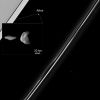
Atlas-PIA11494.jpgAtlas and a few Stars61 visiteCaption NASA:"Atlas is seen in this image with several background stars as the moon orbits within the Roche Division — the Region between Saturn's A and F-Rings.
Atlas (about 30 Km, or approx. 19 miles across) is in the top left quadrant of the image.
This view looks toward the sunlit side of the Rings from about 65° below the Ring-Plane. The image was taken in Visible Light with the Cassini Spacecraft narrow-angle camera on March 23, 2009. The view was acquired at a distance of approx. 913.000 Km (about 567.000 miles) from Saturn and at a Sun-Saturn-Spacecraft, or Phase, Angle of 105°.
Image scale is roughly 5 Km (a little more than 3 miles) per pixel".MareKromiumMag 20, 2009
|
|

Tethys-PIA11495.jpgOdysseus and Penelope57 visiteCaption NASA:"Two large craters named after characters in Homer's Odyssey take the stage in this scene on Saturn's moon Tethys.
The crater on the right is the Odysseus Crater (approx. 450 Km, or about 280 miles across). The one on the left is Penelope, named after the wife of Odysseus.
This view looks toward the anti-Saturn side of Tethys (approx. 1062 Km, or about 660 miles across). North on Tethys is up and rotated 44° to the right.
The image was taken in Visible Light with the Cassini Spacecraft narrow-angle camera on April 12, 2009. The view was acquired at a distance of approx. 931.000 Km (about 578.000 miles) from Tethys and at a Sun-Tethys-Spacecraft, or Phase, Angle of 33°.
Image scale is roughly 6 Km (a little less than 4 miles) per pixel".MareKromiumMag 20, 2009
|
|

Saturn-PIA11493.jpgBetween Day and Night... (Natural Colors; credits: NASA/JPL/Space Science Institute)67 visiteCaption NASA:"Rays of light from the Sun have taken many different paths to compose this glorious image of Saturn and its Rings.
This view looks toward the unilluminated (North) side of the Rings and, at the top of the image, the night side of Saturn. Sunlight has been reflected off the illuminated side of the Rings to light the Planet's Southern Hemisphere, seen here as a bright band of yellow-orange.
The Northern Hemisphere, in the top left corner of the image, is dimly lit by light diffusely scattered through the rings. The Planet's shadow cuts across the Rings, but light reflected off the Southern Hemisphere backlights parts of the C-Ring, making them visible in silhouette. Bright points of light in the image are stars occulted by the Rings.
This view looks toward the unilluminated side of the Rings from about 41° above the Ring-Plane. Images taken using red, green and blue spectral filters were combined to create this Natural Color view. The images were acquired with the Cassini Spacecraft wide-angle camera on March 20, 2009 at a distance of approx. 892.000 Km (such as about 554.000 miles) from Saturn.
Image scale is roughly 50 Km (about 31 miles) per pixel".MareKromiumMag 17, 2009
|
|

The_Rings-PIA11486.jpgShadow on the Rings (Natural Colors; credits: Lunar Explorer Italia)57 visiteCaption NASA:"Saturn's moon Tethys casts a wide shadow over the Planet's "F" and "A"-Rings.
Tethys itself is not visible in this image. As Saturn approaches its August 2009 Equinox, the planet's moons cast shadows onto the Rings. To learn more about this special time and to see a movie of a moon's shadow moving across the Rings, see also PIA11651.
This view looks toward the sunlit side of the rings from about 36° below the Ring-Plane.
The image was taken in Visible Light with the Cassini Spacecraft wide-angle camera on April 21, 2009. The view was obtained at a distance of approx. 1,1 MKM (such as about 684.000 miles) from Saturn and at a Sun-Saturn-Spacecraft, or Phase, Angle of 142°.
Image scale is roughly 63 Km (about 39 miles) per pixel".MareKromiumMag 10, 2009
|
|

The_Rings-PIA11489.jpgShadow on the Rings (Natural Colors; credits: Lunar Explorer Italia)56 visitenessun commentoMareKromiumMag 10, 2009
|
|

The_Rings-PIA11484.jpgShadow on the Rings58 visiteCaption NASA:"The shadow of the moon Mimas extends elegantly across Saturn's A and F-Rings. As Saturn approaches its August 2009 Equinox, the Planet's moons cast shadows onto the rings. To learn more about this special time and to see a movie of a moon's shadow moving across the Rings, see also PIA11651. Two background stars are visible in the image. Mimas is not shown.
This view looks toward the sunlit side of the rings from about 62° below the Ring-Plane. The image was taken in Visible Light with the Cassini Spacecraft narrow-angle camera on April 7, 2009. The view was acquired at a distance of approx. 1,1 MKM (such as about 684.000 miles) from Saturn and at a Sun-Saturn-Spacecraft, or Phase, Angle of 101°.
Image scale is roughly 6 Km (a little more than 4 miles) per pixel".MareKromiumMag 05, 2009
|
|

The_Rings-PIA11483.jpgShadows on the Rings57 visite...EccoVi un altro esempio delle "gigantesche navi spaziali" che si muoverebbero attraverso gli Anelli di Saturno, secondo il Dr Bergrun...
In realtà è soltanto la lunga ombra della luna saturniana Tethys la quale, all'avvicinarsi dell'Equinozio, si stende sugli Anelli del Gigante Gassoso, dando l'impressione - ma solo ad un osservatore completamente disattento - della esistenza di un vascello scuro a forma di fuso che si muove attraverso gli Anelli "F" ed "A".
Caption NASA:"Joining other moons in heralding the coming of Saturn's August 2009 Equinox, the moon Tethys casts its shadow across Saturn's F-Ring and part of the A-Ring.
The penumbra, or outer non-opaque part of Tethys' shadow, has intersected the A-ring. Only around the time of Equinox are the shadows of the moons cast onto Saturn's Rings. For an animation of the moon Epimetheus casting a shadow on the A-Ring, see also PIA11651.
The image on the left was taken in Visible Light with the Cassini Spacecraft wide-angle camera on March 20, 2009. The image on the right was taken with the narrow-angle camera at nearly the same time. Tethys itself is not visible in these images, but the small moon Prometheus can be seen between the F and A-Rings in the top of the wide-angle camera image.
This view looks toward the unilluminated side of the Rings from about 37° above the Ring-Plane. The view was obtained from a distance of approx. 880.000 Km (about 547.000 miles) from Saturn and at a Sun-Saturn-Spacecraft, or Phase, Angle of 124°.
Image scale is roughly 49 Km (about 31 miles) per pixel in the wide-angle image. In the narrow-angle camera image, the scale is roughly 5 Km (a little more than 3 miles) per pixel".MareKromiumMag 02, 2009
|
|

Tethys-PIA11476.jpgTethys (Natural Colors; credits: Lunar Explorer Italia)56 visiteCaption NASA:"The Terminator between shadow and light cuts across a large crater in the high Southern Latitudes of the moon Tethys.
Also visible near the Terminator on the left of the image is a portion of the Ithaca Chasma, a chasm that runs North-South for more than a 1000 Km (about 620 miles). This view looks toward the South Pole of Tethys, and the Pole lies on the Terminator between the crater and the chasm.
Lit Terrain seen here is mostly on the Trailing Hemisphere of Tethys.
The image was taken in Visible Light with the Cassini Spacecraft narrow-angle camera on Feb. 16, 2009. The view was acquired at a distance of approx. 873.000 Km (such as about 542.000 miles) from Tethys and at a Sun-Tethys-Spacecraft, or Phase, Angle of 96°.
Image scale is roughly 5 Km (a little more than 3 miles) per pixel".MareKromiumApr 25, 2009
|
|

Saturn-PIA11478.jpgTransparencies (Natural Colors; credits: NASA/JPL/Space Science Institute)66 visiteCaption NASA:"This Natural Color view from the Cassini Spacecraft highlights the myriad gradations in the transparency of Saturn's inner Rings.
The dark shadows of the Rings separate Saturn's Southern Hemisphere in the bottom of the image from the North. The innermost D-Ring is invisible, laid over the Planet's Northern Hemisphere. The translucent C-Ring runs through the middle of the image. The denser B-Ring stretches across the top of the image.
This view looks toward the sunlit side of the Rings from about 48° below the Ring-Plane. Images taken using red, green and blue spectral filters were combined to create this Natural Color view. The images were acquired with the Cassini Spacecraft wide-angle camera on Feb. 28, 2009 at a distance of approx. 1 MKM (about 620.000 miles) from Saturn.
Image scale is roughly 59 Km (approx. 37 miles) per pixel".MareKromiumApr 25, 2009
|
|

Japetus-PIA11474.jpgCrescent Japetus (Natural Colors; credits: Lunar Explorer Italia)59 visiteCaption NASA:"Only a slice of Japetus is illuminated in this image, but still the Cassini Spacecraft spies the distinctive two-tone surface of this distant Saturnian moon.
Lit terrain seen here is on the Leading Hemisphere of Japetus (about 1471 Km, or about 914 miles across). North on Japetus is up and rotated 13° to the left.
The view was acquired at a distance of approx. 2,7 MKM (about 1,7 MMs) from Japetus and at a Sun-Iapetus-Spacecraft, or Phase, angle of 111°. The image was taken in Visible Light with the Cassini Spacecraft narrow-angle camera on March 3, 2009.
Image scale is roughly 16 Km (about 10 miles) per pixel".MareKromiumApr 22, 2009
|
|

Saturn-PIA11473.jpgThe Northern Region of Saturn (Natural Colors; credits: NASA/JPL/Space Science Institute)68 visiteCaption NASA:"Saturn's Northern Hemisphere is seen here against its nested Rings.
This view from the Cassini Spacecraft looks toward the unilluminated side of the Rings from about 30° above the Ring-Plane. The rings have been brightened relative to the Planet to enhance visibility.
Images taken using red, green and blue spectral filters were combined to create this Natural Color view.
The images were acquired with the Cassini Spacecraft wide-angle camera on Feb. 24, 2009 at a distance of approx. 866.000 Km (about 538.000 miles) from Saturn.
Image scale is roughly 38 Km (about 24 miles) per pixel".MareKromiumApr 19, 2009
|
|
| 2245 immagini su 188 pagina(e) |
 |
|
|
|
|
37 | |
|
|
|
|





