| Ultimi arrivi - Saturn: the "Ringed Beauty" and His Moons |
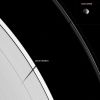
The_Rings_and_Janus_Shadow-PIA11517.jpgJanus and its Shadow on the Rings59 visiteCaption NASA: (Main Frame) "The Cassini Spacecraft catches Janus joining other Saturnian moons in the Equinox "shadow-casting" party. As Saturn approaches its August 2009 Equinox, the Planet's moons cast shadows onto the Rings. Janus (about 179 Km, or approx. 111 miles across) is not visible in this image it has been added in the inset on upper right), but its shadow stretches across Saturn's A and F-Rings. Three background stars are visible in the image.
This view looks toward the sunlit side of the Rings from about 21° below the Ring-Plane. The image was taken in vVisible Light with the Cassini Spacecraft narrow-angle camera on May 10, 2009. The view was acquired at a distance of approx. 965.000 kM (such as about 600.000 miles) from Saturn and at a Phase Angle of 46°.
Image scale is roughly 5 Km (a little more than 3 miles) per pixel".
(Inset): "The small moon Janus is illuminated by light from both the Sun and Saturn. This view looks toward the South Pole of Janus which lies on the Terminator, just below the center of the image. Brightly lit terrain seen on the right is on the Leading Hemisphere of Janus. Light reflected off Saturn dimly lights the Saturn-facing side of Janus on the top left of the image.
The image was taken in Visible Light with the Cassini Spacecraft narrow-angle camera on May 9, 2009. The view was acquired at a distance of approx. 974.000 Km (such as approx. 605.000 miles) from Janus and at a Phase Angle of 99°.
Image scale is roughly 6 Km (a little less than 4 miles) per pixel".MareKromiumGiu 19, 2009
|
|

Daphnis_and_Rings-PIA11656-1.jpgWavy Shadows (ctx frame)58 visiteCaption NASA:"This image of shadows on the Rings and others like it (see also PIA11653 and PIA11655) are only possible around the time of Saturn's equinox which occurs every half-Saturn-year, equivalent to about 15 Earth years. The illumination geometry that accompanies equinox lowers the Sun's angle to the Ring-Plane and causes out-of-plane structures to cast long shadows across the Rings.
This view looks toward the unilluminated side of the Rings from about 49° above the Ring-Plane. The image was taken in visible light with the Cassini Spacecraft narrow-angle camera on April 13, 2009.
The view was obtained at a distance of approx. 1,2 MKM (about 746.000 miles) from Daphnis and at a Sun-Daphnis-Spacecraft, or phase, angle of 56°.
Image scale is roughly 7 Km (about 5 miles) per pixel".MareKromiumGiu 13, 2009
|
|

Daphnis_and_Rings-PIA11656-2.JPGWavy Shadows (edm)57 visiteCaption NASA:"Never-before-seen tall vertical structures created by Saturn's moon Daphnis rise above the Planet's otherwise flat, thin disk of Rings to cast long shadows in this Cassini image.
Daphnis, approx. 8 Km (about 5 miles) across, occupies an inclined orbit within the about 42-Km (approx. 26-mile) wide Keeler Gap in Saturn's outer A-Ring. Recent analyses by imaging scientists published in the Astronomical Journal illustrate how the moon's gravitational pull perturbs the orbits of the particles forming the Gap's edge and sculpts the edge into waves having both vertical and horizontal components.
Measurements of the shadows in this and other images indicate that the vertical structures range between one-half to 1,5 Km tall (about 1/3rd to one mile), making them as much as 150 times as high as the Ring is thick. The main A, B and C-Rings are only about 10 meters (about 30 feet) thick. Daphnis itself can be seen casting a shadow onto the nearby Ring".MareKromiumGiu 13, 2009
|
|

Saturn-PIA11513.jpgSouthern Colors (Natural Colors; credits: NASA/JPL/Space Science Institute)70 visiteCaption NASA:"The Cassini Spacecraft samples a bit of Saturn's Southern Hemisphere along with a spread of the Planet's main Rings.
Working outward from the Planet, the C, B, and A-Rings are visible in this Natural Color image. The Rings have been brightened relative to the Planet to enhance their visibility.
This view looks toward the sunlit side of the Rings from about 59° below the Ring-Plane. Images taken using red, green and blue spectral filters were combined to create this Natural Color view.
The images were acquired with the Cassini Spacecraft wide-angle camera on April 23, 2009 at a distance of approx. 1 MKM (about 621.000 miles) from Saturn.
Image scale is roughly 58 Km (approx. 36 miles) per pixel".MareKromiumGiu 13, 2009
|
|
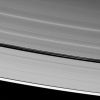
The_Rings-PIA11502.jpgEncke Ringlets58 visiteAlthough Saturn's moon Pan is absent from this image of the A-Ring's Encke Gap, the moon's handiwork is still displayed.
The two ringlets seen in the gap are maintained by the gravitational action of Pan (about 28 Km, or approx. 17 miles across). To learn more about this process, see also PIA07528.
The point of light near the bottom of the image is a star.
This view looks toward the unilluminated side of the Rings from about 41° above the Ring-Plane. The image was taken in Visible Light with the Cassini Spacecraft narrow-angle camera on April 17, 2009. The view was obtained at a distance of approx. 1,3 MKM (about 808.000 miles) from Saturn and at a Sun-Saturn-Spacecraft, or Phase, Angle of 115°.
Image scale is roughly 8 Km (about 5 miles) per pixel.MareKromiumGiu 01, 2009
|
|

The_Rings-PIA11504.jpgGravity-induced "Ondulations"59 visiteCaption NASA:"Saturn's moon Daphnis gives a scalloped look to the edge of the A-Ring as the moon orbits within the Keeler Gap.
Daphnis is the bright spot in the narrow gap near the center of the image. Since the gap is not much larger than the moon, the small moon's gravity is great enough to perturb the particles in the Ring and create the wavelike patterns seen here. See also PIA09850 to learn more.
This view looks toward the unilluminated side of the Rings from about 61° above the Ring-Plane. The image was taken in Visible Light with the Cassini Spacecraft narrow-angle camera on April 30, 2009. The view was acquired at a distance of approx. 1,5 MKM (such as about 932.000 miles) from Daphnis and at a Sun-Daphnis-Spacecraft, or Phase, angle of 73°.
Image scale is roughly 9 Km (a little less than 6 miles) per pixel".MareKromiumGiu 01, 2009
|
|

ZO-Saturn_New_Moon-S2008-S1-PIA11503.jpgSaturn's New Moon S/2008 S161 visiteCaption NASA:"A bright arc within Saturn's faint G-Ring holds a tiny gift: a small moonlet is just visible as a short streak near the ansa of the G-Ring Arc in the top of two versions of the same image.
The second (bottom) version of the image has been brightened to enhance the visibility of the G-Ring. The other streaks in this version of the image are stars smeared by the camera's long exposure time of 26". This version of the image shows a gap in the G-Ring which was faintly visible in an earlier Cassini movie (see PIA08327).
This view looks toward the sunlit side of the Rings from about 1° below the Ring-Plane. The image was taken in Visible Light with the Cassini Spacecraft narrow-angle camera on Jan. 28, 2009. The view was acquired at a distance of approx. 1,2 MKM (such as about 746.000 miles) from Saturn and at a Sun-Saturn-Spacecraft, or Phase, Angle of 27°.
Image scale is roughly 7 Km (a little more than 4 miles) per pixel".MareKromiumGiu 01, 2009
|
|

Pandora-PIA11499.jpgPandora56 visiteCaption NASA:"The thin shadow of the moon Pandora cuts across Saturn's narrow F-Ring.
As Saturn approaches its August 2009 Equinox, the planet's moons cast shadows onto the Rings. Pandora (about 81 Km, or approx. 50 miles across) is on the left of the image. Other bright points of light in the image are background stars.
This view looks toward the unilluminated side of the Rings from about 55° above the Ring-Plane. The image was taken in Visible Light with the Cassini Spacecraft narrow-angle camera on April 16, 2009. The view was obtained at a distance of approx. 1,3 MKM (such as about 808.000 miles) from Saturn and at a Sun-Saturn-Spacecraft, or Phase, Angle of 98°.
Image scale is roughly 8 Km (about 5 miles) per pixel".MareKromiumMag 25, 2009
|
|

Japetus-PIA08375~0.jpgSnow on Japetus' Mountains (Natural Colors; credits: Lunar Explorer Italia)108 visiteDopo aver effettuato la consueta colorizzazione Multispettrale ed in Colori Naturali, la nostra idea è che le chiazze bianche e dai riflessi blu che caratterizzano alcuni rilievi della misteriosa Luna Saturniana Giapeto debbano essere riferiti a ghiaccio d'acqua (la cui albedo e specifica colorazione lo rende inconfondibile).
Pronti a scusarci in caso di errore, rimettiamo la parola ai nostri Amici di Pasadena (che, sino ad oggi, sull'argomento in questione non si sono sbilanciati).MareKromiumMag 24, 2009
|
|

The_Rings-PIA11498.jpgShadow on the Rings (Natural Colors; credits: Lunar Explorer Italia)58 visiteCaption NASA:"The partial shadow of the moon Tethys demonstrates the variations in density across Saturn's Rings.
As the Cassini Spacecraft looks toward the unilluminated side of the Rings from about 37° above the Ring-Plane, part of Tethys' shadow is seen lying across the A-Ring and Cassini Division. The densest part of the A-Ring and the denser B-Ring let neither sunlight nor the darkness of Tethys' shadow pass through to the Spacecraft's camera, so the moon's shadow appears cut off. The B-Ring instead appears brightly lit here from Saturnshine. Tethys is not shown.
As Saturn approaches its August 2009 Equinox, the planet's moons cast shadows onto the Rings. (...)
The image was taken in Visible Light with the Cassini Spacecraft wide-angle camera on April 17, 2009. The view was obtained at a distance of approx. 1,3 MKM (about 808.000 miles) from Saturn and at a Phase Angle of 120°.
Image scale is roughly 75 Km (about 47 miles) per pixel".MareKromiumMag 24, 2009
|
|
Eclipse-N00136236.gifEclipse... (GIF-Movie; credits: Dr G. Barca)57 visiteUno spettacolare GIF-Movie realizzato dal nostro (sempre più bravo) Dr Barca il quale ci mostra una stupenda eclissi mentre si materializza davanti agli "occhi elettronici" dell'Orbiter CASSINI.
Un "commento"? Ecco lo Spazio: l'Ultima Frontiera. La VERA e l'UNICA Ultima Frontiera.MareKromiumMag 23, 2009
|
|

Startrail1-N00135035.gifStartrail or UFO in-transit? (GIF-Movie; credits: Dr G. Barca)69 visitenessun commentoMareKromiumMag 23, 2009
|
|
| 2245 immagini su 188 pagina(e) |
 |
|
|
|
|
36 | |
|
|
|
|





