| |

| Ultimi arrivi - Saturn: the "Ringed Beauty" and His Moons |

The_Rings-PIA11539.jpgShadowing the "Gap"...58 visiteCaptin NASA:"The shadow of the moon Tethys is cast onto Saturn's "A"-Ring, almost blanketing the Enke Gap.
The novel illumination geometry created as Saturn approaches its August 2009 Equinox allows moons orbiting in or near the plane of Saturn's equatorial rings to cast shadows onto the Rings.
These scenes are possible only during the few months before and after Saturn's Equinox which occurs only once in about 15 Earth years. To learn more about this special time and to see a movie of a moon's shadow moving across the rings, see PIA11651 and PIA11660.
This view looks toward the sunlit side of the Rings from about 29° below the Ring-Plane. The image was taken in Visible Light with the Cassini Spacecraft narrow-angle camera on May 25, 2009. The view was acquired at a distance of approx. 759.000 Km (about 472.000 miles) from Saturn and at a Sun-Saturn-spacecraft, or Phase, angle of 56°.
Image scale is roughly 4 Km (about 2,5 miles) per pixel".MareKromiumLug 21, 2009
|
|

Rhea-PIA11537.jpgRhea and two "Possible Companions"58 visiteCaption NASA:"A couple of craters share a crescent of Lit Terrain on Saturn's moon Rhea.
Lit Terrain seen here is on the Trailing Hemisphere of Rhea. This view is centered on 48° North Latitude, 234° West Longitude. The North Pole is on the Terminator, about one-quarter of the way inward from the top of the image.
The image was taken in Visible Violet Light with the Cassini Spacecraft narrow-angle camera on June 3, 2009. The view was obtained at a distance of approx. 1,4 MKM (such as about 870.000 miles) from Rhea and at a Sun-Rhea-Spacecraft, or Phase, Angle of 121°.
Image scale is roughly 8 Km (about 5 miles) per pixel".MareKromiumLug 16, 2009
|
|

Janus-PIA11534.jpgCraters on Janus (possible Natural Colors; credits: Lunexit)58 visiteCaption NASA:"From hundreds of thousands of kilometers away, the Cassini Spacecraft spies craters on the Surface of the moon Janus.
This view looks toward the Saturn-facing side of Janus (about 179 Km, or approx. 111 miles across). North on Janus is up and rotated 27° to the right. The image was taken in Green Light with the Cassini Spacecraft narrow-angle camera on May 25, 2009.
Scale in the original image was roughly 4 Km (approx. 2,5 miles) per pixel. The image has been magnified by a factor of two and contrast-enhanced to aid visibility.
The view was acquired from a distance of approx. 730.000 Km (such as about 454.000 miles) from Janus and at a Sun-Janus-Spacecraft, or Phase, Angle of 38°".MareKromiumLug 14, 2009
|
|

Dione-PIA11532.jpgWispy Dione57 visiteCaption NASA:"The Cassini Spacecraft looks toward the wispy, fractured terrain of the Trailing Hemisphere of the moon Dione.
To learn more about Dione's "Wisps", see also PIA08960.
Lit Terrain seen here is on the Trailing Hemisphere of Dione (about 1123 Km, or approx. 698 miles across). North on Dione is up and rotated 29° to the right.
The image was taken in visible light with the Cassini Spacecraft narrow-angle camera on May 26, 2009. The view was acquired at a distance of approx. 1,3 MKM (about 808.000 miles) from Dione and at a Sun-Dione-Spacecraft, or Phase, Angle of 35°.
Image scale is roughly 8 Km (about 5 miles) per pixel".MareKromiumLug 14, 2009
|
|

Prometheus-PIA11531.jpgPrometheus58 visiteCaption NASA:"The moon Prometheus and a bit of Saturn's Northern Hemisphere are both brilliantly lit by the Sun here, making the A-Ring seem dim in comparison.
The bright limb of Saturn's Northern Hemisphere can be seen through the A-Ring in the lower left of the image.
Prometheus (about 86 Km, or approx. 53 miles across) orbits in the Roche Division between Saturn's A and F-Ring.
For a similar view of Pandora, another of the F-Ring's Shepherding Moons, see PIA09899.
This view looks toward the sunlit side of the Rings, from about 20° below the Ring-Plane.
The image was taken in Red Light with the Cassini Spacecraft narrow-angle camera on May 25, 2009. The view was acquired at a distance of approx. 694,000 Km (about 431.000 miles) from Prometheus and at a Sun-Prometheus-Spacecraft, or Phase, Angle of 49°.
Image scale is roughly 3,6 Km (about 2,2 miles) per pixel".MareKromiumLug 14, 2009
|
|
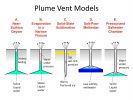
Enceladus-PIA12081.jpgEnceladus' Ice-Plume Models74 visiteCaption NASA:"These illustrations indicate possible ways in which the water vapor and ice particles in the plume of Enceladus may be formed. The Cassini spacecraft recently found a small fraction of salt-rich ice particles from the plumes, while Earth-based observations indicate gas from the plumes is very poor in sodium. These measurements are helping scientists to evaluate how the plumes form.
In model A, salty water boils explosively near the surface of Enceladus when it encounters the vacuum of space. This model can be ruled out, because such explosive activity would spread large amounts of sodium into space where it would have been seen by the Earth-based observers. If this model was correct, then nearly all the ice particles observed by Cassini would be salt-rich, instead of just a fraction of them.
In model B, salty water evaporates more slowly at some depth in a narrow fissure, creating vapor which escapes to the surface to form the plume. This model also seems unlikely because the fissure would rapidly become clogged by salt left behind as water evaporates. The water would also freeze, because not enough heat could reach the water surface up the narrow fissure to replace the heat lost by evaporation.
In model C, the warm ice evaporates directly into vapor to form the plume, in a process called sublimation. The salty particles found in the plume would have been created by liquid water in an earlier epoch and would have been stored in the near-surface layers of Enceladus until the present. These particles would now be incorporated into the plume by the escaping gases. This model cannot be ruled out, but seems unlikely because it may be difficult to dislodge old ice grains from the walls of the fracture.
In model D, the liquid water results from melting of near-surface ice rather than coming from an underlying salty ocean. The water is initially only slightly salty, but its salinity increases as evaporation removes some of the water and leaves the salt behind. Thus, in this model, the salt-rich ice particles seen by Cassini would be derived from initially salt-poor water. This model may be plausible and has not yet been evaluated in detail.
In model E, the water is originally salty, and perhaps comes from a subsurface ocean in contact with an underlying rocky core. The water evaporates slowly into a pressurized chamber, from which water vapor and ice particles, including salty particles from the salt water, escape to the surface along narrow fissures. The large area of the evaporating water surface prevents accumulated salt from clogging the vent and allows enough heat to reach the water surface from below to prevent the water from freezing. This model seems he simplest, and perhaps most likely of the models shown here, but is not the only possibility. Enceladus' plumes may involve a combination of several of these idealized models".MareKromiumGiu 25, 2009
|
|
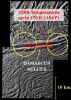
Enceladus-PIA12082.jpgHeat in Damascus Sulcus58 visiteCaption NASA:"This image shows the location of Cassini's most precise measurements so far of the surface temperatures at the active "Tiger Stripe" fractures that cut the South Polar Region of Enceladus. The background image, which shows the Tiger Stripe fracture named Damascus Sulcus, was obtained by Cassini's cameras during the close Enceladus flyby on August 11, 2008 (see PIA11113).
The yellow circles show the approximate location of two of the active plumes of ice particles identified by the Cassini cameras.
The red rectangles show the region of Damascus Sulcus from which heat radiation was measured by Cassini's Composite Infrared Spectrometer (CIRS) at about the same time as the images were taken. The CIRS measurements indicate temperatures up to at least 170 Kelvin (-103 Centigrade or -154 Fahrenheit) near Damascus Sulcus. This is more than 100 degrees Kelvin (180 degrees Fahrenheit) warmer than the surrounding surface, due to heat escaping from Enceladus' interior along the fractures. However, even warmer temperatures are probable over smaller regions close to the Tiger Stripes, and temperatures are expected to be warmer still below Enceladus' Surface.
Therefore, subsurface temperatures may be high enough to melt ice to create liquid water, as is suggested by recent Cassini measurements of the salty composition of ice grains ejected from the Tiger Stripes".MareKromiumGiu 25, 2009
|
|
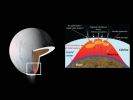
Enceladus-PIA12080.jpgMelted Ice58 visiteCaption NASA:"These drawings depict explanations for the source of intense heat that has been measured coming from Enceladus' South Polar Region. These models predict that water could exist in a deep layer as an ocean or sea and also near the Surface.
Cassini scientists infer that the temperature of the ice in the South Polar Region must be close to its melting point (shown in red). A layer of liquid water (dark blue) might exist between the ice and the silicate core (brown), allowing the ice to deform independent of the rock, providing even more mechanical energy and more flexing of the icy shell for extreme tidal heating.
Tidal heating could also cause friction in faults near the surface, leading to pockets of partially melted ice".MareKromiumGiu 25, 2009
|
|

Mimas-PIA11661.jpgEclipsing Mimas57 visiteCaption NASA:"As the moon Enceladus eclipses its neighbor Mimas, Cassini records a scene possible only around the time of Saturn's approaching Equinox.
Seven images, each taken about 30" apart, were combined to create a movie which shows the shadow of Enceladus (about 504 Km, or approx. 313 miles, across) darkening Mimas (about 396 Km, or approx. 246 miles, across).
Although Saturn has eclipsed moons in previous images (see PIA11143 and PIA11508), this is the first time that Cassini has imaged one of Saturn's moons being eclipsed by another moon rather than the Planet.
The novel illumination geometry created as the Saturnian System approaches Equinox means that during this time moons orbiting in or near the plane of Saturn's Equatorial Rings can cast shadows onto the Rings and onto each other.
This image was taken in Visible Light with the Cassini Spacecraft narrow-angle camera on May 13, 2009. The view was obtained at a distance of approx. 1,3 MKM (about 808.000 miles) from Mimas and at a Phase Angle of 43°.
Image scale is roughly 8 Km (about 5 miles) per pixel".MareKromiumGiu 24, 2009
|
|

The_Rings-PIA11659.jpgShadow from the Dark Side57 visiteCaption NASA:"The shadow of Saturn's moon Tethys seems to disappear as it crosses the Planet's Rings, demonstrating variations in the density of particles across the Rings themselves.
These images, which were combined to create a mosaic and a movie, show Saturn's A-Ring on the left, the Cassini Division in the middle and dense outer B-Ring on the right.
The Cassini Spacecraft looks toward the unilluminated side of the Rings in these frames from about 49° above the Ring-Plane.
The densest parts of the B-Ring do not let much sunlight pass through to the Spacecraft's camera. Consequently, one might expect these dense areas to appear dark because they are on the Dark Side of the Rings and also because the moon's shadow is draped across them. However, these dense areas may appear brighter than expected in this geometry most likely from Saturnshine reflecting from them: denser regions should look brighter in Saturnshine than other regions. As a result, the moon's shadow appears cut off and diminished in these areas.
Seventeen images, each taken about 2' and 17" apart, were combined to create this mosaic. Contiguous images were stitched together to create the mosaic showing the whole swath of the Rings across which the moon's shadow passed. Tethys itself is not shown.
The novel illumination geometry created as the Saturnian System approaches Equinox allows moons orbiting in or near the plane of Saturn's Equatorial Rings to cast shadows onto the Rings. These scenes are possible only during the few months before and after Saturn's Equinox which occurs only once in about 15 Earth years. To see similar movie and mosaic of Mimas' shadow moving across the unlit side of the Rings, see PIA11660.
These images have been processed, and background stars have been removed.
The images were taken in Visible Light with the Cassini Spacecraft narrow-angle camera on April 29, 2009. The view was acquired at a distance of approx. 1,3 MKM (such as about 808.000 miles) from Saturn and at a Sun-Saturn-Spacecraft, or Phase, Angle of 52°.
Image scale is roughly 8 Km (about 5 miles) per pixel".MareKromiumGiu 22, 2009
|
|

The_Rings-PIA11658.jpgA Shadow's Traverse57 visiteCaption NASA:"Mimas' shadow traverses the sunlit side of Saturn's Rings in this mosaic showcasing the unusual sights seen at Saturn as the Planet approaches its August 2009 Equinox.
The novel illumination geometry created as the Saturnian System approaches Equinox allows moons orbiting in or near the plane of Saturn's Equatorial Rings to cast shadows onto the Rings. These scenes are possible only during the few months before and after Saturn's Equinox which occurs only once in about 15 Earth years.
Twenty images, each taken 3' and 36" apart, were combined to create this mosaic. Contiguous images were stitched together to create the mosaic showing the whole swath of the Rings across which the moon's shadow passed.
At the beginning of the sequence, the shadow starts on the bright B-Ring. It crosses the darker Cassini Division and then moves to the A-Ring. At the end, the edge of the shadow just catches the edge of the A-Ring, next to blackness of the Roche Division separating the A-Ring from the thin F-Ring.
These images have been processed, and background stars have been removed. To see a movie and mosaic of Mimas' shadow moving across the unlit side of the Rings, see PIA11660.
This view looks toward the sunlit side of the Rings from about 32° below the Ring-Plane. The images were taken in Visible Light with the Cassini Spacecraft narrow-angle camera on April 9, 2009. The view was obtained at a distance of approx. 1,1 MKM (such as about 684.000 miles) from Saturn and at a Sun-Saturn-Spacecraft, or Phase, Angle of 55°.
Image scale is roughly 6 Km (a little less than 4 miles) per pixel".MareKromiumGiu 22, 2009
|
|

Saturn-PIA11518.jpgApproaching the Equinox76 visiteCaption NASA:"The shadow of the moon Mimas has just slipped off Saturn's Rings and onto the Planet in this Cassini Spacecraft image. The shadow is visible as a short dash below the Rings' shadows on the Planet. At this exposure setting, the Rings are too dim to be seen easily. As Saturn approaches its August 2009 equinox, the Planet's moons cast shadows onto the Rings.
This view looks toward the unilluminated side of the Rings from about 61° above the Ring-Plane. Images taken using red, green and blue spectral filters were combined to create this Natural Color view. The images were obtained with the Cassini Spacecraft wide-angle camera on April 30, 2009 at a distance of approx. 1,4 MKM (about 870.000 miles) from Saturn.
Image scale is roughly 80 Km (about 50 miles) per pixel".MareKromiumGiu 21, 2009
|
|
| 2245 immagini su 188 pagina(e) |
|
|
|
|
|
35 | |
|
|
|
|
|
|





