| Ultimi arrivi - Saturn: the "Ringed Beauty" and His Moons |

Propeller-PIA11672-a.jpgGiant "Propeller" in the A-Ring (CTX Frame)61 visiteAn unusually large "Propeller" feature is detected just beyond the Encke Gap in this Cassini image of Saturn’s outer A-Ring taken a couple days after the Planet’s August 2009 Equinox.
The unique geometry of Equinox has thrown into relief small moonlets within the Rings and the structures they create around them. Propeller-like features, a few kilometers long, centered on and created by the action of small embedded moonlets only about 100 meters across, were discovered early in the mission (see also PIA07792 and PIA07790).
These previous findings constituted the first recognition of the presence in Saturn’s Rings of bodies bigger than the largest ring particles (about 10 meters, or 30 feet, across) but smaller than the 8-Km-wide (about 5-mile-wide) ring moon, Daphnis, in the outer A-Ring.
From the 350-Km (about 220-mile) length of the shadow cast by this 130-Km-long (about 80-mile-long) Propeller, the heights of these features above the Ring-Plane have been measured to reach about 200 meters (650 feet), indicating the moonlet responsible for the Propeller in this image is likely to be 400 meters (1300 feet) across.
A previously released early-Equinox image also had revealed a moonlet in the outer B-Ring about 400 meters (1300 feet) across (see PIA11665).MareKromiumSet 25, 2009
|
|

Propeller-PIA11672-b.jpgGiant "Propeller" in the A-Ring (EDM)56 visiteIt has since become a growing realization resulting from Cassini’s exploration of Saturn that the objects forming Saturn’s Rings very likely span the full spectrum of sizes, from the smallest dust-sized ring particles to the ring-moons like Daphnis and 29-Km-wide (18-mile-wide) Pan - a significant advance in divining the origin of Saturn’s Rings.
The novel illumination geometry that accompanies equinox lowers the Sun’s angle to the Ring-Plane, significantly darkens the Rings and causes out-of-plane structures to cast long shadows across the Rings. (The Rings have been brightened in this image to enhance visibility)
These scenes are possible only during the few months before and after Saturn’s Equinox which occurs only once in about 15 Earth years.
This view looks toward the Northern Side of the Rings from about 20° above the Ring-Plane.
The image was taken in Visible Light with the Cassini Spacecraft narrow-angle camera on Aug. 13, 2009.
This view was acquired at a distance of approx. 1,2 MKM (about 746.000 miles) from Saturn and at a Sun-Saturn-Spacecraft, or Phase, Angle of 87°.
Image scale is roughly 7 Km (about 4,5 miles) per pixel.MareKromiumSet 25, 2009
|
|

TheRings-GIF-W00059891.gifSaturn's "Moons-Carousel" (GIF-Movie; credits: Dr G. Barca)55 visitenessun commentoMareKromiumSet 17, 2009
|
|

Rhea-PIA11550.jpgRhea (Natural Colors; credits: Lunexit)57 visiteCaption NASA:"The battered features of the moon Rhea, seen at low phase, appear washed out by the Sun.
This view looks toward the Saturn-facing side of Rhea at a Sun-Rhea-Spacecraft, or Phase, Angle of 15°. To see Rhea at an even lower phase angle -- near opposition -- see PIA10542.
North on Rhea is up and rotated 7° to the left.
The image was taken in Visible Light with the Cassini spacecraft narrow-angle camera on May 26, 2009. The view was obtained from a distance of approx. 1,4 MKM (such as about 870.000 miles) from Rhea.
Image scale is roughly 9 Km (approx. 5,5 miles) per pixel".MareKromiumSet 13, 2009
|
|
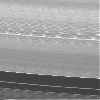
The_Rings-N00139376_to_97.gifSurfing through the Rings... (GIF-Movie; credits: Dr M. Faccin)57 visitenessun commentoMareKromiumSet 12, 2009
|
|

Janus-N00141745to56.gifIn the shadow of Saturn... (GIF-Movie; credits: Dr M. Faccin)57 visitenessun commentoMareKromiumSet 11, 2009
|
|

Janus-PIA11575.jpgJanus (Natural Colors; credits: Lunexit)59 visiteCaption NASA:"The Cassini Spacecraft eyes a prominent crater on the moon Janus.
The South Pole lies on the Terminator at the bottom left of the image. This view is centered on terrain at 16° South Lat., 64° West Long.; this view looks toward the Leading Hemisphere of Janus (about 179 Km, or approx. 111 miles across). North on Janus is up and rotated 31° to the right.
The image was taken in Visible Light with the Cassini Spacecraft narrow-angle camera on July 26, 2009. The view was acquired at a distance of approx. 98.000 Km (such as about 61.000 miles) from Janus and at a Sun-Janus-Spacecraft, or Phase, Angle of 58°.
Image scale is roughly 586 meters (1922 feet) per pixel".MareKromiumSet 09, 2009
|
|
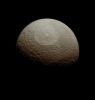
Tethys-PIA11572.jpgOdysseus Crater (Natural Colors; credits: Lunexit)57 visiteCaption NASA:"The Odysseus Crater sprawls across the Mid-Latitudes of the Northern Hemisphere of the moon Tethys.
The Odysseus Crater is about 450 Km across. Lit Terrain seen here is on the anti-Saturn side of Tethys (about 1062 Km, or approx. 660 miles across). This view looks down on the moon's North Pole, which lies on the Terminator about a quarter of the way inward from the top edge of the moon in the image.
The image was taken in Visible Light with the Cassini Spacecraft narrow-angle camera on July 11, 2009.
The view was acquired at a distance of approx. 577.000 Km (about 359.000 miles) from Tethys and at a Sun-Tethys-Spacecraft, or Phase, Angle of 65°.
Image scale is roughly 3 Km (a little less than 2 miles) per pixel".MareKromiumSet 06, 2009
|
|
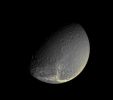
Dione-PIA11565.jpgDione58 visiteCaption NASA:"The Cassini Spacecraft looks down on the North Pole of Dione and the fine fractures that cross its Trailing Hemisphere.
The North Pole of Dione lies on the Terminator between shadow and light, about halfway down the left side of the image. This view is centered at 66° North Lat. and 224° West Long.
Lit terrain seen here is on the Trailing Hemisphere and anti-Saturn side of Dione. To learn more about Dione's fractures, see PIA09764.
The image was taken in Visible Light with the Cassini Spacecraft narrow-angle camera on July 11, 2009. The view was obtained at a distance of approx. 429.000 Km (such as about 267.000 miles) from Dione and at a Sun-Dione-Spacecraft, or Phase, Angle of 67°.
Image scale is roughly 3 Km (a little less than 2 miles) per pixel".MareKromiumAgo 27, 2009
|
|

Enceladus-PIA11562.jpgEnceladus, in the distance (Natural Colors; credits: Lunexit)59 visiteCaption NASA:"Cassini Spacecraft looks toward the varied Surface of the Trailing Hemisphere of Saturn's moon Enceladus. North on Enceladus (about 504 Km, or approx. 313 miles across) is up. For a more detailed view of this Hemisphere, see also PIA08353.
The image was taken in Visible Light with the Cassini spacecraft narrow-angle camera on June 25, 2009. The view was acquired at a distance of approx. 594.000 Km (about 369.000 miles) from Enceladus and at a Sun-Enceladus-Spacecraft, or Phase, Angle of 66°.
Image scale is roughly 4 Km (about 2,5 miles) per pixel".MareKromiumAgo 22, 2009
|
|
The_Rings-N00140419.jpgRings and "noise"59 visitenessun commentoMareKromiumAgo 17, 2009
|
|

The_Rings-N00140429.jpgRings and "noise"57 visitenessun commentoMareKromiumAgo 17, 2009
|
|
| 2245 immagini su 188 pagina(e) |
 |
|
|
|
|
33 | |
|
|
|
|





