| |

| Ultimi arrivi - Saturn: the "Ringed Beauty" and His Moons |

Enceladus-PIA11601.jpgJust like a Pearl... (Natural Colors; credits: Lunexit)58 visiteCaption NASA:"The Cassini Spacecraft looks down at craters near the North Pole of Enceladus.
Cratered surfaces on Solar System moons indicate older terrains, while smooth surfaces are generally younger and therefore indicative of processes which eliminated the craters.
See also PIA08353 to learn more about the true nature of these surfaces and the processes at work on this geologically active moon.
The moon's North Pole lies on the Terminator to the right of the craters seen in this image. Lit Terrain seen here is on the anti-Saturn side and Trailing Hemisphere of Enceladus.
The image was taken in Visible Light with the Cassini Spacecraft narrow-angle camera on July 11, 2009. The view was obtained at a distance of approx. 472.000 Km (such as about 293.000 miles) from Enceladus and at a Sun-Enceladus-Spacecraft (or Phase) Angle of 57°.
Image scale is roughly 3 Km (a little less than 2 miles) per pixel".MareKromiumOtt 14, 2009
|
|

The_Rings-PIA11600.jpgShadows on the Islands...59 visiteCaption NASA:"The shadows cast by Daphnis' attendant edge waves create a dark, jagged pattern on the A-Ring in this image taken as Saturn approached its August 2009 Equinox.
Daphnis (approx. 8 Km, or about 5 miles across) is a bright dot in the Keeler Gap of the A-Ring just below the center of the image. The moon has an inclined orbit, and its gravitational pull perturbs the orbits of the particles forming the Keeler Gap's edges and sculpts both edges into waves having both horizontal (radial) and out-of-plane components. Material on the inner edge of the gap orbits faster than the moon so that the waves there lead the moon in its orbit. Material on the outer edge moves slower than the moon, so waves there trail the moon. (See also PIA11656 to learn more about this process)
The novel illumination geometry that accompanies Equinox lowers the Sun's angle to the Ring-Plane, significantly darkens the Rings, and causes out-of-plane structures to look anomalously bright and cast shadows across the Rings. These scenes are possible only during the few months before and after Saturn's Equinox, which occurs only once in about 15 Earth years. Before and after Equinox, Cassini's cameras have spotted not only the predictable shadows of some of Saturn's moons (see also PIA11657), but also the shadows of newly revealed vertical structures in the Rings themselves (see, for example, the frame PIA11665).
This view looks toward the Northern, unilluminated side of the Rings, from about 36° above the Ring-Plane.
The image was taken in Visible Light with the Cassini Spacecraft narrow-angle camera on July 28, 2009. The view was obtained at a distance of approx. 1 MKM (about 621.000 miles) from Daphnis.
Image scale is roughly 6 Km (a little less than 4 miles) per pixel".MareKromiumOtt 14, 2009
|
|

SaturnDustRing-SST.jpgDust-Ring around Saturn58 visiteWhat has created a large Dust-Ring around Saturn?
At over 200 times the radius of Saturn and over 50 times the radius of Saturn's expansive "E"-Ring, the newly discovered Dust-Ring is the largest planetary ring yet imaged. The Ring was found in IR Light by the Earth-orbiting Spitzer Space Telescope.
A leading hypothesis for its origin is impact material ejected from Saturn's moon Phoebe, which orbits right through the Dust-Ring's middle.
An additional possibility is that the Dust-Ring supplies the mysterious material that coats part of Saturn's moon Japetus, which orbits near the Dust-Ring's Inner Edge. Pictured above in the inset, part of the Dust-Ring appears as false-color orange in front of numerous background stars.MareKromiumOtt 13, 2009
|
|

Janus-PIA11597.jpgJanus (Natural - but enhanced - Colors; credits: Lunexit)58 visiteCaption NASA:"The Cassini Spacecraft looks toward the South Pole and cratered surface of Saturn's moon Janus.
The Pole of Janus lies on the Terminator, about one-third of the way inward from the bottom of the image. This view is centered on terrain at 42° South Lat. and 32° West Long.; the lit Terrain seen here is on the Saturn-facing side of Janus.
The image was taken in visible light with the Cassini Spacecraft narrow-angle camera on July 26, 2009. The view was acquired from a distance of approx. 100.000 Km (i.e. about 62.000 miles) from Janus and at a Sun-Janus-Spacecraft, or Phase, Angle of 63°.
Image scale is roughly 600 meters (1968 feet) per pixel".MareKromiumOtt 08, 2009
|
|

The_Rings-PIA11674.jpgRocky-Rain on the Rings58 visiteCaption NASA:"The bright Streaks visible in these Cassini images taken during Saturn’s August 2009 Equinox are exciting evidence of a constant rain of interplanetary projectiles onto the Planet’s Rings.
Objects, each estimated to be one meter (3 feet) in size and traveling tens of kilometers per second (tens of thousands of miles per hour), likely smashed into the Rings and created elevated clouds of tiny particles that have been sheared out, or elongated and tilted, by orbital motion into bright streaks.
The image on the left shows an impact in the A-Ring. The Streak stretches from the right of the image to the middle, and it does not quite follow the arc of the Rings. The brightest part of that Streak is about 5000 Km (approx. 3100 miles) long (its azimuthal dimension) and about 200 Km (approx. 120 miles) wide (its radial extent, tip to tip) in this image.
The image on the right shows an impact into the C-Ring. This Streak is much smaller than the A-Ring Streak, and it appears on the right of the image. The brightest part of this Streak is approx. 200 Km (about 120 miles) long (its azimuthal dimension) and approx. 10 Km (about 6 miles) wide (its radial dimension, tip to tip) in this image.
By the brightness and dimensions of the Streaks, scientists estimate the impactor sizes at roughly one meter (3 feet), and the elapsed time since impact at one to two days. These Equinox data lend more confidence to a Cassini imaging observation made in 2005 of similar Streaks seen in the C-Ring (see PIA11675).
All together, these observations constitute the visual confirmation of a long-held belief that bits of interplanetary debris continually rain down on Saturn’s Rings and contribute to the Rings’ erosion and evolution.
Although the phase angle of these images is not the best for seeing clouds of small particles, these ejecta clouds are easily seen because very little sunlight is falling on the Rings during the exceedingly low Sun-angle condition prevalent during the four days surrounding exact Saturn Equinox.
Exact Equinox is when the sun is directly overhead at the Equator. A cloud of dust rising above the dark Ring-Plane is more directly catching the Sun’s rays, and is hence well lit and easily visible by contrast.
When the Ring background is at its usual brightness, impacts such as these are very difficult to detect.
The view of the A-Ring Streak on the left looks toward the northern side of the Rings from about 20° above the Ring-Plane. The image was taken in Visible Light with the Cassini Spacecraft narrow-angle camera on Aug. 13, 2009. The view was obtained at a distance of approx. 1,2 MKM (about 746.000 miles) from Saturn and at a Phase Angle of 87°.
Image scale is 7 kilometers (4 miles) per pixel.
The view of the C-Ring Streak on the right looks toward the southern side of the Rings from about 22° below the RingPlane. The image was taken in Visible Light with the Cassini Spacecraft narrow-angle camera on Aug. 11, 2009. The view was obtained at a distance of approx. 263.000 Km (about 164.000 miles) from Saturn and at a Phase Angle of 135°.
Image scale is roughly 1 Km (4007 feet) per pixel".MareKromiumSet 27, 2009
|
|

The_Rings-PIA11664.jpgSpiral Corrugation across the C and D-Rings59 visiteCaption NASA:"Alternating light and dark bands, extending a great distance across Saturn’s D and C-Rings, are shown here in these Cassini images taken one month before the Planet’s August 2009 Equinox.
The C-Ring stretches across the upper left and middle of the image. The D-Ring is barely visible amid the noise in the lower right of the image.
The periodic brightness variations in the Rings have a subtler, narrow appearance in this mosaic of three Cassini images than other larger features of the Rings, such as the Columbo Gap which appears as a black arc on the left of the center frame of the mosaic. These brightness variations are almost certainly caused by the changing slopes in the rippled Ring-Plane, much like the corrugations of a tin roof.
Although previous Cassini observations (see PIA08325) had revealed corrugations in the D-Ring extending over 500 miles (about 800 Km), this image shows these features extending for 6200 miles (about 10.000 Km) into the C-Ring.
Later Equinox images revealed the true dimension of this Corrugation, extending completely across the C ring, right up to the inner B-Ring edge for a total breath of about 17.000 Km (approx. 11.000 miles) -- see PIA11670 and PIA11671.
This and other new imagery supports earlier evidence that something dramatic happened in the early 1980s to initiate this feature.
In 2006, imaging scientists speculated that a collision with a comet or asteroid may have disturbed the D-Ring. That explanation seems less likely now that this and other new images show the effect spread over a much broader radial range, extending right up to the inner B-Ring. Scientists continue to investigate the cause of this disturbance.
Whatever caused the corrugation apparently tilted a vast region of the inner rings relative to Saturn’s gravitational field in a relatively short period of time during the early 1980s. In the intervening years, the natural tendency for inclined orbits to systematically and slowly wobble at different rates, depending on their distance from Saturn, has created a tightly wound spiral corrugation in the Ring-Plane.
This view looks toward the unilluminated side of the Rings from about 24° above the Ring-Plane.
The D-Ring has been brightened relative to C-Ring to enhance visibility.
The images were taken in Visible Light with the Cassini Spacecraft narrow-angle camera on July 11, 2009. The view was acquired at a distance of approx. 470.000 Km (about 292.000 miles) from Saturn and at a Phase Angle of 25°.
Image scale is roughly 2 Km (about 1,25 miles) per pixel".MareKromiumSet 27, 2009
|
|

The_Rings-PIA11587.jpgSpokes on the B-Ring56 visiteCaption NASA:"Saturn's B-Ring shows off bright Spokes in the middle of this image taken at high phase.
This image was captured at a Phase Angle of 119°. To learn more about these ghostly radial markings, see PIA10567 and PIA11144.
This view looks toward the northern, sunlit side of the Rings from about 10° above the Ring-Plane. The image was taken in Visible Light with the Cassini Spacecraft narrow-angle camera on Aug. 20, 2009. The view was acquired at a distance of approx. 2,3 MKM (such as about 1,4 MMs) from Saturn.
Image scale is roughly 13 Km (about 8 miles) per pixel".MareKromiumSet 27, 2009
|
|
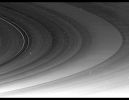
The_Rings-PIA11671.jpgInner B-Ring "Terminus" and Spiral Corrugation58 visiteCaption NASA:"This mosaic of Cassini images, part of a larger mosaic of images captured just hours before exact Equinox at Saturn, shows that the "Spiral Corrugation" in the Planet’s Inner Rings continues right up to the inner B-Ring: an unexpected result that scientists are working to understand.
The inner B-Ring boundary is visible on the right. The C-Ring’s Maxwell Gap, demarcated by two bright arcs in this view, is on the left.
The larger mosaic shows a gently undulating pattern stretching from the D-Ring to inner B-Ring (see PIA11670).
An earlier mosaic, captured in June, showed the corrugation extending only as far as the middle of the C-Ring (see PIA11664).
The periodic brightness variations in this corrugation are most likely caused by the changing slopes in the rippled Ring-Plane, much like the corrugations of a tin roof. Although previous Cassini observations (see PIA08325) had revealed corrugations in the D-Ring extending over 500 miles (about 800 Km), this image now shows these features extending beyond their origin in the D-Ring for 11.000 miles (approx. 17.000 Km) into the C-Ring.
This new imagery supports earlier evidence that something happened in the early 1980s to generate this feature.
In 2006, imaging scientists speculated that a collision with a comet or asteroid may have disturbed the D-Ring. That explanation seems less likely now that this new image shows the effect spread over a much broader radial range, extending completely across the C-Ring, and scientists are continuing to investigate the cause of this disturbance.
Whatever created the corrugation apparently tilted a vast region of the Inner Rings relative to Saturn’s gravitational field in a relatively short period of time during the early 1980s.
In the intervening years, the natural tendency for inclined orbits to systematically and slowly wobble at different rates, depending on their distance from Saturn, has created a tightly wound spiral corrugation in the Ring-Plane.
This view and others like it are only possible around the time of Saturn’s Equinox which occurs every half-Saturn-year (equivalent to about 15 Earth years). Exact Equinox is when the Sun is directly overhead at the Equator. The illumination geometry that accompanies equinox lowers the Sun’s angle to the Ring-Plane, significantly darkens the Rings and causes out-of-plane structures to cast long shadows across the Rings.
Cassini’s cameras have spotted not only the predictable shadows of some of Saturn’s moons (see PIA11657), but also the shadows of newly revealed vertical structures in the Rings themselves (see PIA11665).
This view looks toward the southern side of the Rings from about 4° below the Ring-Plane. Background stars are visible shining through the Rings, and the image has not been cleaned to remove Cosmic Rays, which struck the camera’s detector during the exposures.
The image was taken in Visible Light with the Cassini Spacecraft narrow-angle camera on Aug. 10, 2009. The view was acquired at a distance of approx. 888.000 Km (about 552.000 miles) from Saturn and at a Sun-Saturn-Spacecraft, or Phase, Angle of 157°.
Image scale is roughly 5 Km (a little more than 3 miles) per pixel".MareKromiumSet 27, 2009
|
|

Saturn-PIA11667.jpgThe Lord of the Rings (Natural Colors; credits: NASA/JPL/Space Science Institute)59 visiteCaption NASA:"Of the countless Equinoxes Saturn has seen since the birth of the Solar System, this one, captured here in a mosaic of light and dark, is the first witnessed up close by an emissary from Earth … none other than our faithful robotic explorer, Cassini.
Seen from our planet, the view of Saturn’s Rings during Equinox is extremely foreshortened and limited. But in orbit around Saturn, Cassini had no such problems. From 20° above the Ring-Plane, Cassini’s wide angle camera shot 75 exposures in succession for this mosaic showing Saturn, its Rings, and a few of its moons a day and a half after exact Saturn Equinox, when the Sun’s disk was exactly overhead at the Planet’s Equator.
The novel illumination geometry that accompanies equinox lowers the Sun’s angle to the Ring-Plane, significantly darkens the Rings and causes out-of-plane structures to look anomalously bright and to cast shadows across the Rings themselves.
These scenes are possible only during the few months before and after Saturn’s Equinox which occurs only once in about 15 Earth years.
Before and after Equinox, Cassini’s cameras have spotted not only the predictable shadows of some of Saturn’s moons (see also PIA11657), but also the shadows of newly revealed vertical structures in the Rings (see, for example, PIA11665).
Also at Equinox, the shadows of the Planet’s expansive Rings are compressed into a single, narrow band cast onto the Planet as seen in this mosaic. (For an earlier view of the Rings’ wide shadows draped high on the Northern Hemisphere, see PIA09793)
The images comprising the mosaic, taken over about eight hours, were extensively processed before being joined together. First, each was re-projected into the same viewing geometry and then digitally processed to make the image “joints” seamless and to remove lens flares, radially extended bright artifacts resulting from light being scattered within the camera optics.
At this time so close to Equinox, illumination of the Rings by sunlight reflected off the planet vastly dominates any meager sunlight falling on the Rings. Hence, the half of the Rings on the left illuminated by planetshine is, before processing, much brighter than the half of the Rings on the right. On the right, it is only the vertically extended parts of the Rings that catch any substantial sunlight.
With no enhancement, the Rings would be essentially invisible in this mosaic. To improve their visibility, the dark (right) half of the Rings has been brightened relative to the brighter (left) half by a factor of three, and then the whole Ring System has been brightened by a factor of 20 relative to the Planet. So the dark half of the rings is 60 times brighter, and the bright half 20 times brighter, than they would have appeared if the entire System, Planet included, could have been captured in a single image.
The moon Janus (about 179 Km, or approx. 111 miles across) is on the lower left of this image. Epimetheus about (113 Km, or approx. 70 miles across) appears near the middle bottom. Pandora (about 81 Km, or approx. 50 miles across) orbits outside the Rings on the right of the image. The small moon Atlas (about 30 Km, or approx. 19 miles across) orbits inside the thin F-Ring on the right of the image.
The brightnesses of all the moons, relative to the Planet, have been enhanced between 30 and 60 times to make them more easily visible. Other bright specks are background stars. Spokes -- ghostly radial markings on the B ring -- are visible on the right of the image.
This view looks toward the northern side of the Rings from about 20° above the Ring-Plane.
The images were taken on Aug. 12, 2009, beginning about 1,25 days after exact equinox, using the red, green and blue spectral filters of the wide angle camera and were combined to create this Natural Colors view.
The images were obtained at a distance of approx. 847.000 Km (about 526.000 miles) from Saturn and at a Sun-Saturn-Spacecraft, or Phase, Angle of 74°.
Image scale is roughly 50 Km (about 31 miles) per pixel".
Nota Lunexit: una interpretazione in Colori Naturali davvero stupenda, per qualità, definizione e realismo. Una prova evidente che i lavori "brutti" (e cioè il 99% dei prodotti fotografici a colori riguardanti Marte) la NASA non li fa perchè "non è capace" (ovviamente), ma solo perchè "non vuole farli com sa fare".
Il motivo? Beh, certo non è "pigrizia" (anche se non si può mai dire)...MareKromiumSet 25, 2009
|
|
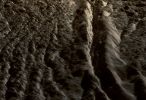
Enceladus-PIA12207.jpgPerspective view of Damascus Sulcus, Enceladus (Natural Colors; credits: Lunexit)58 visiteThis perspective view of Damascus Sulcus was generated using high resolution images of Enceladus acquired in August 2008 at 12 to 30 meters (40 to 100 feet) resolution, together with a new topographic map of the region produced by Dr. Paul Schenk (http://www.lpi.usra.edu/lpi/schenk/) at the Lunar and Planetary Institute in Houston, TX.
Damascus Sulcus is one of several prominent linear structures, dubbed “Tiger Stripes”, within the geologically active South Polar Region of Enceladus. Damascus Sulcus consists of two large parallel ridges separated by a deep V-shaped medial trough. The ridges are each 100 to 150 meters high (325 to 500 feet), while the entire width of Damascus Sulcus is approx. 5 Km (a little more than 3 miles). The medial trough between the ridges is 200 to 250 meters (650 to 820 feet) deep, and may have formed by daily shear (sliding) faulting triggered by tidal forces.
These medial troughs may be the primary source of numerous jets making up the large active water vapor plume over the South Pole of Enceladus. Several small ridges can be seen along the floor of the medial trough. These could be blocks of crust that have slid down the walls of the trough or fractured blocks pushed up from below.
Flanking Damascus Sulcus are repeating sets of broken and disrupted parallel ridges a few tens of meters high. These are typical of the plains that lie between the tiger stripe structures and resemble crumpled or folded rock patterns seen on Earth. Relief has been exaggerated by a factor of ~10 to enhance clarity.
The raw data from which this product was developed were retrieved from the Planetary Data System's Cassini archives. The Cassini-Huygens mission is a cooperative project of NASA, the European Space Agency and the Italian Space Agency. The Jet Propulsion Laboratory, a division of the California Institute of Technology in Pasadena, manages the mission for NASA's Science Mission Directorate, Washington, D.C. The Cassini orbiter and its two onboard cameras were designed, developed and assembled at JPL. The imaging operations center is based at the Space Science Institute in Boulder, Colo. (http://ciclops.org)MareKromiumSet 25, 2009
|
|

Enceladus-PIA12208.jpgPerspective view of Baghdad Sulcus, Enceladus (Natural Colors; credits: Lunexit)57 visiteThis perspective view of Baghdad Sulcus was generated using high resolution images of Enceladus acquired in August 2008 at 12 to 30 meters (40 to 100 feet) resolution, together with a new topographic map of the region produced by Dr. Paul Schenk (http://www.lpi.usra.edu/lpi/schenk/) at the Lunar and Planetary Institute in Houston, TX. Lower resolution images to either side were acquired at 50 to 80 meter (165 to 260 feet) resolution.
Baghdad Sulcus is one of several prominent linear structures, dubbed “Tiger Stripes”, within the geologically active South Polar Region of Enceladus. This view shows a wedge-shaped area between two prominent branches of Baghdad Sulcus. Each branch consists of two large parallel ridges up to 2 Km (approx. 1,2 mile) across separated by a deep V-shaped medial trough.
The ridges are 80 to 100 meters (approximately 260 to 325 feet) high. The medial troughs between the ridges are 200 to 250 meters (650 to 820 feet) deep. The maximum separation between the two branches is about 12 Km (about 7.5 miles).
Troughs such as those shown here are probably the source of numerous jets making up the large active water vapor plume over the South Pole of Enceladus. The floors of the medial troughs are often broken up into smaller ridges. These could be blocks of crust that have slid down the walls of the trough or fractured blocks pushed up from below. Relief has been exaggerated by a factor of ~10 to enhance clarity.
The raw data from which this product was developed were retrieved from the Planetary Data System's Cassini archives. The Cassini-Huygens mission is a cooperative project of NASA, the European Space Agency and the Italian Space Agency. The Jet Propulsion Laboratory, a division of the California Institute of Technology in Pasadena, manages the mission for NASA's Science Mission Directorate, Washington, D.C. The Cassini orbiter and its two onboard cameras were designed, developed and assembled at JPL. The imaging operations center is based at the Space Science Institute in Boulder, Colo. (http://ciclops.org)MareKromiumSet 25, 2009
|
|
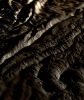
Enceladus-PIA12209.jpgPerspective view of Cairo Sulcus, Enceladus (Natural Colors - credits: Lunexit)58 visiteThis perspective view of Cairo Sulcus was generated using high resolution images of Enceladus acquired in August 2008 at 12 to 30 meters (40 to 100 feet) resolution, together with a new topographic map of the Region produced by Dr. Paul Schenk (http://www.lpi.usra.edu/lpi/schenk/) at the Lunar and Planetary Institute in Houston, TX. Lower resolution images to either side were acquired at 50 to 80 meter (165 to 260 feet) resolution.
Cairo Sulcus is one of several prominent structures, dubbed “Tiger Stripes”, within the geologically active South Polar Region of Enceladus. These structures consist of two large parallel ridges up to 2 Km (approx. 1,2 miles) across separated by a deep V-shaped medial trough. This view highlights one of the wall scarps of the medial trough of Cairo Sulcus, the brightly lit scarp crossing the left-hand side of the view. This wall scarp stands 175 to 250 meters (575 to 820 feet) high. Vertical striations and large boulders tens of meters across clutter the surface of this scarp, evidence of faulting and/or slumping of crustal ices. Troughs such as these are probably the source of numerous jets making up the large active water vapor plume over the South Pole of Enceladus. The parallel sets of rounded mounds and ridges In the foreground are up to 50 meters (165 feet) high. These are typical of the plains that lie between the tiger stripe structures and resemble crumpled or folded rock patterns seen on Earth. Relief has been exaggerated by a factor of ~10 to enhance clarity.
The raw data from which this product was developed were retrieved from the Planetary Data System's Cassini archives. The Cassini-Huygens mission is a cooperative project of NASA, the European Space Agency and the Italian Space Agency. The Jet Propulsion Laboratory, a division of the California Institute of Technology in Pasadena, manages the mission for NASA's Science Mission Directorate, Washington, D.C. The Cassini orbiter and its two onboard cameras were designed, developed and assembled at JPL. The imaging operations center is based at the Space Science Institute in Boulder, Colo. (http://ciclops.org)MareKromiumSet 25, 2009
|
|
| 2245 immagini su 188 pagina(e) |
|
|
|
|
|
32 | |
|
|
|
|
|
|





