| Ultimi arrivi - Saturn: the "Ringed Beauty" and His Moons |

Enceladus-PIA11678.jpgEnceladus: North Polar Map57 visiteThe Northern and Southern Hemispheres of Enceladus are seen in these Polar Stereographic Maps, mosaicked from the best-available Cassini and Voyager clear-filter images. This image shows the North Polar Regions.
Each map is centered on one of the Poles and surface coverage extends to the Equator. Grid lines show Latitude and Longitude in 30-degree increments. The scale in the full-size versions of these maps is 110 meters (360 feet) per pixel.
These two maps show that the character of Terrains near the North Pole differs strongly from those near the South Pole. Terrain near the North Pole is among the most heavily cratered and oldest on the Surface of Enceladus.
The Northern Hemisphere map shows that a broad band of cratered terrain extends from the Equator on the Saturn-facing side (centered on 0-degrees Longitude), over the Pole and to the Equator on the anti-Saturn side (centered on 180-degrees Longitude). Terrains near the Equator and Mid-Latitudes on the Leading (90° West) and Trailing (270° West) sides of Enceladus are much less heavily cratered and are characterized by intense zones of fracturing and faulting.
As seen in the Southern Hemisphere map, the band of cratered terrain at 0 and 180° Longitude extends southward from the Equator. However, poleward of about 55° South Latitude, the cratered terrain is interrupted and replaced by a conspicuously fractured circumpolar terrain that is nearly devoid of impact craters.
In contrast to the very old North Polar Terrains, the South Circumpolar Terrains are among the youngest on the Surface of Enceladus.
Within the South Circumpolar Region is a group of prominent parallel "Stripes" made up of fractures that are delineated by relatively dark albedo markings flanking the sides of each fracture.
An interesting property of the parallel fracture system is that each appears to turn back at its westernmost segment as if it has been "bent" or "folded" into a hook-like curve. Similar patterns of folded or kinked fractures can be found throughout the region -- a unique feature of the South Polar Terrains.MareKromiumNov 12, 2009
|
|
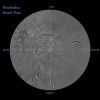
Enceladus-PIA11679.jpgEnceladus: South Polar Map63 visiteThe Northern and Southern Hemispheres of Enceladus are seen in these Polar Stereographic Maps, mosaicked from the best-available Cassini and Voyager clear-filter images. This image shows the South Polar Regions.
Each map is centered on one of the Poles and surface coverage extends to the Equator. Grid lines show Latitude and Longitude in 30-degree increments. The scale in the full-size versions of these maps is 110 meters (360 feet) per pixel.
These two maps show that the character of Terrains near the North Pole differs strongly from those near the South Pole. Terrain near the North Pole is among the most heavily cratered and oldest on the Surface of Enceladus.
The Northern Hemisphere map shows that a broad band of cratered terrain extends from the Equator on the Saturn-facing side (centered on 0-degrees Longitude), over the Pole and to the Equator on the anti-Saturn side (centered on 180-degrees Longitude). Terrains near the Equator and Mid-Latitudes on the Leading (90° West) and Trailing (270° West) sides of Enceladus are much less heavily cratered and are characterized by intense zones of fracturing and faulting.
As seen in the Southern Hemisphere map, the band of cratered terrain at 0 and 180° Longitude extends southward from the Equator. However, poleward of about 55° South Latitude, the cratered terrain is interrupted and replaced by a conspicuously fractured circumpolar terrain that is nearly devoid of impact craters.
In contrast to the very old North Polar Terrains, the South Circumpolar Terrains are among the youngest on the Surface of Enceladus.
Within the South Circumpolar Region is a group of prominent parallel "Stripes" made up of fractures that are delineated by relatively dark albedo markings flanking the sides of each fracture.
An interesting property of the parallel fracture system is that each appears to turn back at its westernmost segment as if it has been "bent" or "folded" into a hook-like curve. Similar patterns of folded or kinked fractures can be found throughout the region -- a unique feature of the South Polar Terrains.MareKromiumNov 12, 2009
|
|

Unusual_Phenomenon-N00143386_to_425_detail.gifUnusual Phenomenon in the Space of Saturn (GIF-Movie; credits: Dr M. Faccin)100 visiteNel ringraziare il nostro Grande Amico e Partner, Marco Faccin, per i Lavori che produce OGNI GIORNO, Vi invitiamo a visionare l'intero filmato (Space Migration) che potete trovare al nostro nuovo indirizzo su Flickr.com (http : / / www . flickr . com / photos / lunexit / 4092732540/).
Buona Visione e, se volete, scriveteci quella che credete che possa essere la causa (o una delle cause) dell'Unusual Phenomenon "emerso", letteralmente, dal buio dello Spazio circum-Saturniano...
MareKromiumNov 11, 2009
|
|
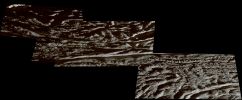
Enceladus-N00118361to64-MF.jpgEnceladus: South Polar Panorama (Image-Mosaic; credits: Dr M. Faccin - Natural Colors; credits: Lunexit)56 visitenessun commentoMareKromiumNov 11, 2009
|
|

Tethys-N00143707_to_09.jpgTethys (Superdefinition; credits: Dr M. Faccin)57 visiteIl Cratere che ben si distingue in questa spettacolare immagine di Tethys (frame processato in Superdefinzione dal nostro eccezionale Marco Faccin) , è "Penelope": un notevole bacino da impatto che, mutatis mutandis, ci ricorda tantissimo il Cratere Odysseus (sempre su Tethys); il Cratere Herschel (noto anche come "L'Occhio di Mimas") ed il Cratere Stickney (un enorme bacino d'impatto che si trova sulla Luna Marziana "Phobos").MareKromiumNov 11, 2009
|
|

Enceladus-N00145393lll.jpgFountains of Light (Natural Colors; image processing credits: Dr M. Faccin)71 visitenessun commentoMareKromiumNov 10, 2009
|
|

Saturnafterthe_Equinox.jpgAfter the Equinox... (Natural Colors; credits: NASA/JPL/Space Science Institute)58 visiteDa "NASA - Picture of the Day" del giorno 10 Novembre 2009:"The other side of Saturn's Ring-Plane is now directly illuminated by the Sun. For the previous 15 years, the Southern Side of Saturn and its Rings were directly illuminated, but since Saturn's Equinox, the orientation has reversed.
Pictured above last month, the robotic Cassini Spacecraft orbiting Saturn has captured the Giant Planet and its majestic Rings soon after Equinox. Imaged from nearly behind, Saturn and its moon Tethys each show a crescent phase to Cassini that is not visible from Earth.
As the Rings continue to point nearly toward the Sun, only a thin shadow of them is visible across the center of the Planet.
Close inspection of Saturn's Rings, however, shows superposed bright features identified as "Spokes" that are thought to be groups of very small electrically charged ice particles. Understanding the nature and dynamics of Spokes is not fully understood and remains a topic of research".MareKromiumNov 10, 2009
|
|

Hyperion-PIA11617.jpgTumbling Hyperion (Natural Colors; credits: Lunexit)58 visiteCaption NASA:"The Cassini Spacecraft peers at the pitted Surface of the small and irregularly-shaped moon Hyperion.
See PIA09728 to learn how these pits are created on low-density Hyperion (about 270 Km, or approx. 168 miles across). To watch a movie of this "tumbling moon", see PIA07683.
Scale in the original image was 9 Km (approx. 5,5 miles) per pixel. The image has been magnified by a factor of three and contrast-enhanced to aid visibility.
The image was taken in Visible Light with the Cassini Spacecraft narrow-angle camera on Sept. 5, 2009. The view was obtained at a distance of approx. 1,4 MKM (such as about 870.000 miles) from Hyperion and at a Phase Angle of 91°".MareKromiumNov 08, 2009
|
|
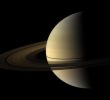
Saturn-PIA11613.jpgPost-Equinox Colors (Natural Colors; credits: NASA/JPL/Space Science Institute)68 visiteCaption NASA:"The Cassini Spacecraft captured this Natural Color View of Saturn almost a month after the Planet's August 2009 Equinox. The shadow cast on the Planet by the Rings remains narrow.
Spokes are visible on the B-Ring. To learn more about these ghostly radial structures, see PIA11144.
Mimas (approx. 396 Km, or about 246 miles across) can be seen in the lower left. Mimas and the Rings have been brightened relative to the Planet to increase visibility.
The novel illumination geometry that accompanies Equinox lowers the Sun's angle to the Ring-Plane, significantly darkens the Rings, and causes out-of-plane structures to look anomalously bright and cast shadows across the Rings. These scenes are possible only during the few months before and after Saturn's Equinox, which occurs only once in about 15 Earth years.
Before and after Equinox, Cassini's cameras have spotted not only the predictable shadows of some of Saturn's moons (see PIA11657), but also the shadows of newly revealed vertical structures in the Rings themselves (see PIA11665).
This view looks toward the Northern, sunlit side of the Rings from about 10° above the Ring-Plane.
The red, green and blue images that were mosaicked together to create this view were obtained with the Cassini Spacecraft wide-angle camera on Sept. 4, 2009. The view was obtained at a distance of approx. 2,7 MKM (such as about 1,7 MMs) from Saturn and at a Sun-Saturn-Spacecraft, or Phase, Angle of 92°.
Image scale is roughly 156 Km (about 97 miles) per pixel".MareKromiumNov 01, 2009
|
|
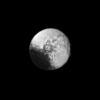
Japetus-PIA11608.jpgJapetus, from far away...62 visiteCaption NASA:"The Cassini spacecraft captures a far-off view of the two-toned surface of Saturn's moon Japetus. Scientists continue to investigate the nature of this moon's Surface. See also PIA08384 to learn more.
This view looks toward the Saturn-facing side of Japetus. North on Japetus is up and rotated 45° to the left. Scale in the original image was about 22 Km (approx. 14 miles) per pixel. The image has been magnified by a factor of three and contrast-enhanced to aid visibility.
The image was taken in visible light with the Cassini Spacecraft narrow-angle camera on Sept. 24, 2009. The view was obtained at a distance of approx. 3,7 MKM (such as about 2,3 MMs) from Japetus and at a Sun-Japetus-Spacecraft, or Phase, Angle of 12°".MareKromiumOtt 23, 2009
|
|
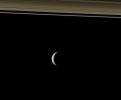
Tethys-PIA12319.jpgTethys and the Rings (Natural Colors; credits: NASA/JPL/Space Science Institute)59 visiteCaption NASA:"Cassini peers toward the distant, icy plains of Saturn's moon Tethys. The Planet's "A" and "F"-Rings slice across the top of this view.
This view of Tethys represents "Target 2" in the fall 2009 edition of the Cassini Scientist for a Day contest. (See http://saturn.jpl.nasa.gov/education/scientistforaday8thedition/.) The contest is designed to give students a taste of life as a scientist by challenging them to write an essay describing the value of one target choice among three for Cassini to image.
Images taken using red, blue and green spectral filters were combined to create this color view. The images were acquired with the Cassini wide-angle camera on Oct. 11, 2009 at a distance of approx. 1,4 MKM (about 900.000 miles) from Tethys".MareKromiumOtt 23, 2009
|
|
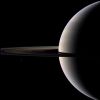
Saturn-PIA12318.jpgCosmic Vision (Natural Colors; credits: NASA/JPL/Space Science Institute)58 visiteCaption NASA:"Looking cool and serene, Saturn shares its soft glow with Cassini. This view of Saturn, its Rings and the moon Tethys represents "Target 1" in the fall 2009 edition of the Cassini Scientist for a Day contest.
(See http://saturn.jpl.nasa.gov/education/scientistforaday8thedition/.) The contest is designed to give students a taste of life as a scientist by challenging them to write an essay describing the value of one target choice among three for Cassini to image.
A bonus feature in the image is the presence of bright Spokes on and just above the ansa, or curved edge of the darkened Ring-Plane. The Spokes are made visible here by sunlight scattering through the dust-sized icy particles and toward Cassini's cameras.
Images taken using red, blue and green spectral filters were combined to create this color view.
The images were acquired with the Cassini wide-angle camera on Oct. 11, 2009 at a distance of approx. 1,7 MKM (a little more than 1 MMs) from Saturn".
Nota Lunexit: la dizione "Natural" l'abbiamo aggiunta noi, dato che la NASA - curiosamente - parla solo di "Color View" (insomma, adesso non fanno più nemmeno la fatica di dirci se si tratta di Natural, Approximate True, True e/o False Colors...bah!).MareKromiumOtt 23, 2009
|
|
| 2245 immagini su 188 pagina(e) |
 |
|
|
|
|
31 | |
|
|
|
|





