| |

| Ultimi arrivi - Saturn: the "Ringed Beauty" and His Moons |

Rhea_and_Titan-EB.jpgJewels, in the Space of Saturn: Rhea and Titan (Natural Colors; credits: Elisabetta Bonora)59 visiteUn lavoro assolutamente PERFETTO e, detto sinceramente, di qualità mediamente superiore ai Lavori di colorizzazione "Made by NASA".
Complimenti vivissimi alla nostra Amica e Partner, Elisabetta Bonora!MareKromiumDic 18, 2009
|
|

Mimas-PIA11642.jpg"Oblate" Mimas (Possible Natural Colors; credits: Lunexit)58 visiteCaption NASA:"The Cassini Spacecraft reveals the cratered surface of Mimas, a moon whose shape is flattened at the Poles. (see PIA07534 to learn more about why the moon has this oblate shape)
This view looks toward the Trailing Hemisphere of Mimas (approx. 396 Km, or about 246 miles, across). North on Mimas is up and rotated 1° to the left.
The image was taken in Visible Green Light with the Cassini Spacecraft narrow-angle camera on Oct. 14, 2009. The view was acquired at a distance of approx. 273.000 Km (such as about 170.000 miles) from Mimas and at a Sun-Mimas-Spacecraft, or Phase, Angle of 5°.
Image scale is roughly 2 Km (about 1,4 miles) per pixel".MareKromiumDic 18, 2009
|
|
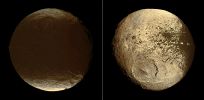
Japetus-PIA11690.jpgGlobal View of Japetus' "Brightness Dichotomy" (Approx. True Colors; credits: Lunexit)64 visiteCaption NASA:"These two global images of Japetus show the extreme brightness dichotomy on the Surface of this peculiar Saturnian moon. The left-hand panel shows Japetus' Leading Hemisphere and the right-hand panel shows its Trailing Side. While Low and Mid Latitudes of the Leading Side exhibit a Surface almost as dark as charcoal, broad tracts of the Trailing Side are almost as bright as snow.
The dark terrain covers about 40% of the Surface of Japetus and it has been named "Cassini Regio". The names of the bright terrain are Roncevaux Terra (North) and Saragossa Terra (South).
On both Hemispheres, the dominant landforms are impact craters. The largest known well-preserved basin on Japetus, called "Turgis", has a diameter of about 580 Km (approx. 360 miles). It lies at 17° North Latitude and 28° West Long., at the Eastern Edge of the Cassini Regio and is visible on the right side of the left-hand panel. The prominent basin on the Southern Trailing Side (at the lower left of the right-hand panel) is named Engelier.
Engelier is located at 41° South Latitude and 265° West Longitude, and it has a diameter of about 504 Km (such as approx. 313 miles).
Its formation destroyed about half of Gerin, another large basin on Japetus. Gerin is located at 46° South Latitude and 233° West Longitude; it has a diameter of about 445 Km (approx. 276 miles).
Tortelosa Montes, a part of the giant Equatorial Ridge that was discovered in Cassini images on December 25, 2004, is visible in the left panel as a thin line within Cassini Regio, and as a tall prominence at the Western Limb. It continues onto the Trailing Side (right side of right panel), where the bright Western Flanks of the Carcassone Montes appear as dominant bright spots within the Western Edge of Cassini Regio.
The cause of the extreme brightness dichotomy on Japetus is likely to be "thermal segregation of water ice" on a global scale.
Thermal effects are usually expected to act latitudinally.
That is, Polar Areas are colder than Equatorial Terrain in most cases due to the more oblique angle of the Solar Irradiation. Therefore, an additional process is required to explain the longitudinal difference as well.
In one model, dark, reddish dust coming in from space and preferentially deposited on the Leading Side forms a small, but crucial difference between the Leading and Trailing Hemispheres, which is sufficient to allow the thermal effect to evaporate the water ice on the Leading Side completely, but only marginally on the Trailing Side. (see PIA11689 to learn more)
Japetus' extremely slow Rotation Rate (about 1 hour and 54 minutes), its distance from the Sun, its relatively small size and Surface Gravity and its outer position within the regular satellite system of Saturn are also crucial contributing conditions for this mechanism to work as observed.
North on Japetus is approx. up in the images. Japetus has a diameter of about 1471 Km (approx. 914 miles).
The right-hand panel, released previously as PIA08384, shows a mosaic of 60 different images, obtained on September 10, 2007.
The left-hand panel is a color composite of three images obtained through InfraRed, Green and UltraViolet Spectral Filters (centered at 752, 568 and 338 nanometers, respectively) by Cassini's narrow-angle camera on Dec. 27, 2004.
The view was acquired at a distance of approx. 717.000 Km (about 446.000 miles) from Japetus and at a Sun-Japetus-Spacecraft, or Phase, Angle of 22°.
Scale in the original image on the left was about 4 Km (approx. 2,5 miles) per pixel. For ease of comparison, the scales in both the left and right images were set to 1400 meters (such as 4600 feet) per pixel".MareKromiumDic 18, 2009
|
|
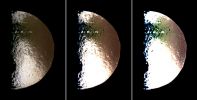
Japetus-PIA11689.jpgColor-Dichotomy on Japetus (False Colors; credits: NASA/JPL/Space Science Institute)60 visiteCaption NASA:"Three different false-color views of Saturn's moon Japetus show the boundary of the so-called global "Color Dichotomy" on the Hemisphere of this moon facing away from Saturn.
Such a "Color Dichotomy", which has been detected in images from the Cassini Imaging Team, is a second global pattern found on Japetus besides the well-known global "Brightness Dichotomy".
This image consists of three panels, each of which was contrast-enhanced in different ways to bring out Surface Features. Minimal enhancement was applied to the image on the left panel while those on the middle and right panels were enhanced more (with contrast increased by factors of two and four, respectively), making them appear brighter and overexposed.
In the case of Japetus' Brightness Dichotomy, the Dark Terrain extends towards its Trailing Side at Equatorial Regions, while the Bright Terrain extends towards Japetus' Leading Side in the Polar Regions (see PIA11116).
In the case of the Color Dichotomy seen here, its boundary is quite well correlated with the boundary between Japetus' Leading and Trailing Hemispheres. At Near-InfraRed wavelengths, the Bright Terrain on the Leading Side is redder than the one visible on the Trailing Side. This pattern is visible in the panel on the left, which uses normal contrast enhancement. The characteristic reddish distribution also appears on the dark material, as seen in the middle and right-hand panels that have been adjusted with even higher contrast.
Indeed, the otherwise uniformly dark material shows different color hues, depending on whether the viewer looks at the Leading vs. the Trailing Side.
Cassini scientists think this effect is caused by material falling onto Japetus from the outer irregular moons of Saturn. (see PIA06145 to learn more)
Images obtained with InfraRed, Green and UltraViolet Spectral Filters (centered at 953, 563 and 338 nanometers, respectively) were combined to create these False Color views. The color seen here is similar to that produced in (red, green and blue) Natural Color views.
North on Japetus is approx. up in these images. The images were taken with the Cassini Spacecraft narrow-angle camera on Oct. 15, 2004. The view was obtained at a distance of approx. 1,2 MKM (such as about 746.000 miles) from Japetus and at a Sun-Japetus-Spacecraft, or Phase, Angle of 88°.
Image scale is roughly 7 Km (a little more than 4 miles) per pixel".MareKromiumDic 18, 2009
|
|

Saturn-Exagon.jpgThe "Exagon" of Saturn's North Pole58 visiteIt is unclear how an unusual Hexagonal Cloud System that surrounds Saturn's North Pole was created, keeps its shape, or how long it will last.
Originally discovered during the Voyager flybys of Saturn in the 80s, nobody has ever seen anything like it elsewhere in the Solar System.
Although its IR glow was visible previously to the Cassini Spacecraft now orbiting Saturn, over the past year the mysterious Hexagonal Vortex became fully illuminated by Sunlight for the first time during the Cassini's visit. Since then, Cassini has imaged the rotating Hexagon in Visible Light enough times to create this full-view. (the North Pole center was not well imaged and has been excluded)
Planetary scientists are sure to continue to study this most unusual cloud formation for quite some time.MareKromiumDic 15, 2009
|
|
EnceladusSky-EB-N00148200-N00148225.gifIcy-Jets, Cosmic Rays and other UFO's in the Space of Saturn (GIF-Movie; credits: Elisabetta Bonora)73 visiteDalla nostra Amica e Partner, Elisabetta Bonora, un suggestivo GIF-Movie che ci porta nello Spazio circum-Enceladiano ad ammirare, ancora una volta, assieme alle Fontane di ghiaccio tipiche della "Luna di Neve", una serie di interssantissimi targets: dalla semplice "noise" (i puntini bianchi che tempestano il filmato e che assecondano patterns del tutto casuali) ai noti ed agevolmente riconoscibili "Cosmic Rays", passando dal transito di (MOLTI) altri OVNI - e cioè Oggetti Volanti Non Identificati - i quali, talora in coppia (porzione superiore del quadro), talora singolarmente (porzione inferiore), sfrecciano davanti alle ottiche di CASSINI.
Si tratta di Lune Saturniane? Sinceramente, noi ne dubitiamo...
Grandissimi Complimenti ad Elisabetta Bonora!
Technical Data: from N00148200 up to N00148229 ---> frames taken between 16:00 and 16:35 UTC; from this data we can derive that the average time-lap existing between each exposure was about 1' and 10" (in other words, the captioned pictures were taken about every 70" from each other). During that period of time the speed of the CASSINI Probe varied from 10,23 Km-per-sec up to 10,42 Km-per-sec.MareKromiumDic 13, 2009
|
|
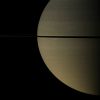
Saturn-PIA11640.jpgNarrow Shadow59 visiteCaption NASA:"From just above the Plane of Saturn's Rings, the Cassini Spacecraft snapped this shot of Saturn two months after Saturn's August 2009 Equinox, showing the shadow of its Rings as a narrow band on the Planet.
Cassini is looking toward the sunlit side of the rings from about 1° above the Ring-Plane.
The novel illumination geometry that accompanies Equinox lowers the Sun's angle to the Ring-Plane, significantly darkens the Rings, and causes out-of-plane structures to look anomalously bright and cast shadows across the Rings. These scenes are possible only during the few months before and after Saturn's Equinox, which occurs only once in about 15 Earth years.
Before and after Equinox, Cassini's cameras have spotted not only the predictable shadows of some of Saturn's moons (see, for instance, PIA11657), but also the shadows of newly revealed Vertical Structures in the Rings themselves (see PIA11665).
The image was taken with the Cassini Spacecraft wide-angle camera on Oct. 16, 2009 using a spectral filter sensitive to wavelengths of Near-InfraRed Light centered at 752 nanometers. The view was obtained at a distance of approx. 1,5 MKM (such as about 932.000 miles) from Saturn and at a Sun-Saturn-Spacecraft, or Phase, Angle of 83°.
Image scale is roughly 86 Km (approx. 53 miles) per pixel".MareKromiumDic 09, 2009
|
|

Daphnis-PIA11637.jpgHeavy Disturbances58 visiteCaption NASA:"This Cassini image, which at first appears to show a serene scene, in fact reveals dramatic disturbances created in Saturn's A-Ring by its moon Daphnis.
Near the center of the image, tiny Daphnis (about 8 Km across) appears as a bright dot in the Keeler Gap near the edge waves it has created in the A-Ring. The moon has an inclined orbit and its gravitational pull both perturbs the orbits of the particles of the A-Ring forming the Keeler Gap's edge and sculpts the edge into waves having both horizontal (radial) and out-of-plane components. Material on the inner edge of the gap orbits faster than the moon so that the waves there lead the moon in its orbit. Material on the outer edge moves slower than the moon, so waves there trail the moon.
Epimetheus (approx. 113 Km, or about 70 miles across) orbits beyond the F-Ring at the bottom of the image. Bright specks in the image are background stars.
This view looks toward the Northern, sunlit side of the Rings, from about 11° above the Ring-Plane.
The image was taken in Visible Light with the Cassini Spacecraft narrow-angle camera on Sept. 24, 2009. The view was obtained at a distance of approx. 1,8 MKM (about 1,1 MMs) from Daphnis.
Image scale is roughly 11 Km (a little less than 7 miles) per pixel".MareKromiumDic 09, 2009
|
|
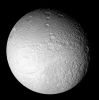
Tethys-CASSINI.jpgTethys58 visiteWhat processes formed the unusual Surface of Saturn's moon Tethys? To help find out, NASA sent the robotic Cassini Spacecraft right past the enigmatic ice moon in 2005. Pictured above is one of the HR images of an entire face of Tethys yet created. The pervasive white color of Tethys is thought to be created by fresh ice particles continually falling onto the moon from Saturn's diffuse E-Ring - particles expelled by Saturn's moon Enceladus. Some of the unusual cratering patterns on Tethys remain less well understood, however. Close inspection of the above image of Tethys' South Pole will reveal a great rift running diagonally down from the middle: Ithaca Chasma. A leading theory for the creation of this great canyon is anchored in the tremendous moon-wide surface cracking that likely occurred when Tethys' internal oceans froze.
If so, Tethys may once have harbored internal oceans, possibly similar to the underground oceans some hypothesize to exist under the surface of Enceladus today. Might ancient life be frozen down there?MareKromiumDic 08, 2009
|
|

Rhea-PIA11638.jpgCraterland (Natural Colors; credits: Lunexit)58 visiteCaption NASA:"Craters imprinted upon other craters record the long history of impacts endured by Saturn's moon Rhea.
This view looks toward the Mid-Southern Latitudes of the Saturn-facing side of Rhea. North on Rhea is up.
The image was taken in Visible Light with the Cassini Spacecraft narrow-angle camera on Oct. 13, 2009. The view was obtained at a distance of approx. 45.000 Km (about 28.000 miles) from Rhea and at a Sun-Rhea-Spacecraft, or Phase, Angle of 105°.
Image scale is approx. 260 meters (about 860 feet) per pixel".MareKromiumDic 06, 2009
|
|

TheRings-PIA11635.jpgAegaeon and the G-Ring57 visiteCaption NASA:"The bright arc within Saturn's G-Ring is shown truncated by the shadow of the Planet at the bottom of this image.
Although it can't be seen here, the tiny moonlet Aegaeon (formerly known as S/2008 S 1) orbits within the bright arc.
This view looks toward the northern, sunlit side of the Rings from about 4° above the Ring-Plane. Many background stars are visible elongated by the motion of the Spacecraft during the image's exposure.
The image was taken in Visible Light with the Cassini Spacecraft narrow-angle camera on Oct. 9, 2009. The view was obtained at a distance of approx. 2,1 MKM (about 1,3 MMs) from Saturn. Image scale is roughly 12 Km (a little more than 7 miles) per pixel".MareKromiumDic 02, 2009
|
|
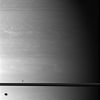
Saturn-PIA11633.jpgShadows...57 visiteCaption NASA:"The shadows of two moons appear on Saturn, above and below the plane of the Planet's Rings.
North on Saturn is up in this image, and the shadow of Dione can be seen south of the Planet's Equator. The smaller shadow of Mimas is north of the Equator.
Dione and Mimas both have orbits that are slightly inclined in relation to the Planet's Equatorial Plane, so, depending upon the orientation of their orbits, their shadows may appear North or South of Saturn's Equator. The moons themselves do not appear in this image.
This view looks toward the Northern, sunlit side of the Rings from about 1° above the Ring-Plane. Scale in the original image was about 100 Km (approx. 62 miles) per pixel. The image has been magnified by a factor of 1.5 and contrast-enhanced to aid visibility.
The image was taken with the Cassini Spacecraft wide-angle camera on Oct. 15, 2009 using a spectral filter sensitive to wavelengths of Near-InfraRed Light centered at 752 nanometers. The view was acquired at a distance of approx. 899.000 Km (about 558.000 miles) from Saturn and at a Sun-Saturn-Spacecraft, or Phase, angle of 65°".MareKromiumNov 29, 2009
|
|
| 2245 immagini su 188 pagina(e) |
|
|
|
|
|
28 | |
|
|
|
|
|
|





