| Ultimi arrivi - Saturn: the "Ringed Beauty" and His Moons |

Prometheus-091227-N00148969-EB.jpgPrometheus adrift... (possible Natural Colors; credits: Elisabetta Bonora - Lunexit Team)57 visiteNulla di artefatto o manipolato digitalmente, in questo frame prodotto dalla nostra Elisabetta Bonora!
La colorazione rosacea di Prometheus, infatti, potrebbe e dovrebbe dipendere, a nostro modo di vedere, dal Saturnshine (o "Chiaro di Saturno").
E non è neppure inutile rammentare che Prometheus non è la sola Luna Saturniana ad avere un colore simile!
Esso, infatti, forma uno splendido "Space Duo" con Hyperion la cui Superficie, sempre secondo la NASA (e ad eccezione di quanto contenuto nei bizzarri crateri che lo ricoprono quasi per intero), sarebbe di color rosa pallido, con sfumature grigie e bianco/verdastre.MareKromiumDic 29, 2009
|
|

The_Rings-091227-W00062195-96-98-EB-LXTT.jpgRings on Parade! (possible Natural Colors; credits: Elisabetta Bonora - Lunexit Team)56 visiteMareKromiumDic 29, 2009
|
|

Prometheus-N00148968-N00148985-GB.gifPrometheus adrift... (GIF-Movie; credits: Dr G. Barca)57 visitenessun commentoMareKromiumDic 29, 2009
|
|

The_Rings-PIA12512.jpgThe "E-Ring"59 visiteCaption NASA:"The Cassini Spacecraft takes a look at Saturn's diffuse E-Ring which is formed from icy material spewing out of the South Pole of the moon Enceladus (see PIA08921 to learn more about how Enceladus creates the E-Ring). The E-Ring is seen nearly edge-on from slightly above the Northern Side of Saturn's Ring-Plane.
The image was taken in Visible Light with the Cassini Spacecraft wide-angle camera on Oct. 23, 2009. The view was acquired at a distance of approx. 2,5 MKM (such as about 1,6 MMs) from Saturn.
Image scale is roughly 149 Km (approx. 92 miles) per pixel".MareKromiumDic 27, 2009
|
|
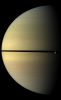
Saturn-PIA12513.jpgCrescent Saturn (Natural Colors; credits: NASA/JPL/Space Science Institute)56 visiteCaption NASA:"Saturn, stately and resplendent in this Natural Color view, dwarfs the icy moon Rhea.
Rhea orbits beyond the Rings on the right of the image. The moon Tethys is not shown here, but its shadow is visible on the Planet on the left of the image. This view looks toward the Northern, sunlit side of the Rings from just above the Ring-Plane.
Images taken using red, green and blue spectral filters were combined to create this Natural Color view. The images were obtained with the Cassini Spacecraft wide-angle camera on Nov. 4, 2009 at a distance of approx. 1,3 MKM (about 808.000 miles) from Saturn.
Image scale is roughly 72 Km (about 45 miles) per pixel".MareKromiumDic 27, 2009
|
|

Janus-PIA11694.gifObscuring Janus (GIF-Movie; credits: NASA/JPL/Space Science Institute)62 visiteCaption NASA:"Sunlight passing through the Cassini Division between Saturn's "A" and "B" Rings sweeps across and illuminates the surface of the moon Janus in this movie captured shortly after Saturn's August 2009 Equinox.
The novel illumination geometry that accompanied Equinox lowered the Sun's Angle to the Ring-Plane, significantly darkened the Rings, caused out-of-plane structures to look anomalously bright and threw shadows across the Rings. As this movie shows, the Equinox period also allowed the Rings to cast shadows on the moons. These scenes were possible only during the few months before and after Saturn's Equinox, which occurs only once in about 15 Earth years. Before and after Equinox, cameras on NASA's Cassini Spacecraft spotted not only the predictable shadows of some of Saturn's moons, but also the shadows of newly revealed Vertical Structures in the Rings themselves (see PIA11665).
This view looks toward the Trailing Hemisphere of Janus (approx. 179 Km, or about 111 miles across). North on Janus is up and rotated 8° to the right.
The movie is a concatenation of 12 still images. The images were obtained in Visible Light with Cassini's narrow-angle camera on Aug. 27, 2009. The view was acquired at a distance of approx. 268.000 Km (about 67.000 miles) from Janus and at a Sun-Janus-Spacecraft, or Phase, Angle of 25°.
Image scale is roughly 2 Km (5271 feet) per pixel".MareKromiumDic 26, 2009
|
|

Saturnian_Sky.gifIn the Sky of Saturn (GIF-Movie; credits: Dr M. Faccin)57 visitenessun commentoMareKromiumDic 26, 2009
|
|
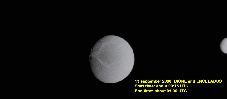
Dione_and_Enceladus-N00119781-N00119798.gifRush! (GIF-Movie; credits: Elisabetta Bonora)65 visitenessun commentoMareKromiumDic 26, 2009
|
|
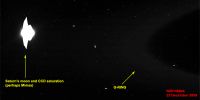
OverSaturation-N00148644.jpgOversaturation (by Elisabetta Bonora)58 visiteNon sempre la sovrasaturazione (o "sovraesposizione") - che è produttiva di una serie di image-artifacts tipici (su tutti, la cosiddetta "Light-Drop") - è il frutto di un errore: gli "oggetti a debole o debolissima luminosità", infatti, per essere evidenziati richiedono - come ben sapete - dei tempi di esposizione più lunghi del solito.
E quando poi, nel campo di ripresa, assieme all'"oggetto debole", vi è pure un "oggetto ad albedo elevata" - come in questo caso accade, rispettivamente, per l'Anello-G di Saturno e la sua luna Mimas -, ecco che l'immagine finale "sembra" venir fuori "sbagliata". Brutta e mossa, di regola (come vedete anche le stelle sono divenute, in questo frame, delle piccole "star-trails").
Ma la verità è che non si è trattato di un errore, ma di è una - oggettiva - necessità (come ben dimostra questa chiara elaborazione della nostra Elisabetta Bonora).MareKromiumDic 26, 2009
|
|
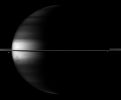
Saturn-PIA11649.jpgOut of the Darkness...60 visiteCaption NASA:"Dramatic differences between dark and light embellish this Cassini Spacecraft image of Saturn, its rings and its moons Dione and Enceladus.
Saturn's Northern and Southern Latitudes appear dark in this image because of the camera filter used. This view uses a spectral filter sensitive to absorption of certain wavelengths of light by Methane in Saturn's Atmosphere. The cloud tops in the Northern and Southern Latitudes are at a slightly greater depth than in the Equatorial Region, and are underneath a layer of Methane. This means that light travels along a longer path compared to the Equatorial Region as it enters the Atmosphere, reflects off the cloud tops, and returns through the Upper Atmosphere to enter the camera.
The light at Near-InfraRed wavelengths thus passes through more light-absorbing Methane at the Northern and Southern Latitudes than at the Equator, and so these Latitudes appear darker.
Dione (approx 1123 Km, or about 698 miles across) can be seen on the left of the image. Enceladus (approx. 504 Km, or about 313 miles across) is visible on the right.
This view looks toward the Northern, sunlit side of the Rings from just above the Ring-Plane.
The image was taken with the Cassini Spacecraft wide-angle camera on Oct. 21, 2009 using a spectral filter sensitive to wavelengths of Near-InfraRed Light centered at 890 nanometers. The view was obtained at a distance of approx. 2,5 MKM (such as about 1,6 MMs) from Saturn and at a Sun-Saturn-Spacecraft, or Phase, Angle of 104°.
Image scale is roughly 143 KM (such as about 89 miles) per pixel".MareKromiumDic 22, 2009
|
|

Tethys_and_Rhea-N00147318-N00147337.gifSilent Running: Tethys and Rhea (GIF-Movie; credits: Elisabetta Bonora)58 visitenessun commentoMareKromiumDic 18, 2009
|
|

Rhea_and_Titan-MF.jpgRhea and Titan (NIR View; credits: Dr M. Faccin)58 visite...Una "Visione" davvero splendida, da lasciare con il fiato sospeso...MareKromiumDic 18, 2009
|
|
| 2245 immagini su 188 pagina(e) |
 |
|
|
|
|
27 | |
|
|
|
|





