| Ultimi arrivi - Saturn: the "Ringed Beauty" and His Moons |

SaturnianSpace-RB1.gifViews and Features of the Space of Saturn (GIF-Movie; credits: Elisabetta Bonora - Lunexit Team)57 visitenessun commentoMareKromiumGen 28, 2010
|
|

The_Rings-MF-N00150070_to_N00150100.jpgGlowing in the Darkness... (Image Mosaic - Possible True Colors; credits: Dr M. Faccin - Lunexit Team)56 visitenessun commentoMareKromiumGen 28, 2010
|
|

The_Rings-EB3-N00150070-77.jpgCosmic Wonder... (Natural Colors; credits: Elisabetta Bonora - Lunexit Team)57 visitenessun commentoMareKromiumGen 26, 2010
|
|

The_Rings-EB2-N00150070-73.jpgCosmic Wonder... (Natural Colors; credits: Elisabetta Bonora - Lunexit Team)57 visitenessun commentoMareKromiumGen 26, 2010
|
|
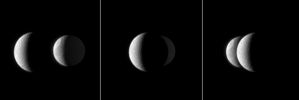
Tethys_and_Dione-PIA12534.jpgMutual Event in the Space of Saturn: Tethys and Dione57 visiteCaption NASA:"From the Cassini Spacecraft's perspective, Saturn's moon Dione passes in front of the moon Tethys in this "Mutual Event".
These 3 images were each taken about one minute apart. These images are part of a Mutual Event Sequence in which one moon passes close to or in front of another. Such observations help scientists refine their understanding of the orbits of Saturn's moons.
Brightly lit Terrain seen here is on the anti-Saturn side of Dione and between the Leading Hemisphere and anti-Saturn side of Tethys. The large Odysseus Crater is visible on Tethys. Tethys is approx.2,6 MKM (about 1,6 MMs) from Cassini. Dione is spprox. 2,2 MKM (such as about 1,4 MMs) away.
Sunlight reflected by Saturn, which is out of the frame to the right, is lighting up the side of Tethys that is away from the Sun, but due to the Spacecraft's viewing angle and the relative positions of each body, this is not true for Dione.
The images were taken in Visible Light with the Cassini pacecraft narrow-angle camera on Nov. 28, 2009. Scale in the original images was roughly 13 Km (a little more than 8 miles) per pixel on Dione and about 16 Km (approx. 10 miles) per pixel on Tethys.
The images were contrast enhanced and magnified by a factor of 1.5 to enhance the visibility of Surface Features on both moons".MareKromiumGen 25, 2010
|
|

Japetus-MF1.jpgThe unusually-looking Surface of Japetus (possible Natural Colors; credits: Dr M. Faccin - Lunexit Team)65 visitenessun commentoMareKromiumGen 24, 2010
|
|

Japetus-MF2.jpgJapetus' Skyline (possible Natural Colors; credits: Dr M. Faccin - Lunexit Team)58 visitenessun commentoMareKromiumGen 24, 2010
|
|

Japetus-MF3.jpgUps and Downs on Japetus (Image-Mosaic; credits: Dr M. Faccin)58 visitenessun commentoMareKromiumGen 24, 2010
|
|

Mimas-PIA12532.jpgLost in the Dark (Natural Colors; credits: Dr Paolo C. Fienga - Lunexit Team)56 visiteCaption NASA:"Lit terrain seen here is on the Trailing Hemisphere of Mimas. This view looks toward the Northern, sunlit side of the Rings, from just above the Ring-Plane.
The image was taken in Visible Light with the Cassini Spacecraft narrow-angle camera on Nov. 3, 2009. The view was obtained at a distance of approx. 760.000 Km (about 472.000 miles) from Mimas and at a Sun-Mimas-Spacecraft, or Phase, Angle of 61°.
Image scale is roughly 5 Km (a little more than 3 miles) per pixel. MareKromiumGen 23, 2010
|
|

Saturn-PIA12533.jpgEternal Vision (Natural Colors; credits: NASA/JPL/Space Science Institute)59 visiteCaption NASA:"A pastel crescent of Saturn is interrupted by the moon Mimas and the Rings in this color image.
Mimas (approx. 396 Km - or about 246 miles across) appears as a dark speck just above the Rings.
This view looks toward the Northern, sunlit side of the Rings, from just above the Ring-Plane.
Images taken using red, green and blue spectral filters were combined to create this Natural Color view. The images were obtained with the Cassini Spacecraft wide-angle camera on Oct. 27, 2009 at a distance of approx. 2,2 MKM (such as about 1,4 MMs) from Saturn.
Image scale is roughly 129 Km (approx. 80 miles) per pixel".MareKromiumGen 23, 2010
|
|
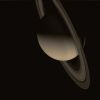
Saturn-W00003104-6-GB-LXTT.jpgThe "Lord of the Rings" (Natural Colors; credits: Dr G. Barca - Lunexit Team)57 visitenessun commentoMareKromiumGen 22, 2010
|
|

Dione-PIA12529.jpgCrescent Dione (possible Natural Colors; credits: Dr Paolo C. Fienga - Lunexit Team)58 visiteCaption NASA:"The tortured Terrain of Saturn's moon Dione is documented in this Cassini Spacecraft image.
The wispy fractures on the moon's Trailing Hemisphere can be seen on the left of the image, and Cratered Terrain on the moon's anti-Saturn side dominates the center of the image. North on Dione is up.
The image was taken in Visible Light with the Cassini Spacecraft narrow-angle camera on Nov. 23, 2009. The view was acquired at a distance of approx. 896.000 Km (such as about 557.000 miles) from Dione and at a Sun-Dione-Spacecraft, or Phase, Angle of 81°.
Image scale is roughly 5 Km (a little more than 3 miles) per pixel".MareKromiumGen 19, 2010
|
|
| 2245 immagini su 188 pagina(e) |
 |
|
|
|
|
25 | |
|
|
|
|





