| Ultimi arrivi - Saturn: the "Ringed Beauty" and His Moons |
Mimas-Titan-Rhea-W00062956-58-EB-LXTT.jpgBrothers in the Night... (Natural Colors; credits: Elisabetta Bonora - Lunexit Team)62 visitenessun commentoMareKromiumFeb 11, 2010
|
|

Mimas_and_the_Rings-PIA12543.jpgIn-Between (Natural Colors; credits: NASA/JPL/Space Science Institute)56 visiteCaption NASA:"Two of Saturn's moons straddle the Planet's Rings in this view. Mimas is closest to the Cassini Spacecraft here. Epimetheus, instead, is on the far side of the Rings.
Saturn's shadow cuts across the middle of the Rings. This view looks toward the sunlit side of the Rings from just above the Ring-Plane.
Images taken using red, green and blue spectral filters were combined to create this Natural Color view. The images were obtained with the Cassini Spacecraft narrow-angle camera on Oct. 24, 2009 at a distance of approx. 2,7 MKM (such as about 1,7 MMs) from Epimetheus and approx. 2,4 MKM (about 1,5 MMs) from Mimas.
Scale on Mimas is roughly 14 Km (a little less than 9 miles) per pixel".MareKromiumFeb 07, 2010
|
|

Prometheus_and_Friends-EB.gifSingle Tone (GIF-Movie; credits: Elisabetta Bonora - Lunexit Team)57 visitenessun commentoMareKromiumFeb 03, 2010
|
|

Dione-EB-4311210639_db673f3300_b.jpgA Beautiful "Slice" of Dione (by Elisabetta Bonora - Lunexit Team)57 visitenessun commentoMareKromiumFeb 02, 2010
|
|
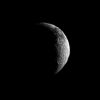
Japetus-PIA12539.jpgCrescent Japetus57 visiteCaption NASA:"The Cassini Spacecraft looks toward a crescent of Saturn's dark and light moon, Japetus.
Scientists continue to investigate the nature of this moon's surface. Lit Terrain seen here is in the Transition Area between the Saturn-facing Side and the Trailing Hemisphere of Japetus. North on Iapetus is up and rotated 23° to the left.
The image was taken in Visible Light with the Cassini Spacecraft narrow-angle camera on Nov. 29, 2009. The view was acquired at a distance of approx. 1,5 MKM (about 932.000 miles) from Japetus and at a Phase Angle of 117°.
Image scale in the original image was roughly 9 Km (about 5,5 miles) per pixel.
The image was contrast enhanced and magnified by a factor of two to enhance the visibility of Surface Features".MareKromiumFeb 02, 2010
|
|

Prometheus-4311527645_dc29b5404a_o.jpgPrometheus adrift... (possible Natural Colors; credits: Dr M. Faccin - Lunexit Team)55 visitenessun commentoMareKromiumGen 31, 2010
|
|

Prometheus-4311527815_3a8df4624e_o.jpgPrometheus adrift... (High-Def-3D - Possible Natural Colors; credits: Dr M. Faccin - Lunexit Team)58 visitenessun commentoMareKromiumGen 31, 2010
|
|

Prometheus-4312264140_cd64e12a23_o.jpgPrometheus adrift... (possible Natural Colors; credits: Dr M. Faccin - Lunexit Team)58 visitenessun commentoMareKromiumGen 31, 2010
|
|

Aegaeon-EB.gifIn the Aegaeon Sea... (GIF-Movie; creditgs: Elisabetta Bonora - Lunexit Team)56 visiteAegaeon, OR also Saturn LIII (being its provisional designation S/2008-S-1), is one of the very many moons of Saturn.
Its discovery was first announced by Dr Carolyn Porco, of the Cassini Imaging Science Team, on March 3, 2009, from observations taken on August, 15, 2008.
Aegaeon orbits within the bright segment of Saturn's G-Ring, and is likely a major source of the Ring itself. Debris knocked off the moon form a bright Arc near the Inner Edge of the G-Ring, which in turn spreads to form the rest of the Ring.
Aegaeon is "trapped" in the 7:6 co-rotation Eccentricity Resonance with Mimas. Aegaeon, Anthe and Methone therefore form a distinctive class of objects in the Saturn System: small moons in co-rotation Eccentricity Resonances with Mimas associated with (bright) "Arcs of Debris". Comparisons among these different Ring-Arc Systems reveal that Aegaeon’s orbit is closer to the exact Resonance than Anthe’s and Methone’s orbits are.
This could indicate that Aegaeon has undergone significant orbital evolution via its interactions with the other objects in its Arc's Segmet, which would be consistent with the evidence that Aegaeon’s mass is much smaller relative to the total mass in its Arc than Anthe’s and Methone’s masses are.
Assuming that Aegaeon has the same albedo as Pallene, his size is estimated to be about half a kilometer (approx. 500 mt) in diameter.
Aegaeon orbits Saturn at an average distance of about 167.500 Km from the Parent Planet (top of the Saturnian Clouds), in 0,80812 days (a little more than 19 hours), at an inclination of 0,001° to Saturn's Equator (being his Orbital Eccentricty equal to, 0,0002 - remember that the so-named "Mean Eccentricity" of an object is its Average Eccentricity, as resulting of perturbations over a given time period).
It is named after Aegaeon, one of the so-called "Hecatonchires" (Greek or "Centimani", in Latin). The Hecatonchires were 3 giants of incredible strength and ferocity, even superior to that of the Titans whom they helped overthrow.
Their name derives from the Greek words "hekaton" ---> "hundred" and "kheir" ---> "hand", and each one of them had a hundred hands and fifty heads.
Hesiod's Theogony (624, 639, 714, 734–35) reports that the 3 Hecatonchires became the guards of the gates of Tartarus (in Greek Mithology, it is a deep, gloomy place - a pit, or an abyss - used as a dungeon of torment and suffering that resides beneath the underworld).
In other words: an Hell deeper and darker than the "Traditional" Hell...MareKromiumGen 31, 2010
|
|

SaturnianSpace-EB3.gifViews and Features of the Space of Saturn (Edited GIF-Movie; credits: Elisabetta Bonora - Lunexit Team)57 visitenessun commentoMareKromiumGen 29, 2010
|
|

SaturnianSpace-EB2.gifViews and Features of the Space of Saturn (GIF-Movie; credits: Elisabetta Bonora - Lunexit Team)58 visitenessun commentoMareKromiumGen 28, 2010
|
|

SaturnianSpace-MF.gifStars, Streaks and (overexposed) Moons in the Space of Saturn (GIF-Movie; credits: Dr M. Faccin - Lunexit Team)58 visitenessun commentoMareKromiumGen 28, 2010
|
|
| 2245 immagini su 188 pagina(e) |
 |
|
|
|
|
24 | |
|
|
|
|





