| |

| Ultimi arrivi - Saturn: the "Ringed Beauty" and His Moons |

Tethys-PIA09915-1.jpgShall Odysseus ever find Ithaca? (Stretched Absolute Natural Colors; credits for the add. process.: Dr Paolo C. Fienga-LXTT-IPF)135 visiteCaption NASA:"From a highly inclined orbit, the Cassini Spacecraft looks toward far Northern Latitudes on Tethys.
Here, the spacecraft was above a position about 45° North of the moon's Equator.
This vantage point afforded a view of the moon's three most recognizable features: the Ithaca Chasma Canyon System (at lower right), Odysseus Crater (at upper left) and the Equatorial Band of Darker Terrain (at lower left).
Lit terrain seen here is on the Leading Hemisphere of Tethys (1062 Km, or approx. 660 miles across). North is up.
The image was taken in Visible Light with the NASA - Cassini Spacecraft narrow-angle camera on April 29, 2008.
The view was obtained at a distance of approx. 991.000 Km (such as about 616.000 miles) from Tethys and at Phase Angle of 73°.
Image scale is roughly 6 Km (about 4 miles) per pixel".MareKromiumGen 03, 2020
|
|
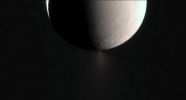
Enceladus-PIA18328-PCF-LXTT-IPF.jpgIn the Saturnshine... (Absolute Natural Colors; credits for the additional process. and color.: Dr Paolo C. Fienga/Lunar Explorer Italia/Italian Planetary Foundation)125 visiteThe Saturnian moon Enceladus looks as if it is half lit by Sunlight in this view from the NASA - Cassini Spacecraft; but looks, as you know, can be (as they often are) deceiving.
In fact, the kind of pinkish area of Enceladus visible on the right (Dx) of the frame, where MANY Surface Features can be made out (---> seen/identified), is actually illuminated by the light reflected off of Saturn (such as the so-called "Saturnshine"). On the other hand, a sliver of the Enceladian Surface that is actually illuminated by direct Sunlight is visible - and also highly overexposed! - on the left (Sx) of the picture. Images like this one are designed to capture the extended Plumes of Icy Materials spraying from huge cracks located the moon's South Polar Region. Such images need to be taken with the NASA - Cassini Spacecraft looking toward the Icy moon's Night Side, since the small particles that form the Plumes (however, just barely visible in this picture) are most easily seen when backlit by the Sun.
This view looks toward the Leading Hemisphere of Enceladus; North is up. The image was taken in Visible Light with the NASA - Cassini Spacecraft's Narrow-Angle Camera on May 10, 2015. Enceladus is roughly 313 miles (such as about 503,72 Km) across. The view was acquired at a distance of approximately 226.000 miles (such as approx. 363.7210,84 Km) from Enceladus and at a Sun-Enceladus-Cassini Spacecraft, or Phase, Angle of 152°. Image scale is roughly 1,4 miles (about 2,2530 Km) per pixel.
This frame (which is an Original NASA - CASSINI Spacecraft's b/w and NON Map-Projected image published on the NASA - Planetary Photojournal with the ID n. PIA 18328) has been additionally processed, contrast enhanced, magnified, in order to allow the vision of the slightest details of the Surface, Gamma corrected and then re-colorized - according to an educated guess (or, if you wish, an informed speculation) carried out by Dr Paolo C. Fienga - in Absolute Natural Colors (such as the colors that a human eye would actually perceive if someone were onboard the NASA - Cassini Spacecraft and then looked outside, toward the Saturnian moon "Enceladus"), by using an original technique created - and, in time, dramatically improved - by the Lunar Explorer Italia Team. Different colors, as well as different shades of the same color, mean, among other things, the existence of different Elements (Minerals) present on the Surface of Enceladus, each having a different Albedo (---> Reflectivity) and Chemical Composition.
Note: it is possible (but we, as IPF, have no way to be one-hundred-percent sure of such a circumstance), that the actual luminosity of Enceladus - as it is in this frame - would appear, to an average human eye, a little bit lower than it has been shown (or, better yet: interpreted) here.MareKromiumSet 24, 2015
|
|

Hyperion-PIA17194-PCF-LXTT-IPF.jpgFarewell Hyperion! Part II (Absolute Natural Colors; credits for the additional process. and color.: Dr Paolo C. Fienga/Lunar Explorer Italia/Italian Planetary Foundation)82 visiteThe NASA - Cassini Spacecraft's Imaging Scientists processed this view of Saturn's so-called "spongy" moon Hyperion, which was taken - just like yesterday's one - during a close Fly-By that occurred on May 31, 2015. This Fly-By marks the Mission's Final Close Approach to this Saturnian highly irregularly shaped moon. North on Hyperion is up and rotated 34° to the left (Sx).
The image was taken in Visible Light, with the NASA - Cassini Spacecraft's Narrow-Angle Camera - as we wrote herebefore - on May 31, 2015. The view was acquired at a distance of approximately 24.000 miles (such as about 38.624,159 Km) from Hyperion and at a Sun-Hyperion-Cassini Spacecraft, or Phase, Angle of 46°. Image scale is roughly 145 feet (such as approx. 44,196 meters) per pixel. l.
This frame (which is an Original NASA - CASSINI Spacecraft's b/w and NON Map-Projected image published on the NASA - Planetary Photojournal with the ID n. PIA 17194) has been additionally processed, contrast enhanced, magnified to help the visibility of the Surface details, Gamma corrected and then re-colorized - according to an educated guess (or, if you wish, an informed speculation) carried out by Dr Paolo C. Fienga - in Absolute Natural Colors (such as the colors that a human eye would actually perceive if someone were onboard the NASA - Cassini Spacecraft and then looked outside, towards the Saturnian moon "Hyperion"), by using an original technique created - and, in time, dramatically improved - by the Lunar Explorer Italia Team. Different colors, as well as different shades of the same color, mean, among other things, the existence of different Elements (Minerals) present on the Surface of Hyperion, each having a different Albedo (---> Reflectivity) and Chemical Composition.
Note: it is possible (but we, as IPF, have no way to be one-hundred-percent sure of such a circumstance), that the actual luminosity of Hyperion - as it is in this frame - would appear, to an average human eye, a little bit lower than it has been shown (or, better yet: interpreted) here.MareKromiumSet 24, 2015
|
|

Hyperion-PIA17193-PCF-LXTT-IPF.jpgFarewell Hyperion! Part I (Absolute Natural Colors; credits for the additional process. and color.: Dr Paolo C. Fienga/Lunar Explorer Italia/Italian Planetary Foundation)91 visiteThe NASA - Cassini Spacecraft's Imaging Scientists processed this view of Saturn's so-called "spongy" moon Hyperion, which was taken during a close Fly-By that occurred on May 31, 2015. This Fly-By marks the Mission's Final Close Approach to this Saturnian highly irregularly shaped moon. North on Hyperion is up and rotated 37° to the right (Dx).
The image was taken with the NASA - Cassini Spacecraft's Narrow-Angle Camera - as we wrote herebefore - on May 31, 2015, by using a Spectral Filter which preferentially admits Wavelengths of Near-InfraRed Light, centered at 862 nanometers. The view was acquired at a distance of approx. 37.000 miles (such as about 59.545,58 Km) from Hyperion, and at a Sun-Hyperion-Cassini Spacecraft, or Phase, Angle of 20°. The Image Scale is roughly 1180 feet (such as approx. 359,664 meters) per pixel.
This frame (which is an Original NASA - CASSINI Spacecraft's b/w and NON Map-Projected image published on the NASA - Planetary Photojournal with the ID n. PIA 17193) has been additionally processed, contrast enhanced, magnified to help the visibility of the Surface details, Gamma corrected and then re-colorized - according to an educated guess (or, if you wish, an informed speculation) carried out by Dr Paolo C. Fienga - in Absolute Natural Colors (such as the colors that a human eye would actually perceive if someone were onboard the NASA - Cassini Spacecraft and then looked outside, towards the Saturnian moon "Hyperion"), by using an original technique created - and, in time, dramatically improved - by the Lunar Explorer Italia Team. Different colors, as well as different shades of the same color, mean, among other things, the existence of different Elements (Minerals) present on the Surface of Hyperion, each having a different Albedo (---> Reflectivity) and Chemical Composition.
Note: it is possible (but we, as IPF, have no way to be one-hundred-percent sure of such a circumstance), that the actual luminosity of Hyperion - as it is in this frame - would appear, to an average human eye, a little bit lower than it has been shown (or, better yet: interpreted) here.MareKromiumSet 24, 2015
|
|

Tethys_and_Saturn-PIA18318-PCF-LXTT-IPF.jpgFather and Daughter... (Absolute Natural Colors; credits for the additional process. and color.: Dr Paolo C. Fienga - Lunexit Team)70 visiteThe two large Impact Craters on Tethys, near the line where the day fades into the night (the so-called "Terminator Line"), almost resemble two giant eyes observing Saturn. The location of these aforementioned Impact Craters on Tethys' Terminator throws their topography into sharp relief. Both are large Impact Craters, but the larger and Southernmost of the two, shows a more complex structure.
The angle of the lighting highlights a Central Peak in this Crater. In fact, Central Peaks are the final and well visible result of the Surface (of the impacted Celestial Body) reacting to the violent Post-Impact Excavation of the Crater itself. On the other hand, the Northern Crater does not show a similar Surface Feature. Why? No one knows for sure but, possibly, the impact was too small (better yet: to small AND slow) to form a Central Peak or, maybe, the composition of the Materials located in the immediate vicinities of the Impact Area couldn't support the formation of a Central Peak. In this image, Tethys is significantly closer to the NASA - Cassini Spacecraft's Wide-Angle Camera, while the Ringed Gas-Giant Planet (---> Saturn) is in the background. And yet, the moon is still utterly dwarfed by Saturn.
This view looks toward the Anti-Saturn Side of Tethys; North is up and rotated 42° to the right (Dx). The image was taken in Visible Light with the NASA - Cassini Spacecraft's Wide-Angle Camera on April 11, 2015. The view was obtained at a distance of approximately 75.000 miles (such as about 120.700,5 Km) from Tethys and the Image Scale on Tethys is roughly 4 miles (such as about 6,437 Km) per pixel.
This frame (which is an Original NASA - CASSINI Spacecraft's b/w and NON Map-Projected image published on the NASA - Planetary Photojournal with the ID n. PIA 18318) has been additionally processed, contrast enhanced, magnified, in order to allow the vision of the slightest details of the Surface, Gamma corrected and then colorized - according to an educated guess (or, if you wish, an informed speculation) carried out by Dr Paolo C. Fienga - in Absolute Natural Colors (such as the colors that a human eye would actually perceive if someone were onboard the NASA - Cassini Spacecraft and then looked outside, toward Saturn and the Saturnian moon "Tethys"), by using an original technique created - and, in time, dramatically improved - by the Lunar Explorer Italia Team. Different colors, as well as different shades of the same color, mean, among other things, the existence of different Elements (Gases and Minerals, respectively) present in the Atmosphere of Saturn, and on the Surface of Tethys, each having a different Albedo (---> Reflectivity) and Chemical Composition.
Note: it is possible (but we, as IPF, have no way to be one-hundred-percent sure of such a circumstance), that the actual luminosity of Saturn and Tethys - as it is in this frame - would appear, to an average human eye, a little bit lower than it has been shown (or, better yet: interpreted) here.MareKromiumSet 22, 2015
|
|

Dione-PIA17126-PCF-LXTT-IPF.jpgRomulus and Friends (Absolute Natural Colors; credits for the additional process. and color.: Dr Paolo C. Fienga/Lunar Explorer Italia/IPF)60 visiteLike their semi-divine namesakes, Dione's twin Impact Craters Romulus and Remus (just above-right of the center) stand together while Dido, the larger Impact Crater showing a magnificent and impressive Central Peak, lies to the South/East, on the lower left Limb of Dione and almost half-way on top of the Terminator. The lit Terrain seen here is on the Saturn-facing Hemisphere of Dione and North is up.
The image was taken in Visible Light with the NASA - Cassini Spacecraft Narrow-Angle Camera on April 28, 2013. The view was obtained at a distance of approximately 870.000 miles (such as a little more than 1,4 Million KiloMeters) from Dione and at a Sun-Dione-Cassini Spacecraft, or Phase, Angle of 77°. Image scale is roughly 5 miles (a little more than 8 Km) per pixel.
This frame (which is an Original NASA - Cassini Spacecraft b/w frame published on the NASA - Planetary Photojournal with the ID n. PIA 17126) has been additionally processed, contrast enhanced, magnified to aid visibility of the Surface details and then colorized, according to an educated guess carried out by Dr Paolo C. Fienga/LXTT/IPF, in what they should be its Absolute Natural Colors (such as the colors that a human eye would actually perceive if someone were onboard the NASA - Cassini Spacecraft and then looked outside, towards the Saturnian moon Dione), by using an original technique created - and, in time, dramatically improved - by the Lunar Explorer Italia Team. Different colors, as well as different shades of the same color, mean, among others, the existence of different Elements present on the Surface of Dione, each having a different Albedo (---> Reflectivity) and Chemical Composition.
Note: it is possible (but we, as IPF, have no way to be one-hundred-percent sure of such a circumstance), that the actual luminosity of Dione - as it is in this frame - would appear, to an average human eye, a little bit lower than it has been shown (or, better yet: interpreted) here.MareKromiumSet 08, 2013
|
|

Janus-PIA14667-PCF-LXTT-IPF.jpgJanus, from far away... (Absolute Natural Colors; credits for the additional process. and color.: Dr Paolo C. Fienga/Lunar Explorer Italia/Italian Planetary Foundation)90 visiteIn this frame, we can see that the NASA - Cassini Spacecraft has recently caught a glimpse of Janus: an irregularly-shaped Minor Saturnian moon. Lacking sufficient gravity to pull itself into a round shape, Janus (which is approx. 111 miles - such as about 178,63 - across) has had its lumpy primordial shape only slightly modified by impacts since its formation. A huge Impact Crater can be seen on the upper left corner of the illuminated side of Janus, jointly with other barely visible Surface Details. Furthermore, if you look carefully (after bringing the image to its full size), a few more Surface Details that are found of that part of Janus that lies in the shadows, beyond the Terminator Line, can be (even though just barely) seen, jointly with the outline of the moon.
This view looks toward the Trailing Hemisphere of Janus. North on Janus is up and rotated 44° degrees to the left. The image was taken in Visible Light with the NASA - Cassini Spacecraft Narrow-Angle Camera on April 28, 2013; the view was obtained at a distance of approximately 780.000 miles (such as about 1.255.285 Million KiloMeters) from Janus and at a Sun-Janus-Cassini Spacecraft (or Phase), Angle of 77°. The mage scale is roughly 5 miles (such as 8,04 Km) per pixel.
This frame (which is an Original NASA - Cassini Spacecraft b/w frame published on the NASA - Planetary Photojournal with the ID n. PIA 14667) has been additionally processed, contrast enhanced, magnified and then colorized in Absolute Natural Colors (such as the colors that a human eye would actually perceive if someone were onboard the NASA - Cassini Spacecraft and then looked outside, towards the Saturnian moon Janus), by using an original technique created - and, in time, dramatically improved - by the Lunar Explorer Italia Team. Different colors, as well as different shades of the same color, mean, among others, the existence of different Elements present on the Surface of Janus, each having a different Albedo (---> Reflectivity) and Chemical Composition.MareKromiumLug 14, 2013
|
|

Janus-PIA14607-PCF-LXTT-IPF.jpgClosing-up on Janus (Absokute Natural Colors; credits for the additional process. and color.: Dr Paolo C. Fienga/Lunar Explorer Italia/Italian Planetary Foundation)86 visiteDark and deep Shadows were obscuring most part of Janus' cratered Surface, when the NASA - Cassini Spacecraft took a close look at this Saturnian moon during the Fly-By which occurred on March 27, 2012.
This view is centered on Terrain located at approx. at 13° South Latitude and 26° West Longitude. The image was taken in Visible Light with the NASA - Cassini Spacecraft Narrow-Angle Camera, at a distance of approximately 28.000 miles (such as about 45.061 Km) from Janus and at a Sun-Janus-Cassini Spacecraft , or Phase, Angle of 109°. Image scale is 892 feet (272 meters) per pixel.
This frame (which is an Original NASA - Cassini Spacecraft b/w frame published on the NASA - Planetary Photojournal with the ID n. PIA 14607) has been additionally processed, contrast enhanced, magnified and then colorized in Absolute Natural Colors (such as the colors that a human eye would actually perceive if someone were onboard the NASA - Cassini Spacecraft and then looked outside, towards the Saturnian moon Janus), by using an original technique created - and, in time, dramatically improved - by the Lunar Explorer Italia Team. Different colors, as well as different shades of the same color, mean, among others, the existence of different Elements present on the Surface of Janus, each having a different Albedo (---> Reflectivity) and Chemical Composition.MareKromiumLug 14, 2013
|
|

Saturn-North_Pole-PIA14945-PCF-LXTT-IPF.jpgNorth Polar Spring (Absolute Natural Colors; credits for the additional process. and color.: Dr Paolo C. Fienga/Lunar Explorer Italia/Italian Planetary Foundation)64 visiteThe North Pole of the Gas-Giant Planet Saturn, now illuminated by the fresh lights of the incoming Spring, is finally revealed in this image taken by the NASA - Cassini Spacecraft on November 27, 2012. As you know, the North Pole of Saturn has been hiding for a long time from the gaze of the Cassini's Imaging Cameras, and that circumstance was due to the fact that it was still Wintertime in (and therefore a deep darkness all over) the Northern Hemisphere of the Ringed Planet when the Spacecraft arrived in the Saturnian System in the AD 2004.
A Hurricane-like Storm circling Saturn's North Pole at about 89° North Latitude is also well visible inside the famous "Hexagon" Feature, which scientists think is a wandering Jet-Stream that whips around the North Pole of Saturn at a relatively constant mean speed of about 220 miles per hour (such as a little more than 354 Km per hour). Such a Jet-Stream it is folded into a six-sided shape because the Hexagon is a Stationary Wave that guides the path of the Gases existing inside the Jet itself. The Hexagon borders occur at about 77° North Latitude and the Feature is wider than two (flat) Earths. Last, but not least, a little section of the Rings of Saturn can also be seen in the upper right corner of the image.
This frame was acquired with the NASA - Cassini Spacecraft Wide-Angle Camera at a distance of approximately 260.000 miles (such as a little more than 418.000 Km) from the top of the Saturnian Clouds and at a Sun-Saturn-Cassini Spacecraft, or Phase, Angle of 96°. Image scale is roughly 18 miles (such as 28,968 Km) per pixel. For another image of the Hexagon and the Hurricane-like Storm that encircles the North Pole of Saturn, please refer to the APOD of December, 29, 2012.
This frame (which is a NASA - CASSINI Spacecraft Original Natural Color frame published on the NASA - Planetary Photojournal and identified by the serial n. PIA 14945) has been additionally processed, magnified, contrast enhanced and then re-colorized, according to an educated guess carried out by Dr Paolo C. Fienga (LXTT-IPF), in Absolute Natural Colors (such as the colors that a human eye would actually perceive if someone were onboard the NASA - Cassini Spacecraft and then looked outside, towards the North Pole of Satun), by using an original technique created - and, in time, dramatically improved - by the Lunar Explorer Italia Team. Different colors, as well as different shades of the same color, mean, among others, the existence of different Elements in the Upper Atmosphere of Satun, each having a different Albedo (---> Reflectivity) and Chemical Composition.MareKromiumGiu 16, 2013
|
|

Rhea-PIA14660-PCF-LXTT-IPF.jpgFarewell to Rhea (Absolute Natural Colors; credits for the additional process. and color.: Dr Paolo C. Fienga/Lunar Explorer Italia/Italian Planetary Foundation)72 visiteOn its fourth and final targeted Fly-By of Rhea, the NASA - Cassini Spacecraft provided, among others, this stunning view its ancient, tormented and heavily cratered Surface. Billions of years of impacts, in fact, have sculpted Rhea's Surface into the form we see today and, with a diameter of approx. 950 miles (such as about 1528,8 Km), Rhea is the second-largest moon of Saturn.
This view is centered on Terrain located at 33° North Latitude and 358° West Longitude. The image was taken in Visible Light with the NASA - Cassini Spacecraft Narrow-Angle Camera on March 9, 2013, at a distance of approximately 2.348 miles (such as about 3.778,73 Km) from the Surface of Rhea. Just out of curiosity, we, as IPF, have found (as far as this specific picture is concerned) a slight discrepancy between the data regarding the distance of the NASA - Cassini Spacecraft from the Surface of Rhea, as reported in the NASA - Planetary Photojournal (where it has been written that the distance was of approx. 2.280 miles) and in the caption attached to this frame - entitled "Rhea's Shadowy Craters" - and reported in the NASA - Cassini Solstice Mission Official WebSite (where the distance between the Spacecraft and Rhea is estimated to be 2.348 miles). Obviously, everybody - even our Friends from NASA - makes mistakes, every now and then...
This frame (which is an Original NASA - Cassini Spacecraft b/w image published on the NASA - Planetary Photojournal and identified by the serial n. PIA 14660) has been additionally processed, contrast enhanced, and then colorized in Absolute Natural Colors (such as the colors that a human eye would actually perceive if someone were onboard the NASA - Cassini Spacecraft and then looked down, towards the Surface of the Saturnian moon Rhea), by using an original technique created - and, in time, dramatically improved - by the Lunar Explorer Italia Team. Different colors, as well as different shades of the same color, mean, among others, the existence of different Elements present on the Surface of Rhea, each having a different Albedo (---> Reflectivity) and Chemical Composition.
Note: it is possible (but we, as IPF, have no way to be one-hundred-percent sure of such a circumstance), that the actual luminosity of the Surface of Rhea - as it is presented in this image - would appear, to an average human eye, way lower than it has been shown (or, better yet: interpreted) here.MareKromiumMag 26, 2013
|
|

Rhea-IMG004754-br500-PCF-LXTT-IPF.jpgFarewell to Rhea (Absolute Natural Colors; credits for the additional process. and color.: Dr Paolo C. Fienga/Lunar Explorer Italia/Italian Planetary Foundation)56 visiteOn its fourth and final targeted Fly-By of Rhea, the NASA - Cassini Spacecraft provided, among others, this stunning view its ancient, tormented and heavily cratered Surface. Billions of years of impacts, in fact, have sculpted Rhea's Surface into the form we see today and, with a diameter of approx. 950 miles (such as about 1528,8 Km), Rhea is the second-largest moon of Saturn.
Scientists are still trying to understand some of the curious Surface Features visible in this image, including a curving, narrow Fracture, or Graben, which is a Block of Ground lower than its surroundings and bordered by Cliffs on both sides. This Feature looks remarkably recent, since it cuts most of the Impact Craters that it crosses, with only a few (and small) Impact Craters superimposed.
This view was taken - using the filters CL1 and CL2 - on March 9, 2013, at a distance of approximately 1.727 miles (such as about 2.779,33 Km) from the Surface of Rhea.
This frame (which is an Original NASA - Cassini Spacecraft b/w image identified by the serial n. IMG004754-br500) has been additionally processed, contrast enhanced, and then colorized in Absolute Natural Colors (such as the colors that a human eye would actually perceive if someone were onboard the NASA - Cassini Spacecraft and then looked down, towards the Surface of the Saturnian moon Rhea), by using an original technique created - and, in time, dramatically improved - by the Lunar Explorer Italia Team. Different colors, as well as different shades of the same color, mean, among others, the existence of different Elements present on the Surface of Rhea, each having a different Albedo (---> Reflectivity) and Chemical Composition.
Note: it is possible (but we, as IPF, have no way to be one-hundred-percent sure of such a circumstance), that the actual luminosity of the Surface of Rhea - as it is presented in this image - would appear, to an average human eye, way lower than it has been shown (or, better yet: interpreted) here.MareKromiumMag 26, 2013
|
|

Rhea-IMG004709-br500-PCF-LXTT-IPF.jpgFarewell to Rhea (Absolute Natural Colors; credits for the additional process. and color.: Dr Paolo C. Fienga/Lunar Explorer Italia/Italian Planetary Foundation)71 visiteOn its fourth and final targeted Fly-By of Rhea, the NASA - Cassini Spacecraft provided many stunning views its ancient, tormented and heavily cratered Surface. Billions of years of impacts, in fact, have sculpted Rhea's Surface into the form we see today and, with a diameter of approx. 950 miles (such as about 1528,8 Km), Rhea is the second-largest moon of Saturn.
In the EDM here (is on the lower right - Dx - of the CTX Frame), you can see an extremely interesting and, in a way, really mysterious and bizarre-looking Horizontal Linear Structure that looks like a Wall and whose upper edge is still illuminated by the Sun; the Structure - whose origin is and, most likely, will remain unknown - is located within a relatively small-sized and Unnamed Impact Crater and it extends for about one/third of its Inner Diameter. This view was taken in Visible Light on December 22, 2012, at a distance of approximately 16.805 miles (such as a little less than 27.045 Km) from the Surface of Rhea.
This frame (which is an Original NASA - Cassini Spacecraft b/w image identified by the serial n. N00199484) has been additionally processed, contrast enhanced, and then colorized in Absolute Natural Colors (such as the colors that a human eye would actually perceive if someone were onboard the NASA - Cassini Spacecraft and then looked down, towards the Surface of the Saturnian moon Rhea), by using an original technique created - and, in time, dramatically improved - by the Lunar Explorer Italia Team. Different colors, as well as different shades of the same color, mean, among others, the existence of different Elements present on the Surface of Rhea, each having a different Albedo (---> Reflectivity) and Chemical Composition.
Note: it is possible (but we, as IPF, have no way to be one-hundred-percent sure of such a circumstance), that the actual luminosity of the Surface of Rhea - as it is presented in this image - would appear, to an average human eye, way lower than it has been shown (or, better yet: interpreted) here.MareKromiumMag 26, 2013
|
|
| 2245 immagini su 188 pagina(e) |
2 | |
|
|
|
|
|
|
|
|
|
|
|





