| Ultimi arrivi - Saturn: the "Ringed Beauty" and His Moons |

Dione-Mosaic-EB-LXTT.jpgDione (an Image-Mosaic in Natural and Natural but enhanced Colors by Elisabetta Bonora - Lunexit Team)56 visitenessun commentoMareKromiumApr 11, 2010
|
|

Dione-EB-LXTT.jpgThe Surface of Dione (an Image-Mosaic by Elisabetta Bonora - Lunexit Team)55 visitenessun commentoMareKromiumApr 10, 2010
|
|

Dione-EB-LXTT2.jpgThe Surface of Dione (an Image-Mosaic by Elisabetta Bonora - Lunexit Team)56 visitenessun commentoMareKromiumApr 10, 2010
|
|
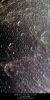
Dione-EB-LXTT3.jpgThe Surface of Dione (an Image-Mosaic by Elisabetta Bonora - Lunexit Team)55 visitenessun commentoMareKromiumApr 10, 2010
|
|
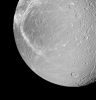
Dione-PIA12608.jpgDione55 visiteCaption NASA:"Wispy Terrain winds across the Trailing Hemisphere of Saturn's moon Dione in this Cassini view taken during the Spacecraft's Jan. 27, 2010 non-targeted Fly-By.
Cassini came within about 45.000 Km (approx. 28.000 miles) of the moon during this Fly-By, but this image was acquired at a distance of approx. 137.000 Km (about 85.000 miles) from Dione.
This view looks toward the anti-Saturn Side and Trailing Hemisphere of Dione. North on Dione is up.
The image was taken in Visible Light with the Cassini Spacecraft narrow-angle camera on Jan. 27, 2010. The view was obtained at a Sun-Dione-Spacecraft, or Phase, Angle of 38°.
Image scale is about 819 meters (2687 feet) per pixel".MareKromiumApr 09, 2010
|
|
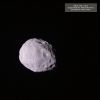
Janus-EB-LXTT.jpgJanus (credits: Elisabetta Bonora - Lunexit Team)55 visitenessun commentoMareKromiumApr 09, 2010
|
|

Mimas-PIA12568.jpgThe "Eye" of Mimas55 visiteCaption NASA:"This mosaic, created from images taken by NASA's Cassini Spacecraft during its closest flyby of Saturn's moon Mimas, looks straight at the moon's huge Herschel Crater and reveals new insights about the moon's Surface. Bright-walled Craters, with Floors and surroundings - about 20% darker than the steep Crater Walls - are notable in this view. Mimas' original Surface, like the surfaces of most of the other major Saturnian moons without Atmospheres, is not pure ice but contains some dark impurities.
Herschel Crater (about 130 Km - approx. 80 miles - wide) and some of the smaller craters seen in this mosaic show relatively dark markings along the lower portion of their walls. Cassini scientists interpret this darkening as evidence for the gradual concentration of impurities from evaporating icy materials in areas where the dark impurities slide slowly down the Crater Wall. There, bright ice is baked away by the Sun and the vacuum of space.
At Herschel, the edge where the Darker Regions contact the Crater Floor, is interrupted by an extensive hummocky area. Scientists believe the hummocky texture came from the flow of melted ice that occurred during the impact that created the Crater itself. That melt filled the bottom of the Crater around the Central Peak.
Dark Streaks are seen making their way down the sides of some craters (marked red in the annotated version), often originating from pockets of dark contaminants embedded just below the rim of the crater wall. The pockets themselves likely represent small, pre-existing, dark-floored craters that were buried by the blanket of material that was thrown out from the newer impact that created the crater rim. The material from a newly exposed dark layer eventually moves downslope and forms a streak. Streaks are sometimes seen starting from the floors of smaller, dark-floored craters perched along Rims of larger Craters.
The interior of Herschel Crater is significantly less cratered than the continuous blanket of ejected material that extends radially outward from its rim. The violent meteor impact that excavated Herschel blasted pulverized debris, including massive chunks of ice, upward. The fallback of this ejected material over the Crater Rim created a thick Debris Blanket and dotted it with Secondary Craters. The presence of a fluid pool of melted material on the Crater Floor, which solidified after the debris fell, probably explains the relative absence of Craters on Herschel's Floor. These are common processes that should occur on bodies without Atmospheres throughout the Solar System. They may be accentuated on Mimas because of the large size of Herschel in comparison to Mimas' size.
Cassini came within about 9500 Km (approx. 5900 miles) of Mimas during its flyby on Feb. 13, 2010. This mosaic was created from 7 images taken that day in Visible Light with Cassini's narrow-angle camera. An eighth image, taken with the wide-angle camera on the same flyby, is used to fill in the lower right of the mosaic. The images were re-projected into an orthographic map projection. This view looks toward the Leading Hemisphere of Mimas.
This view is centered on terrain at about 10° South Latitude and 125° West Longitude. North is up.
The view was obtained at a distance of approx. 30.000 Km (about 19.000 miles) from Mimas and at a Sun-Mimas-Spacecraft, or Phase, Angle of 27°.
Image scale is roughly 180 meters (600 feet) per pixel".MareKromiumApr 05, 2010
|
|

Mimas-PIA12570.jpgWho are YOU looking at???55 visiteCaption NASA:"This view of Mimas is centered on Terrain located at about 11° South Latitude and 158° West Longitude. North is up.
This view was obtained at a distance of approx. 50.000 Km (approx. 31.000 miles) from Mimas and at a Sun-Mimas-Spacecraft, or Phase, Angle of 17°.
Image scale is roughly 240 meters (790 feet) per pixel".MareKromiumApr 05, 2010
|
|

Mimas-PIA12571.jpgA "hint" of color for Mimas (possible Natural Colors; credits: Dr Paolo C. Fienga - Lunexit Team)56 visitenessun commentoMareKromiumApr 05, 2010
|
|
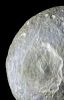
Mimas-PIA12572.jpgHerschel Basin (False Colors; credits: NASA/JPL/SSI)55 visitenessun commentoMareKromiumApr 05, 2010
|
|

Mimas-PIA12867.jpgUneven Warmth on Mimas55 visiteThe image shows NASA's Cassini Spacecraft imaging science subsystem Visible-Light mosaic of Mimas from previous flybys on the left. The right-hand image shows the new CIRS temperature data mapped on top of the Visible-Light image.
It has to be underlined the unexpected and bizarre pattern of daytime temperatures found on Saturn's small inner moon Mimas (about 396 Km, or approx. 246 miles, in diameter). The data were obtained by the composite infrared spectrometer (CIRS) on the Cassini Spacecraft during the Spacecraft's closest-ever look at Mimas on Feb. 13, 2010.
The warm part has typical temperatures near 92 Kelvin (minus 294 Fahrenheit), while typical temperatures on the cold part are about 77 Kelvin (minus 320 Fahrenheit). The cold part is probably colder because surface materials there have a greater thermal conductivity, so the Sun's energy soaks into the Sub-surface instead of warming the Surface itself. But why conductivity should vary so dramatically across the Surface of Mimas is a mystery.
The map used to create this image is a mosaic of images taken by Cassini's imaging science subsystem cameras on previous flybys of Mimas. The cold side includes the giant Herschel Crater, which is a few degrees warmer than its surroundings. It's not yet known whether Herschel is responsible in some way for the larger region of cold temperatures that surrounds it.
Cassini took 85 minutes to make the temperature map, as the Spacecraft receded from Mimas. During that time, the distance to Mimas increased from 38.000 to 67.000 Km (such as about 24.000 to 42.000 miles) and the longitude of the center of Mimas' disk increased from 128° West to 161° West, due to the moon's rotation.
Because of this changing geometry, the alignment of the temperatures relative to specific features or coordinates on Mimas is shown only approximately. The temperatures were calculated from the brightness of the moon's infrared heat radiation, measured by CIRS at a wavelength of 12 to 16 microns".MareKromiumApr 05, 2010
|
|
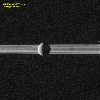
Rhea-Janus-Prometheus-_EB-LXTT.gifThe Endless "Cosmic Race" (a GIF-Movie by Elisabetta Bonora - Lunexit Team)57 visitenessun commentoMareKromiumApr 04, 2010
|
|
| 2245 immagini su 188 pagina(e) |
 |
|
|
|
|
19 | |
|
|
|
|





