| Ultimi arrivi - Saturn: the "Ringed Beauty" and His Moons |

AL-Streak Again-N00018570.jpgStreak again!75 visiteUna nuova "Striscia nel Cielo" - del 17/9/2004 - da guardare con estrema cura. Il motivo è questo: abbiamo svolto una semplice analisi sul frame scoprendo che la Striscia, stavolta, è costituita - ed è la 1ma volta che lo si vede con estrema chiarezza - da una sequenza di punti luminosi ravvicinatissimi i quali, per altro, non hanno tutti la stessa intensità luminosa. Un effetto similare (se non identico) lo si può ottenere, sulla Terra, riprendendo - con obbiettivo grandangolare o simile - una porzione di cielo notturno (con esposizione fra i 10 ed i 18/20") mentre un qualsiasi velivolo convenzionale si trovi in transito attraverso tale porzione di cielo. Effettuato lo sviluppo dell'immagine, noterete che il corpo del velivolo risulterà costituito da una serie ravvicinatissima di punti luminosi i quali diventeranno "più luminosi" in corrispondenza dei flash emessi dalle sue luci di posizione. Cosa implichiamo con questo discorso?
Che la Streak in the Sky di oggi NON E' CERTAMENTE un raggio cosmico!Set 19, 2004
|
|

AI-Saturn-Streak in the Sky-N00018041.jpgA new "Bright Streak" in the Sky of Saturn85 visiteUna nuova "striscia luminosa" (bright streak) nel Cielo di Saturno, ripresa il giorno 14 Settembre 2004. Che dire? Secondo noi - anche se accettassimo acriticamente la teoria che spiega alcune (comunque brevi e piuttosto deboli) striature di luce che, spesso, appaiono nelle immagini scattate guardando verso lo spazio come "raggi cosmici" - questa specifica "striscia" sembra qualcosa di molto particolare. Qualcosa che non può essere semplicemente ricondotto all'emissione luminosa di una micro-particella che schizza nello spazio a velocità relativistica.
Secondo noi, questa striscia (come anche altre, riprese dalla superficie di Marte) è causata da qualcosa di diverso.
Cosa?
E se lo sapessimo...Set 17, 2004
|
|

Saturn_s Rings in color - PIA06114_modest.jpgSaturn's Rings in natural colors from Cassini-Huygens55 visiteCaption NASA originale:Saturn's faintly banded atmosphere is delicately colored and its threadbare rings cross their own shadows in this marvelous natural color view from Cassini.
The planet and its rings would nearly fill the space between Earth and the Moon. Yet, despite their great breadth, the rings are a few meters thick and in some places, very translucent. In this image, we can see through the C-Ring, which is closest to Saturn, and through the Cassini division, the 4.800-Km wide gap that arcs across the top of the image and separates the optically thick B-Ring from the A-Ring. The part of the atmosphere seen through the gap appears darker and more bluish due to scattering at blue wavelengths by the cloud-free upper atmosphere.
The different colors in Saturn's atmosphere are due to particles whose composition is yet to be determined.
The image was obtained with the Cassini spacecraft narrow angle camera on July 30, 2004, at a distance of 7.6 MKM from Saturn".Set 17, 2004
|
|

Saturn storms_-PIA06477_modest.jpgAn "oval" storm near Saturn's South Pole56 visiteCaption NASA originale:"The region near Saturn's south pole shows a great deal of fascinating detail in this view from Cassini. Near upper right, an oval-shaped storm is bordered to the north and south by bright streaks of cloud, and two dark storms hover in a brighter cloud lane near the center.
The image was taken with the Cassini spacecraft narrow angle camera on Aug. 7, 2004, at a distance of 8.4 million kilometers (5.2 million miles) from Saturn through a filter sensitive to wavelengths of infrared light. The image scale is 50 kilometers (31 miles) per pixel". Set 16, 2004
|
|

Saturn & family-PIA06475_modest.jpgSaturn and Family56 visiteCaption NASA originale:"Satellites visible in this image are (clockwise from upper left): Dione (1.118 Km or 695 miles wide), Enceladus (499 Km or 310 miles wide), Tethys (1.060 Km or 659 miles wide), Mimas (398 Km or 247 miles wide) and Rhea (1.528 Km or 949 miles wide).
The image was taken in visible red light on Aug. 1, 2004, at a distance of 7.8 MKm (4.8 million miles) from Saturn. The image scale is 464 Km (288 miles) per pixel". Set 14, 2004
|
|

Saturn from HST-PIA01272_modest.jpg"Ringless Saturn" from Hubble Space Telescope (1998)55 visiteCaption NASA originale:"TOP - This is a NASA Hubble Space Telescope snapshot of Saturn with its rings barely visible. Normally, astronomers see Saturn with its rings tilted. Earth was almost in the plane of Saturn's rings, thus the rings appear edge-on. BOTTOM - This photograph shows Saturn with its rings slightly tilted. The moon called Dione, on the lower right, is casting a long, thin shadow across the whole ring system due to the setting Sun on the ring plane. The moon on the upper left of Saturn is Tethys".Set 12, 2004
|
|

Saturn in infrared-HST-PIA01268_modest.jpgInfrared view of Saturn - HST56 visiteCaption NASA originale:"The blue colors indicate a clear atmosphere down to a main cloud layer. The green and yellow colors indicate a haze above the main cloud layer. The red and orange colors indicate clouds reaching up high into the atmosphere and red clouds are even higher than the orange ones. The densest regions of two storms near Saturn's equator appear white hile the rings, basically made up of chunks of ice, are as white as images of ice taken in visible light".Set 12, 2004
|
|
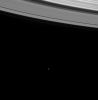
Saturn and Mimas-PIA06473.jpgSaturn and Mimas57 visiteCaption NASA originale:"On its first orbit of the ringed planet, the Cassini spacecraft gazed into the distance to capture this image of the icy moon Mimas (398 Km - 247 miles wide). The faint F-Ring is visible as the outermost strand of the rings in this view. The image was taken in visible light with the narrow angle camera on August 16, 2004, at a distance of 8.9 MKm (5.5 MMs) from Saturn. The image scale is 53 kilometers (33 miles) per pixel. Contrast was slightly enhanced to aid visibility".Set 11, 2004
|
|

Saturn-The Atlas Ring-The New Object-PIA06116.jpgThe "New Object" found in Saturn's "F-Ring" (2)55 visiteMa c'è di più: ingrandite le 2 immagini che Vi abbiamo proposto e poi osservate attentamente in alto alla Vostra Dx. Vedrete una piccola, ma ben definita, linea luminosa. Andate quindi sul Sito NASA "Planetary Photojournal - Images of Saturn": c'è una bellissima animazione ottenuta montando in sequenza 18 frames, oltre ai 2 qui pubblicati (ripresi con frequenza di 1 ogni 8 minuti su un arco di 135 minuti). Noterete che la "striscia" di luce di cui Vi stiamo parlando appare solo in 6.
Strano, vero?!?Set 10, 2004
|
|

Saturn-The Atlas Ring-The New Object-PIA06115.jpgThe "New Object" found in Saturn's "F-Ring" (1)56 visiteEcco il nuovo enigma che ci viene proposto da Saturno e che, come già si era detto, potrà affascinare coloro che conoscono la storia (o la "leggenda", se preferite) dei "Ringmasters of Saturn". Questa, in originale, la nota di commento al fenomeno rilasciata dalla NASA: "A small new found object, temporarily designated S/2004 S 3, has been seen orbiting Saturn's outer F ring. Its nature, moon or clump, is not presently known".
Una dichiarazione che ci lascia davvero pensare...Set 10, 2004
|
|

Saturn-The Atlas Ring-PIA06113_modest.jpgThe "F-Ring" (or "Atlas Ring") of Saturn55 visiteRiteniamo la dichiarazione che riportiamo qui di seguito di GRANDE INTERESSE, specie per coloro che sappiano dei cosiddetti "Ring-Masters", ossìa i ("Mitologici") Creatori degli Anelli di Saturno: "...Scientists examining Saturn's contorted F-Ring - which has baffled them since its discovery - have found 1 or 2 small bodies orbiting in the F-ring region, and a ring of material associated with Saturn's moon Atlas...".
Cosa sono questi 1 o 2 "small bodies"? Perchè non si parla di nuovi mini-satelliti?Set 09, 2004
|
|

Saturn_s South-Pole.jpgSaturn's South-Pole from approx. 8.900.000 Km55 visiteMacchie di nuvole bianche e svariate tempeste "scure" dominano le regioni polari dell'emisfero sud di Saturno in questa immagine ripresa il 18 Agosto 2004 da una distanza di circa 8.9 milioni di Km e con l'uso di un filtro sensibile alle lunghezze d'onda proprie della luce infrarossa. La scala dell'immagine è di 54 Km (33 miglia) per pixel.Set 08, 2004
|
|
| 2245 immagini su 188 pagina(e) |
 |
|
|
|
|
174 | |
|
|
|
|





