| Ultimi arrivi - Saturn: the "Ringed Beauty" and His Moons |

The Rings-N00021001.jpgThe "Rings"54 visiteAltissima definizione per questa spettacolare veduta degli Anelli di Saturno: un'immagine - almeno apparentemente - perfetta.
E meno male che, secondo alcuni (le solite "Cassandre"...), la Sonda Cassini-Huygens, su Saturno (oppure in orbita attorno a Saturno) non ci sarebbe mai arrivata...Ott 08, 2004
|
|
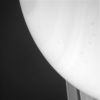
Saturn-N00020846.jpgSaturn and something else...55 visiteDi frames come questo, ogni giorno, ne giungono sulla Terra a decine, forse a centinaia. Noi cerchiamo di esaminarne il maggior quantitativo possibile (circa la metà di quelli che la NASA rende disponibili) e, di tanto in tanto, ci imbattiamo in qualche anomalia (o "stranezza", se Vi piace di più), come quella che Vi proponiamo ora. Dovete espandere l'immagine sino a full-size e poi guardare nel Cielo di Saturno, circa a mezza altezza dell'immagine. Sono visibili alcune stelle e poi una piccola traccia luminosa che sembra lasciarsi dietro una scia. Secondo noi non è un raggio cosmico (le loro tracce sono differenti); di certo non è un Satellite minore di Saturno (non c'è nel frame precedente nè in quello successivo) e non sembra una stella.
E allora cos'è?...Ott 06, 2004
|
|
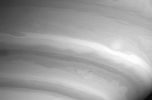
Saturn-PIA06491_modest.jpgSaturn's swirls and ribbons55 visiteCaption NASA originale:"This Cassini image shows mesmerizing detail in the swirls and ribbons of air in Saturn's atmosphere. The view was obtained at a distance of 8.5 million Km from Saturn and is but a taste of what the spacecraft's powerful cameras will show when Cassini draws nearer to the planet. The limb of the planet is visible at lower right.
The image was taken with the Cassini spacecraft narrow angle camera on Sept. 15, 2004, through a filter sensitive to wavelengths of infrared light. The image scale is 101 Km per pixel. The image was magnified by a factor of two and slightly contrast enhanced to improve visibility of features in the atmosphere".Ott 06, 2004
|
|

Saturn-N00020544.jpgSaturn and many dark spots and swirls on the surface54 visiteImmagine di Saturno ripresa da una distanza di poco superiore ai 7 milioni di Km. Abbiamo scelto questo frame a causa dei notevoli dettagli superficiali che sono agevolmente osservabili senza la necessità di processare ulterioremente la fotografia. Potete vedere svariate nuvole bianche (probabilmente composte da vapore acqueo); una miriade di uragani scuri e di modeste dimensioni - sulla Sn -; i bordi frastagliati di una perturbazione di dimensioni quasi planetarie - sempre sulla Sn, ma più vicino al centro dell'immagine -; una porzione degli anelli (a Dx in basso) ed un paio di strisce luminose che - come dicono alla NASA - dovrebbero essere tracce lasciate dal passaggio di "raggi cosmici". Insomma: quasi tutta la fenomenologia tipica di Saturno in un solo frame!Ott 03, 2004
|
|

Prometheus-PIA06488_modest.jpgPrometheus: one of the Ring-Masters74 visiteCaption NASA originale:"In its own way, the shepherd moon Prometheus is one of the Master of Saturn's rings. That's because the little moon maintains the inner edge of Saturn's thin, knotted, F-Ring, while its slightly smaller cohort Pandora (84 Km across) guards the ring's outer edge.
This view is a composite of nine raw images combined in a way that improves resolution and reduces noise. The final image was magnified by a factor of five.
The image clearly shows that Prometheus is not round, but instead has an oblong, potato-like shape.
The moon was discovered during the Voyager mission, and scientists then noted ridges, valleys and craters on its surface. Hints of its varied topography are present in this view, although Cassini will likely obtain much better images of Prometheus later in the mission".Ott 01, 2004
|
|

Saturn_s sky-N00020366.jpgThe Sky of Saturn56 visiteIl cielo di Saturno, visto da Cassini/Huygens. Queste immagini, purtroppo, non vengono molto pubblicizzate, nè dalla NASA nè da altri organi di informazione (scientifica o meramente divulgativa). Il motivo è abbastanza chiaro: frame come questo - si dice - non mostrano "nulla di particolare", se non qualche stella e qualche satellite di Saturno. Secondo noi, frame come questo possiedono una grandissima magia ed un enorme fascino: lo Spazio visto DALLO Spazio! Qualcuno ha detto che "...Se non c'è bellezza, non ci può essere curiosità; e se non c'è curiosità, non ci può essere scienza alcuna...".
Noi siamo d'accordo.Ott 01, 2004
|
|

Hyperion-PIA06486.jpgHyperion, the "tumbling" moon55 visiteUn'immagine non particolarmente bella ma comunque densa di suggestione e di mistero: si tratta di Iperione (o "Hyperion"), la luna di Saturno che non "scorre", ma "rotola" (come dicono gli Scienziati) lungo la sua orbita. Si tratta, probabilmente, di una delle lune che sono state - letteralmente - "rubate" dal Signore degli Anelli: un macigno proveniente dalle profondità del Sistema Solare (un "KBO") che si è avvicinato troppo a Saturno ed è stato catturato dal suo "abbraccio gravitazionale". Il movimento caotico di Iperione - tenendo a mente che l'impulso iniziale impresso ad un corpo, nello spazio, viene dal corpo stesso mantenuto (praticamente) all'infinito - deriva, con ogni probabilità, dal fatto che si tratta di un frammento di un oggetto celeste di più grandi dimensioni il quale andò in pezzi a seguito di un impatto occorso in epoche assai remote.
Una delle "schegge" che derivarono dalla collisione la vediamo orbitare (anzi: "rotolare") ancora oggi intorno a Saturno: questo è Iperione.Set 30, 2004
|
|
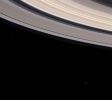
Saturn-PIA06485_modest.jpgSaturn, Janus and Mimas (in natural colors)55 visiteCaption NASA originale:"Looking something like the fibrous bow of a violin, Saturn's colorful rings sweep through this spectacular natural color view while two small moons look on.
From left, the moons visible here are Janus (181 Km across) and Mimas (398 Km across). Cassini's view in this image is from beneath the ring plane; the moons are on the far side of Saturn. Janus leads Mimas as the two moons orbit the planet. Nearly the entire ring system can be seen in this view. The diaphanous C-Ring appears at the upper right, followed by the multi-hued B-Ring. Next, the famous Cassini division (4.800 Km wide) separates the A and B rings. The outer edge of the B-Ring which forms the inner boundary of the Cassini division is maintained by a gravitational resonance with Mimas. Near the outer edge of the A-Ring are the Encke Gap (325 Km wide) and the barely visible Keeler Gap (35 Km wide). The faint, thread-like F-Ring is slightly discernible just beyond the main rings". Set 28, 2004
|
|
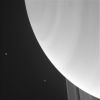
Saturn + 2-N00019308.jpgSatrun, one little Moon and "something else" - N 0001930756 visiteInnanzitutto il commento NASA originale: "N00019308.jpg was taken on September 24, 2004 and received on Earth September 25, 2004. The camera was pointing toward SATURN at approx. 7.752.875 Km away and the image was taken using the CL1 and UV3 filters".
Si vede subito che c'è un altro oggetto luminoso, accanto a Saturno, oltre alla Luna che avevamo già notato nel frame precedente. Se ingrandite l'immagine, poi, ecco la sorpresa: l'oggetto "nuovo" sembra essere il centro (o la causa?) di una sorta di "esplosione". Se osservate attentamente nell'area centrale dell'esplosione (!) vedrete qualcosa di simile ad un triangolino bianco: un effetto della possibile eccessiva luminosità dell'epicentro del fenomeno. Dunque, di che cosa si tratta?
Ancora un errore/difetto nella/della trasmisione dati? Una cometa che si disintegra?
E' purtroppo probabile che non lo sapremo mai, tuttavia il fenomeno immortalato (crediamo in maniera del tutto casuale) dalla Sonda potrebbe anche essere di valore storico. Potrebbe...Set 26, 2004
|
|

Saturn + 1-N00019307.jpgSaturn and one little Moon N 0001930756 visiteVi proponiamo due immagini da guarddare in stretta correlazione. In questo primo frame, Saturno è accompagnato da una delle sue tante Lune. Non sapremmo dire di quale si tratti, ma questo non è un dato - in questa sede - di importanza fondamentale. EccoVi il commento NASA al frame:"N00019307.jpg was taken on September 24, 2004 and received on Earth September 25, 2004. The camera was pointing toward SATURN at approximately 7.752.936 Km away and the image was taken using the BL1 and CL2 filters".
Accanto alla Luna di Saturno si può intuire - espandendo il frame sino a full-size - una leggera ombratura chiara. Noi abbiamo pensato che fosse un difetto dell'immagine. Ma ora andate a guardare il frame successivo...Set 26, 2004
|
|
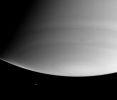
Saturn and Enceladus - PIA06483_modest.jpgSaturn and Enceladus (in ultra-violet)56 visiteCaption NASA originale:"Looking beyond Saturn's south pole, this was the Cassini spacecraft's view of the distant, icy moon, Enceladus on July 28, 2004. The planet itself shows few obvious features at these ultraviolet wavelengths, due to scattering of light by molecules of the gases high in the atmosphere. Enceladus is 499 Km wide.
The image was taken with the Cassini spacecraft narrow angle camera at a distance of 7.4 MKM from Saturn through a filter sensitive to ultraviolet wavelengths of light. The image scale is 44 Km per pixel of Saturn".Set 24, 2004
|
|

Saturn and Prometheus-PIA06481_modest.jpgSaturn and Prometheus56 visiteCaption NASA originale:"Saturn's moon Prometheus is seen shepherding the inner edge of Saturn's "F-Ring". Prometheus is 102 Km across and was captured in a close-up view by the Cassini spacecraft near the time of orbital insertion at Saturn (see PIA06098). A number of clumps are visible here along the arcing "F-Ring".
The image was taken with the Cassini spacecraft narrow angle camera on Aug. 5, 2004, at a distance of 8.2 MKM from Saturn through a filter sensitive to visible green light. The image scale is 49 Km per pixel. Contrast was slightly enhanced to aid visibility".Set 22, 2004
|
|
| 2245 immagini su 188 pagina(e) |
 |
|
|
|
|
173 | |
|
|
|
|





