| Ultimi arrivi - Saturn: the "Ringed Beauty" and His Moons |

Japetus in the darkness-PIA06146_modest.jpgThe night-side of Japetus (from 1,6 MKMs)56 visiteCaption NASA originale:"Japetus, as it has been already said, is mainly famous for some dramatic contrasts in brightness on its surface: the leading hemisphere is as dark as a freshly-tarred street while the trailing hemisphere and poles are almost as bright as fresh snow. Many impact craters can be seen in the bright terrain and in the transition zone between bright and dark and for the first time in parts of the dark terrain. Also visible is a line of mountains that appear as a string of bright dots (see the color images "Sharp views of Japetus"). These mountains were originally detected in Voyager images and might compete in height with the tallest mountains on Earth, Jupiter's moon Io and possibly even Mars. Further observations will be required to precisely determine their heights. Interestingly, the line of peaks is aligned remarkably close to the equator of Japetus". Dic 09, 2004
|
|

Japetus-PIA06145_modest.jpgSharp views of Japetus58 visiteIn sequenza, alcune delle migliori immagini di Giapeto ottenute da Cassini e superiori, per qualità e dettaglio, a quelle ottenute dalla Sonda Voyager 2 qualche anno fa. Le immagini a colori visibili sulla Sn dell'Osservatore ed al centro sono state ottenute usando (e combinando) i filtri per l'ultravioletto (a 338 Nnmts), il verde (a 568 Nnmts) e l'infrarosso (a 930 Nnmts); l'immagine a Dx è stata ottenuta riprendendo nel cosiddetto "spettro visibile". Le immagini sono state riprese da una distanza oscillante fra gli 1,1 e gli 1,3 MKMs; Giapeto si caratterizza sia per il gigantesco cratere da impatto visibile nell'emisfero sud (400 Km di diametro), sia per alcune notevoli differenze di albedo fra diverse zone della sua superficie (il che ci fa supporre che esistano aree ricoperte, probabilmente, da vasti depositi di polveri - che sono causa di una bassa riflessione della luce ergo di una bassa albedo - ed altre aree che, forse, sono costituite da rocce o addirittura da depositi di ghiaccio).Dic 09, 2004
|
|

The C-Ring-PIA06537_modest.jpgThe C-Ring in full detail56 visiteCaption NASA originale: "Saturn's inner C-Ring spreads across the field of view, showing the characteristic plateau and wave-like structure for which it is famed.
The center of this image shows an area approximately 75.000 Km from Saturn. The dark gap through the middle of the frame is the Colombo gap which houses the bright, narrow, eccentric Colombo ringlet, in resonance with the moon Titan.
The image was taken with the Cassini spacecraft narrow angle camera on Oct. 29, 2004, at a distance of about 842.000 Km from Saturn. The image scale is 4.7 Km per pixel".Dic 08, 2004
|
|

The F-Ring-PIA06144~1.jpgThe "F-Ring", alone57 visiteCaption NASA originale:"Zigzagging kinks and knots dance around Saturn in the F-Ring. From a great distance, as during Cassini's initial approach to Saturn in mid-2004, the F-Ring appears as a faint, knotted strand of material at the outer fringe of Saturn's immense ring system. From this close vantage point, just after the spacecraft rounded the planet to begin its second orbit, the F ring resolves into several ringlets with a bright central core. The core of the F ring is about 50 Km wide and is located at a distance of approximately 80.100 Km from Saturn's cloud tops". Dic 04, 2004
|
|

Prometheus-PIA06143_modest.jpgPrometheus and the F-Ring55 visiteAs it completed its first orbit of Saturn, Cassini zoomed in on the rings to catch this wondrous view of the shepherd moon Prometheus (102 Km across) working its influence on the multi-stranded and kinked F-Ring. The F-Ring resolves into five separate strands in this closeup view. Potato-shaped Prometheus is seen here, connected to the ringlets by a faint strand of material. Imaging scientists are not sure exactly how Prometheus is interacting with the F-Ring here, but they have speculated that the moon might be gravitationally pulling material away from the ring. The ringlets are disturbed in several other places. In some, discontinuities or "kinks" in the ringlets are seen; in others, gaps in the diffuse inner strands are seen. All these features appear to be due to the influence of Prometheus. The image was taken in visible light with the narrow angle camera on Oct. 29, 2004, at a distance of about 782.000 Km from Prometheus and at a phase angle of 147°. Scale is 4.7 Km per pixel".Dic 04, 2004
|
|

Saturn_s Rings-PIA06533_modest.jpgSaturn's Rings from about 631.000 Km57 visiteCaption NASA originale:"The usually bright B-Ring (at center) appears very dim in this view of the rings taken on the side of the rings that is not illuminated. The scene resembles a photographic negative, with bright and dark areas reversed (although in some places in the rings, the blackness of space is seen). From this viewing angle, the rings are lit from below: both dense and empty regions are dark, and regions of intermediate particle density are bright.
The image was taken with the Cassini spacecraft wide angle camera on Oct. 27, 2004, at a distance of about 631.000 Km from Saturn through a filter sensitive to wavelengths of visible violet light. The image scale is 34 Km per pixel". Dic 03, 2004
|
|

Saturn-the Encke Gap-PIA06534_modest.jpgThe "Encke Gap" of Saturn's Rings56 visiteCaption NASA originale:"An intriguing knotted ringlet within the Encke Gap is the main attraction in this Cassini image. The Encke Gap is a small division near the outer edge of Saturn's rings that is about 300 Km wide. The tiny moon Pan (20 Km across) orbits within the gap and maintains it.
Many waves produced by orbiting moons are also visible.
The image was taken in visible light with the Cassini spacecraft narrow angle camera on Oct. 29, 2004, at a distance of about 807,000 Km from Saturn. The image scale is 4,5 Km per pixel".
Dic 03, 2004
|
|

Mimas-PIA06142_modest.jpgMimas and Saturn in real colors64 visiteCaption NASA originale:"In a splendid portrait created by light and gravity, Saturn's lonely moon Mimas is seen against the cool, blue-streaked backdrop of Saturn's northern hemisphere. Delicate shadows cast by the rings arc gracefully across the planet, fading into darkness on Saturn's night side. The bright blue swath near Mimas is created by sunlight passing through the Cassini division (4.800 Km wide). The rightmost part of this distinctive feature is slightly overexposed and therefore bright white in this image. Shadows of several thin ringlets within the division can be seen here as well. The dark band that stretches across the center of the image is the shadow of Saturn's B-Ring, the densest of the main rings. Part of the actual Cassini division appears at the bottom, along with the A-Ring and the narrow, outer F-Ring. The A-Ring is transparent enough that, from this viewing angle, the atmosphere and threadlike shadows cast by the inner C-Ring are visible through it".Dic 01, 2004
|
|
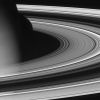
Saturn-PIA06532_modest.jpgSaturn from 618.000 Km56 visiteCaption NASA originale:"Cassini pierced the ring plane and rounded Saturn on Oct. 27, 2004, capturing this view of the dark portion of the rings. A portion of the planet's atmosphere is visible here, as is its shadow on the surface of the rings.
The image was taken with the Cassini spacecraft wide angle camera on Oct. 27, 2004, at a distance of about 618.000 Km from Saturn through a filter sensitive to wavelengths of infrared light centered at 1001 nanometers. The image scale is 33 Km per pixel".Dic 01, 2004
|
|

Enceladus-PIA06531_modest.jpgEnceladus56 visiteCaption NASA originale:"The image shows the trailing hemisphere of Enceladus, which is the side opposite the moon's direction of motion in its orbit. Enceladus is 499 Km across.
The image was taken in visible light with the Cassini spacecraft narrow angle camera on Oct. 27, 2004, at a distance of about 766.000 Km from Enceladus and at a Sun-Enceladus-spacecraft, or phase, angle of 34 degrees. The image scale is 4,6 Km per pixel".Dic 01, 2004
|
|

Tethys-PIA06140-N-HD.jpgTethys in natural colors (HD)57 visiteCommento NASA originale estratto da "NASA - Picture of the Day" del 29 Novembre 2004:"Tethys is one of the larger and closer moons of Saturn. The Cassini spacecraft now orbiting Saturn passed near the frozen moon at the end of October, capturing the most detailed images since the Voyager spacecrafts in the early 1980s. Tethys is composed almost completely of water ice and shows a large impact crater that nearly circles the planet. Because this crater did not disrupt the moon, Tethys is hypothesized to be at least partly liquid in its past. Two smaller moons, Telesto and Calypso, orbit Saturn just ahead of and behind Tethys. Giovanni Cassini discovered Tethys in 1684. The Cassini spacecraft is scheduled for a close fly-by of Tethys in September 2005". Nov 29, 2004
|
|

Dione-PIA06528_modest.jpgDione from approx. 1.200.000 Km56 visiteA gorgeous Dione poses for Cassini, with shadowed craters and bright, wispy streaks first observed by the Voyager spacecraft 24 years ago. The wispy areas will be imaged at higher resolution in mid-December 2004. Subtle variations in brightness across the surface of this moon are visible here as well. Dione's diameter is 1.118 Km. The image shows primarily the trailing hemisphere of Dione, which is the side opposite the moon's direction of motion in its orbit. The image has been rotated so that north is up.
The image was taken in visible light with the Cassini spacecraft narrow angle camera on Oct. 27, 2004, at a distance of about 1.2 MKMs from Dione and at a Sun-Dione-spacecraft, or phase, angle of 28°. The image scale is 3.5 Km per pixel. Nov 26, 2004
|
|
| 2245 immagini su 188 pagina(e) |
 |
|
|
|
|
168 | |
|
|
|
|





