| Ultimi arrivi - Saturn: the "Ringed Beauty" and His Moons |

Dione-PIA06163.jpgDione: close-up (2) - HR54 visiteCaption NASA originale:"This very detailed image taken during the Cassini spacecraft's closest approach to Saturn's moon Dione on Dec. 14, 2004 is centered on the wispy terrain of the moon. To the surprise of Cassini imaging scientists, the wispy terrain does not consist of thick ice deposits, but rather the bright ice cliffs created by tectonic fractures". Una nostra piccola annotazione: tutta la superficie di Dione è, a ben vedere, un mosaico di quelle che alla NASA chiamano "tectonic fractures"; ma guardate bene che cosa si diparte, circa al centro dell'immagine, dalla linea del terminatore: una "frattura tettonica anomala", perfettamente dritta, curiosamente molto luminosa (ci ricorda una pista di atterraggio/decollo di aeromobili oppure un'autostrada...) che attraversa altre fratture (decisamente più "naturali"...) e che costeggia il bordo di almeno 5 crateri, uno dei quali ci sembra abbastanza grande. Se non la vedete, guardate il detail mgnf che abbiamo preparato per Voi nel frame successivo.Dic 17, 2004
|
|

Dione-PIA06156_modest.jpgDione: close-up (1) - HR61 visiteCaption NASA originale:"This incredible, HR view of Saturn's moon Dione was taken during Cassini's first close approach to the icy moon on Dec. 14, 2004. The view shows linear, curving features within the region of the bright wispy terrain Dione is known for.
The image was obtained in visible light with the Cassini spacecraft narrow angle camera at a distance of approximately 156.000 Km (97.000 miles) from Dione. The Sun-Dione-spacecraft, or phase, angle is 34°. The image scale is about 1 Km (0.6 miles) per pixel".Dic 17, 2004
|
|

Dione-PIA06155-1.jpgDione and Saturn in natural colors80 visiteCaption NASA originale:"Cassini captured Dione against the globe of Saturn as it approached the icy moon for its close rendezvous on Dec. 14, 2004. This natural color view shows the moon has strong variations in brightness across its surface, but a remarkable lack of color, compared to the warm hues of Saturn's atmosphere. Several oval-shaped storms are present in the planet's atmosphere, along with ripples and waves in the cloud bands.
The images used to create this view were obtained with the Cassini spacecraft wide-angle camera at a distance of approximately 603.000 Km from Dione through a filter sensitive to wavelengths of ultraviolet light centered at 338 nanometers. The Sun-Dione-spacecraft, or phase, angle is 34°. The image scale is about 32 Km per pixel".Dic 17, 2004
|
|

Saturn-W00003808.jpgSaturn and Dione78 visitenessun commentoDic 16, 2004
|
|

Dione-N00025942.jpgDione from approx. 167.000 Km56 visiteDa guardare: nessun commento.Dic 16, 2004
|
|
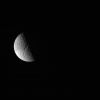
Tethys-N00025970.jpgTethys from approx. 564.000 Km56 visiteUn'ottima immagine di Tethys la quale, nonostante la grande distanza che ancora separa la Sonda Cassini/Huygens da questa luna, è già capace di rivelarci alcune delle tante caratteristiche superficiali di questa luna. Notiamo, in particolare, all'altezza dell'equatore di Tethys, a ridosso del terminatore (e con riflessi su una larga parte della sua superficie illuminata), la presenza di una profondissima cicatrice la quale, probabilmente, è la prova di un catastrofico impatto - occorso qualche milione di anni orsono - fra questa luna ed uno o più corpi vaganti di notevoli dimensioni. Le note oggettive della cicatrice più grande suggeriscono un angolo di impatto piuttosto basso. Non è neppure da escludersi la possibilità che Tethys sia stata colpita nella medesima area da (almeno) tre corpi celesti ed in epoche diverse e lontane fra loro (osservate infatti i 2 solchi quasi paralleli fra loro - ad ore 8 di Tethys - che intersecano, sovrapponendosi, il solco più grande che giunge sino al terminatore). Dic 16, 2004
|
|

Dione-N00025969.jpgDione from approx. 81.000 Km54 visiteUn ulteriore ingrandimento sui lunghissimi (e, riteniamo, piuttosto profondi) crepacci che caratterizzano la superficie di questa grande luna di Saturno. Si tratta di un'immagine molto bella ed ottimamente definita che ci aiuta a cogliere e studiare molto bene alcune delle caratteristiche superficiali maggiori di questo vero e proprio pianetino. Dic 16, 2004
|
|

Dione-N00025769.jpgDione from approx. 82.000 Km55 visiteSpettacolare immagine di Dione in una sua area prossima al terminatore. Sono chiaramente visibili, oltre a numerosi crateri di notevole ampiezza, anche dei lunghissimi canyon i quali dovrebbero essere la conseguenza del "repentino" (in senso geologico, naturalmente) raffreddamento della sua superficie.Dic 16, 2004
|
|

A - Saturn-a.jpgSaturn, Tethys and Dione in almost true colors191 visiteSaturn Data and Statistics
Mass (kg) = 5.688e+26
Mass (Earth = 1) = 9,5181e+01
Equatorial radius = 60.268 Km
Equatorial radius (Earth = 1) = 9,4494e+00
Mean density (gm/cm^3) = 0,69
Mean distance from the Sun = 1.429.400.000 Km
Mean distance from the Sun (Earth = 1) = 9,5388
Rotational period (hours) = 10,233
Orbital period (years) = 29,458
Mean orbital velocity = 9,67 Km per second
Tilt of axis = 25,33°
Orbital inclination = 2,488°
Equatorial surface gravity (m/sec^2) = 9,05
Equatorial escape velocity = 35,49 Km per second
Magnitude (Vo) = 0,67
Mean cloud temperature = - 125°C
Atmospheric pressure (bars) = 1,4
Atmospheric composition: Hydrogen 97% and Helium 3% Dic 15, 2004
|
|

Japetus-N00025365.jpgThe anomalous moon "Japetus" from approx. 4,7 MKMs56 visitenessun commentoDic 13, 2004
|
|

Mimas, Janus, Prometheus-PIA06529_modest.jpgMimas, Janus and Prometheus, from the darkside59 visiteCaption NASA originale: "Visible in this image are: Mimas (398 Km, or 247 miles across) brightest and above center; Janus (181 Km, or 112 miles across) second brightest at upper left; and Prometheus (102 Km, or 63 miles across) just above the main rings at upper left.
The normally bright B-Ring appears very dark from this vantage point. Regions with smaller concentrations of particles, such as the Cassini division (bright near center) transmit more sunlight and thus are brighter.
The image was taken in visible light with the Cassini spacecraft wide angle camera on Oct. 27, 2004, at a distance of 757.000 Km(470.000miles) from Saturn. The image scale is about 42 Km (26 miles) per pixel".Dic 11, 2004
|
|

Saturn-PIA06538_modest.jpgSaturn and the shadow of his Rings56 visiteThis majestic view of Saturn captures several phenomena of interest to scientists working on the Cassini mission. The planet's nighttime atmosphere looms ahead - an excellent place to search for storms and lightning. Saturn's shadow stretches across the rings, which will over the next four years receive their most thorough examination since Galileo discovered them in 1610. And barely visible near lower right just inside the F-Ring, is the small shepherd moon Prometheus (102 Km across). Researchers will explore the many moons of Saturn, including special ones like Prometheus that help maintain some of the rings and gaps in this complex and dynamic system.
The image was taken in visible light with the Cassini spacecraft wide angle camera on Oct. 29, 2004, at a distance of about 940.000 Km from Saturn. The image scale is 52 Km per pixel."Dic 09, 2004
|
|
| 2245 immagini su 188 pagina(e) |
 |
|
|
|
|
167 | |
|
|
|
|





