| Ultimi arrivi - Saturn: the "Ringed Beauty" and His Moons |
Mimas-N00026522.jpgMimas: the Ring-Master58 visitenessun commentoGen 19, 2005
|
|

Enceladus-N00026632.jpgCrescent Enceladus (2)55 visiteUna falce sottilissima e l'immagine - in full frame - è costellata da artefatti fotografici. In realtà il frame è comunque bellissimo e gli artefatti che vediamo nella versione piena della fotografia ci sono comunque utili per imparare a riconoscerli.Gen 19, 2005
|
|

Enceladus-N00026569.jpgCrescent Enceladus (1)55 visiteDue bellissime istantanee di Enceladus, una delle "Lune Minori" di Saturno. Il volume di dettagli della superficie di Enceladus che si riescono a cogliere con questo frame è davvero notevole, specie allorchè si guarda verso la linea del terminatore.
Non ci sono anomalie in queste immagini (o, almeno, noi non ne abbiamo viste); in compenso si tratta di due vedute di questo mondo gelido assolutamente splendide, da conservare.Gen 19, 2005
|
|
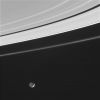
Mimas-N00026835.jpgMimas and the Rings55 visiteUna ripresa davvero spettacolare ci arriva dalla Sonda Cassini e ci mostra, accanto agli Anelli, Mimas, una delle lune di Saturno definite "Ring-Master" (ossìa - letteralmente - "I Padroni degli Anelli"), al suo primo quarto. Come avevamo già accennato in passato gli equilibri che consentono agli Anelli di Saturno di "non andare in pezzi", sono garantiti dagli influssi gravitazionali di alcune delle sue stesse Lune. Una delicatissima meccanica mareale, costituita da impulsi attrattivi e repulsivi, che mantiene in situ l'intero Sistema degli Anelli. Alcuni Scienziati si domandano se questo equilibrio sia stabile o instabile. La risposta, ad oggi, non si può dare, ma la logica ci suggerisce di pensare ad un equilibrio sostanzialmente stabile, tuttavia suscettibile di essere alterato in qualsiasi momento. Pensate, infatti, a che cosa accadrebbe se, magari a seguito di un impatto, uno dei Ring-Master cambiasse - anche solo impercettibilmente - la propria orbita, allontanandosi o avvicinandosi a Saturno...Gen 19, 2005
|
|

Japetus-PIA07000_modest.jpgJapetus' surface composition (organic material?!?)55 visiteCaption NASA originale:"These two color composite images of Saturn's moon Japetus from Cassini's visual and infrared mapping spectrometer were obtained on Dec. 31, 2004, an hour and a half before the New Year, at a distance of 121.000 Km (75.186 miles), with a spatial resolution of about 60 Km (37 miles).
The three colors used in the left mosaic correspond to 1.01, 1.51, and 2 microns, while the right mosaic is comprised of images at 3.0, 3.21, and 4.60 microns. The two images show the vast difference in the composition of the bright and dark regions of Japetus. As one moves from the near infrared 1 to 2 micron spectral region (left image) to the 3 to 5 micron spectral region (right image) the bright, ice-rich region on Japetus turns dark and the dark region rich in organics turns bright".Gen 11, 2005
|
|

Japetus-PIA07003_modest.jpgJapetus' surface composition (organic material?!?)67 visiteCaption NASA originale:"The polar water ice is relatively dark at this wavelength, so the ice cap is not seen. The next frame shows carbon dioxide on the surface. The carbon dioxide peaks at mid latitudes and shows less strength at the pole and along the equator (the dark band curving near the left edge of the image). The third frame shows the strength of water absorption on Japetus. The brightest regions are due to water ice near the pole. The grayer areas indicate water bound to minerals on the surface. The color composite shows water as blue, carbon dioxide as green, and non-ice minerals as red".Gen 11, 2005
|
|

Japetus-PIA07002_modest.jpgJapetus' surface composition (organic material?!?)56 visiteCaption NASA originale:"The three colors used in the mosaic correspond to 1.01, 3.21, and 3.80 microns. The different colors represent vastly different surface compositions. The upper bright blue region is rich in water ice, while the lower, dark brown region is composed mainly of a substance rich in organic material. The yellow region consists of a mixture of ice and organics, suggesting a gradual change in composition on the surface. This pattern suggests Iapetus swept up the dark material, which may have come from debris created from meteoritic impacts onto the small, outer satellites of Saturn".Gen 11, 2005
|
|
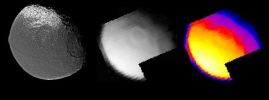
Japetus-temp.3-PIA07004_modest.jpgJapetus Thermal Radiation Image55 visiteCaption NASA originale:"This image of the infrared heat radiation from Saturn's moon Japetus was obtained by the Cassini composite infrared spectrometer instrument 16 hours before Cassini's closest approach to this mysterious moon, on December 31, 2004. The thermal radiation is shown as both a grayscale image, equivalent to what we would see if our eyes were sensitive to infrared wavelengths near 15 microns and as a color-coded temperature map. A previously-released mosaic obtained by Cassini's imaging camera shortly before the composite infrared spectrometer observation, with similar scale and orientation, is also shown for comparison. Temperatures in the large crater near the center of the disc are slightly different from those in surrounding areas, because sloping surfaces within the crater are warmer where they are tilted towards the Sun and cooler when tilted away from the Sun".Gen 11, 2005
|
|
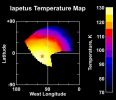
Japetus-temp.2-PIA07005_modest.jpgJapetus Temperature Map55 visiteCaption NASA originale:"Temperatures reach nearly 130 Kelvin (-226 F) at noon on the equator on the dark material that covers most of this side of Japetus, making high noon on Japetus's dark side probably the warmest place in the Saturn System. This is much warmer than temperatures on the moon Phoebe - as measured by the composite infrared spectrometer in June 2004 - which peaked near 112 Kelvin (-258 F). That's because, although Phoebe is almost as dark as Japetus's dark material and absorbs nearly as much sunlight, Phoebe rotates much more quickly (once every 9 hours, compared to 79 days for Japetus). That means the surface has less time to heat up during the day. Temperatures on Japetus' bright material are much colder, peaking near 100 Kelvin (-280 F), both because the bright material absorbs less sunlight and because it is further from the equator on this side of Japetus".Gen 11, 2005
|
|

Japetus-temp.1-PIA07006_modest.jpgJapetus Temperature Variation Map57 visiteCaption NASA originale:"This plot shows how daytime temp.s at low latitudes on the Dark Material on Japetus vary with time of day from about 130 Kelvin (-226 F) at noon to about 70 Kelvin (-334 F) at sunset. The observations are compared to a "forecast" model (green line) which predicts temperatures based on an assumed value of a parameter called the "thermal inertia. Rock or solid ice has a high thermal inertia (approx. 2.000.000 as measured in the obscure units used for thermal inertia), meaning that it is good at storing heat and cools down or heats up relatively slowly. On Japetus, in contrast, temperatures drop precipitously in the afternoon as the Sun sinks towards the horizon and a very small value of the thermal inertia (30.000 units) is needed in the model to match the data. This means that Japetus's surface is extremely bad at storing heat and is thus extremely fluffy, probably due to the pulverizing effect of billions of years of meteorite impacts (...)".Gen 11, 2005
|
|

Japetus-PIA06171_modest.jpgLandslide on Japetus57 visiteCaption NASA originale:"A spectacular landslide within the low-brightness region of Japetus's surface known as Cassini Regio. The landslide material appears to have collapsed from a scarp 15 Km high that forms the rim of an ancient 600 Km impact basin. Unconsolidated rubble from the landslide extends halfway across a conspicuous, 120-Km diameter flat-floored impact crater that lies just inside the basin scarp. Landslides are common geological phenomena on many planetary bodies, including Earth and Mars. The appearance of this landslide on an icy satellite with low-brightness cratered terrain is reminiscent of landslide features that were observed during NASA's Galileo mission on the Jovian satellite Callisto. The fact that the Japetus landslide traveled many kilometers from the basin scarp could indicate that the surface material is very fine-grained and perhaps was fluffed by mechanical forces that allowed the landslide debris to flow extended distances". Gen 08, 2005
|
|

Japetus-PIA06170_modest.jpgJapetus in HR57 visiteCaption NASA originale:"This oblique view of Saturn's moon Japetus from high latitude shows how the dark, heavily cratered terrain of Cassini Regio transitions to a bright, icy terrain at high latitudes. In this mosaic of 2 HR images taken during Cassini's New Year's Eve 2004 flyby of Japetus, the direction toward the north pole is approximately 15° below the horizontal on the right. At the equator terrains are uniformly covered with a dark mantle of material that has a reflectivity of about 4%. At latitudes toward the pole of about 40°, the dark deposits become patchy and diffuse as the surface transitions to a much brighter, icy terrain near the pole. The brightest icy materials exhibit visual reflectivity over 60%. Superimposed on the bright terrain is a subtle, ghostly pattern of crudely parallel, north-south trending wispy streaks. The streaks, which were discovered during this flyby of Iapetus, are typically a few kilometers wide and sometimes tens of kilometers long. Their appearance and orientation may be connected with the emplacement of dark materials that cover Cassini Regio. The dark materials might represent the gradual accumulation of dark debris falling from space, or alternatively, may represent fallout from plume-style eruptions that may have accompanied the formation of Iapetus's enigmatic equatorial ridge (see PIA 06166)".Gen 08, 2005
|
|
| 2245 immagini su 188 pagina(e) |
 |
|
|
|
|
164 | |
|
|
|
|





