| Ultimi arrivi - Saturn: the "Ringed Beauty" and His Moons |
Saturnian_Space-N00156094-N00156177.gifCosmic Shower (GIF-Movie; credits: Dr Gianluigi Barca - Lunexit Team)59 visitenessun commentoMareKromiumLug 04, 2010
|
|
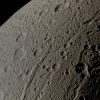
Dione-PIA12663.jpgDione (Absolute Natural Colors; credits for the additional process. and color.: Dr Paolo C. Fienga - Lunexit Team)59 visiteCaption NASA:"The Cassini Spacecraft swooped in for a close-up of the cratered, fractured surface of Saturn's moon Dione in this image taken during the Spacecraft's Jan. 27, 2010, non-targeted Fly-By.
Cassini came within about 45.000 Km (approx. 28.000 miles) of the moon during the Fly-By, and this image was acquired at a distance of approx. 46.000 Km (about 29.000 miles).
This view looks toward the Leading Hemisphere of Dione. North on Dione is up. The image was taken in Visible Light with the Cassini Spacecraft narrow-angle camera.
The view was acquired at a Sun-Dione-Spacecraft, or Phase, Angle of 108°. Image scale is roughly 270 meters (886 feet) per pixel".MareKromiumLug 01, 2010
|
|

Japetus-PIA12657.jpgLight and Darkness on Japetus (possible Natural Colors; credits for the additional process. and color.: Dr Paolo C. Fienga - Lunexit Team)57 visiteCaption NASA:"Light and Dark Terrain covers the Surface of Saturn's moon Japetus; Lit Terrain seen here is on the area between the Saturn-facing Side and Trailing Hemisphere of Japetus. North is up and rotated 4° to the right.
The image was taken in Visible Light with the Cassini Spacecraft narrow-angle camera on Dec. 1, 2009. The view was obtained at a distance of approx. 1,4 MKM (about 870.000 miles) from Japetus and at a Sun-Japetus-Spacecraft, or Phase, Angle of 100°.
Image scale is roughly 8 Km (approx. 5 miles) per pixel".MareKromiumGiu 23, 2010
|
|

Helene-PIA12653.jpgHelene57 visitenessun commentoMareKromiumGiu 14, 2010
|
|

The_Rings-N00154606-610-EB-LXTT.jpgLike a "Neon-Light"! (an Image-Mosaic by Elisabetta Bonora - Lunexit Team)103 visitenessun commentoMareKromiumGiu 11, 2010
|
|

The_Rings-N00154629-35-EB-LXTT.gifAstrophysics in motion (a GIF-Movie by Elisabetta Bonora - Lunexit Team)106 visitenessun commentoMareKromiumGiu 11, 2010
|
|

Pandora-N00154611-17-23-EB-LXTT.jpgApproaching Pandora (an Image-Mosaic by Elisabetta Bonora - Lunexit Team)77 visitenessun commentoMareKromiumGiu 10, 2010
|
|

Pandora-N00154612-13-14-EB-LXTT.jpgApproaching Pandora (an Image-Mosaic by Elisabetta Bonora - Lunexit Team)68 visitenessun commentoMareKromiumGiu 10, 2010
|
|

Pandora-N00154618-19-20-EB-LXTT.jpgApproaching Pandora (an Image-Mosaic by Elisabetta Bonora - Lunexit Team)73 visitenessun commentoMareKromiumGiu 10, 2010
|
|

Pandora-N00154624-25-26-EB-LXTT.jpgApproaching Pandora (an Image-Mosaic by Elisabetta Bonora - Lunexit Team)71 visitenessun commentoMareKromiumGiu 10, 2010
|
|

Rhea-N00154965-66-67-EB-LXTT.jpgCraterland (an Image-Mosaic by Elisabetta Bonora - Lunexit Team)80 visitenessun commentoMareKromiumGiu 10, 2010
|
|

Rhea-PIA12648.jpgGibbous Rhea (Natural Colors; credits for the additional process. and color.: Dr Paolo C. Fienga - Lunexit Team)132 visiteCaption NASA:"The Cassini Spacecraft looks toward the cratered plains of the Trailing Hemisphere of Rhea.
Some of the moon's fractures, appearing like wispy bright lines, can be seen on the left of the image. Rhea's North Pole is up and rotated 3° to the right.
This Celestial Body is about 1528 Km (approx. 949 miles) across.
The image was taken in Visible Light with the Cassini Spacecraft wide-angle camera on Nov. 21, 2009. The view was obtained at a distance of approx. 30.000 Km (about 19.000 miles) from Rhea and at a Sun-Rhea-Spacecraft, or Phase, Angle of 27°.
Image scale is roughly 2 Km (a little more than 1 mile) per pixel.
MareKromiumGiu 04, 2010
|
|
| 2245 immagini su 188 pagina(e) |
 |
|
|
|
|
16 | |
|
|
|
|





